
I’m a sim racer and amateur racer with a passion for Motorsport, good racecraft and the technical and setup aspect of sim racing.
Quick Navigation
Jump directly to what you’re looking for:
Settings Finder Tool |
Understanding FanaLab |
Tuning Menu Settings Explained |
iRacing FFB Settings |
Per-Wheelbase Recommendations |
Torque Scaling |
Common Mistakes |
Settings for Other Sims
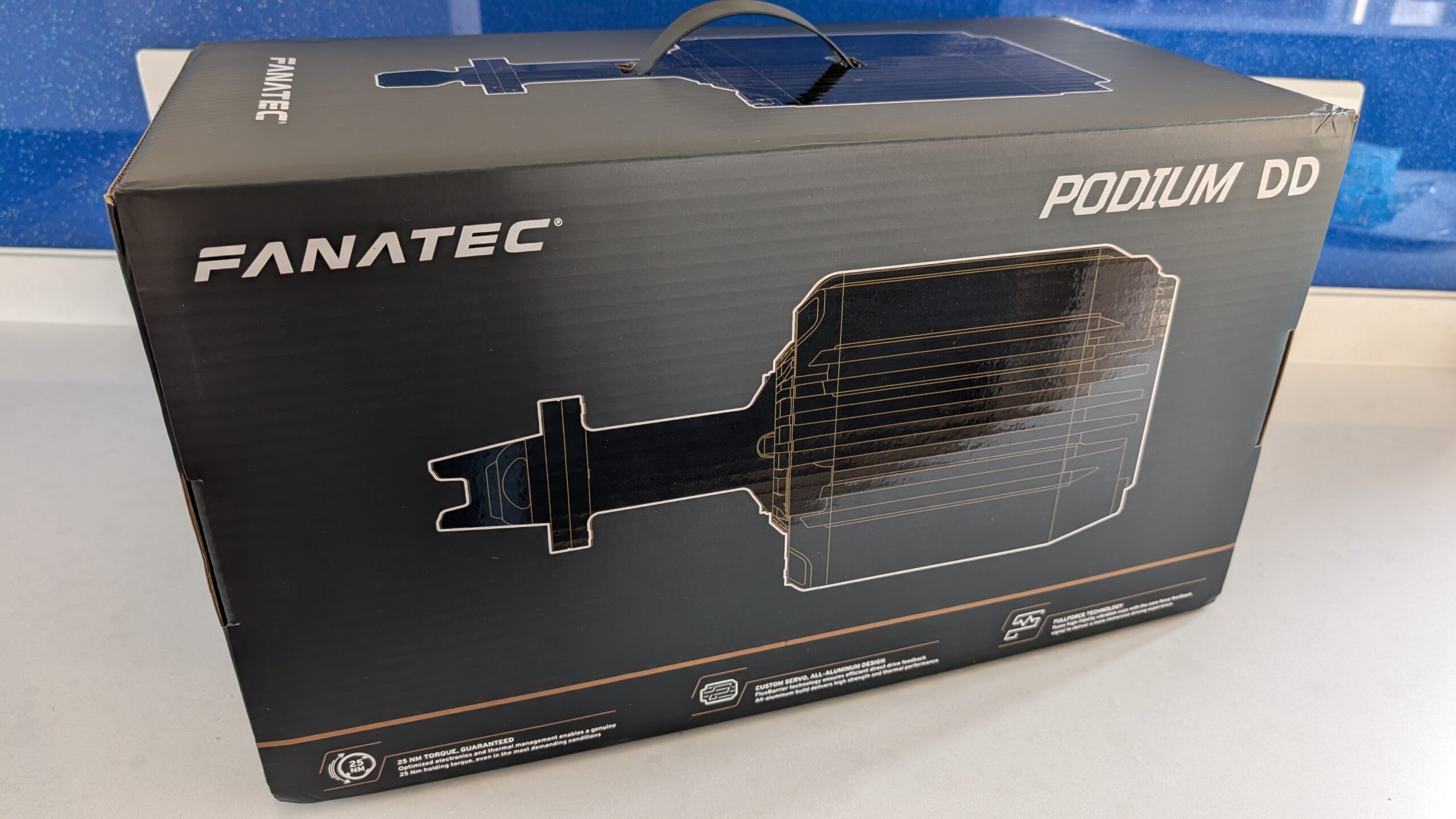
I’ve owned three Fanatec wheelbases over the years – a DD2, a CSL DD 8 Nm, and a Podium DD. Every time I plugged one in, the first hour was the same: staring at a wall of three-letter abbreviations in FanaLab, wondering which combination of NDP, NFR, and INT would stop the wheel from oscillating without turning the force feedback into mush.
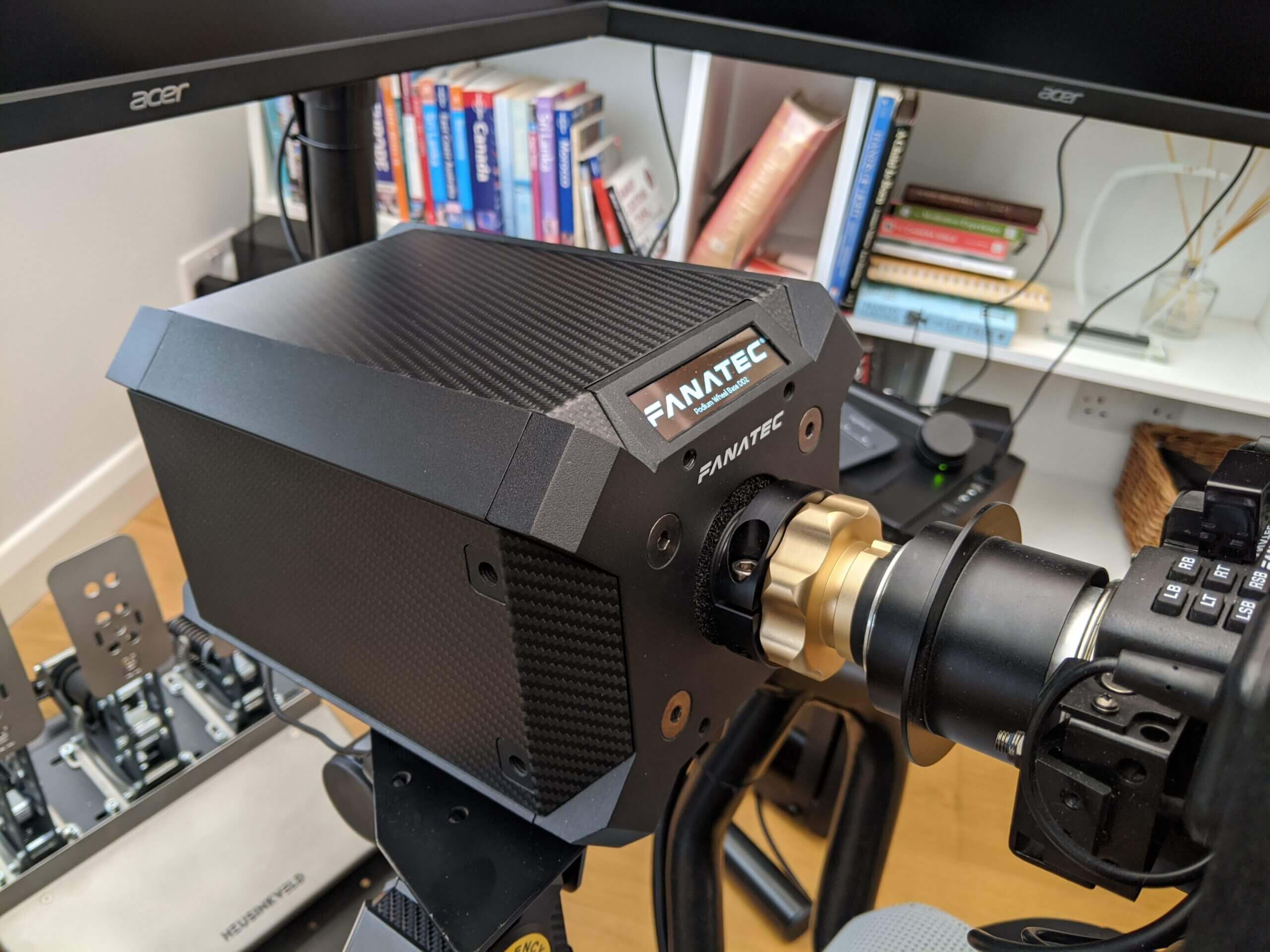
This guide is the result of pulling together every credible source I could find – Fanatec forum recommendations, per-sim community breakdowns, GamerMuscle’s baseline philosophy, community surveys, and settings I’ve personally landed on after hundreds of hours of testing. It covers the Fanatec direct drive range from the CSL DD upwards, across iRacing, ACC, Assetto Corsa, AMS2, Le Mans Ultimate, RaceRoom, Dirt Rally 2.0, EA WRC and rFactor2.
If you just want settings and don’t care about the why, use the tool below. Pick your wheelbase, pick your sim, done. If you want to understand what you are changing and why, read on.
Fanatec Settings Finder
This tool contains community-sourced profiles for every Fanatec direct drive wheelbase across 9 racing sims. Each wheelbase/sim combination has up to three profiles: a balanced starting point, a high-detail setup for competitive driving, and a comfort profile for longer stints. Choose your wheelbase and your sim, and it shows you both the FanaLab tuning menu settings and the in-sim FFB settings you need.
Understanding the Two-Layer System
Every Fanatec direct drive wheelbase has two layers of force feedback settings that work together. If you only ever adjust one of them, the other can’t do its job properly – you’re tuning half the system and wondering why the wheel still doesn’t quite feel right.
Layer 1: FanaLab / Tuning Menu. These are hardware-level settings that live on the wheelbase itself. You adjust them through FanaLab on PC or directly on the wheelbase display. They control how the motor behaves regardless of which sim you are running – things like overall force output (FF), signal smoothing (INT), and oscillation damping (NDP). Think of these as the foundation.
Layer 2: In-Sim Settings. Each sim has its own force feedback menu. iRacing has Wheel Force and Strength. ACC has Gain and Dynamic Damping. These sit on top of your FanaLab settings. The sim sends a signal, FanaLab processes it through your tuning menu, and the motor outputs the result.
The single biggest mistake people make is adjusting only one layer. You’ll see someone copy a YouTube creator’s FanaLab settings but ignore their in-sim values, or vice versa. Both matter. The profiles in the tool above include both layers for exactly this reason.
FanaLab Tuning Menu Settings Explained
Fanatec’s tuning menu uses abbreviations that are not exactly intuitive. Here’s what each one does and why you’d change it.
SEN (Sensitivity)
Sets the wheel rotation range in degrees. For most modern sims, leave this on Auto and let the game control it per car. iRacing, ACC, and AMS2 all handle rotation automatically when SEN is set to Auto. The only time you’d manually set this is for older titles that don’t communicate rotation to the wheelbase.
FF (Force Feedback Strength)
Master force output as a percentage of your wheelbase peak torque. This is where torque scaling matters most. A CSL DD at 5 Nm running FF 100 outputs 5 Nm. A Podium DD1 at 20 Nm running FF 100 outputs 20 Nm – four times the force. That’s why higher-torque bases typically run lower FF percentages. The Forza community survey data backs this up: CSL DD owners almost universally run FF 100, while Podium DD1/DD2 owners cluster around FF 30-50.
FFS (Force Feedback Scaling)
Two modes: Peak or Linear. Peak amplifies high-force moments for more impact at the cost of some midrange detail. Linear gives a flatter, more proportional response across the whole range. Community consensus is overwhelmingly Peak – out of 35 submissions in a Forza Motorsport community survey, 32 used Peak. GamerMuscle is one of the few who prefers Linear, specifically for the smoother midrange detail it provides.
NDP (Natural Damper)
Adds resistance to quick wheel movements and helps prevent oscillation when you let go. This is the setting most people reach for when the wheel wobbles at speed. Fanatec default is 50, but most community profiles run it much lower – between 5 and 30. Too high and you lose road feel entirely. Most published CSL DD guidance puts NDP at 25-30 depending on the sim. I found 15-25 works for most situations.
NFR (Natural Friction)
Simulates mechanical friction in the steering column. Makes the wheel feel heavier and more grounded when turning. Most profiles set this to Off. The exception is if you’re driving older cars without power steering or you want a more planted centre feel – in that case, 5-10 is enough. Anything above 20 and you start fighting the wheel more than driving the car.
NIN (Natural Inertia)
Simulates the weight of the steering axis. Can help if you are using a very light wheel rim and the self-aligning torque feels too snappy. Almost universally set to Off for direct drive bases. Some iRacing profiles run NIN 5 – just enough to add a touch of momentum without introducing delay.
INT (Interpolation Filter)
Smooths the incoming FFB signal from the game. Lower values give sharper, more granular detail. Higher values smooth out rough signals but add latency. This is sim-dependent. iRacing has a notoriously coarse FFB engine, so INT 3 or even 6 helps clean it up. ACC and AC have cleaner signals and work best at INT 1. GamerMuscle golden rule: INT 3 and FEI 70 for Fanatec. I’d agree on the INT, less so on reducing FEI.
One thing to note: newer ClubSport DD and DD+ bases reportedly respond better at INT 0-1 compared to the older DD1/DD2 which benefit from INT 2-3. The motor architecture is different.
FEI (Force Effect Intensity)
Controls how punchy kerbs, road texture, and surface effects feel. 100 gives maximum sharpness. Reduce to 80-90 if things feel too aggressive, especially on bumpy tracks. Most profiles keep this at 100 – it’s the detail channel, and detail is what you paid for with a direct drive base.
Visit Our Sponsors
FOR, SPR, DPR (Force, Spring, Damper)
These three work together as a set. FOR is a master multiplier for the game FFB signal – keep at 100. SPR adds a centering spring force. DPR adds friction-based damping. One thing to watch out for here: the correct SPR and DPR values depend entirely on the sim. iRacing wants SPR and DPR at 100 because it manages spring and damper in-sim. ACC wants them at 0 or Off because it handles everything through its own FFB engine. Get this wrong and you’re doubling up effects in one sim or losing them entirely in another. The tool above sets these correctly per sim.
iRacing Force Feedback Settings
iRacing FFB menu is deceptively simple but the relationship between its settings and your FanaLab config trips people up constantly.
Wheel Force
Set this to match your wheelbase peak torque. CSL DD 5 Nm = Wheel Force 5. CSL DD 8 Nm = 8. Podium DD1 = 20. This tells iRacing how strong your wheel is so it can scale the signal appropriately. Every FF percentage in this guide scales from this number, so check it before you touch anything else.
Strength vs Max Force
Click the word “Strength” in the iRacing menu and it toggles to “Max Force” and back. They’re two ways of expressing the same thing. Strength is a multiplier (higher = stronger). Max Force is a Nm cap (higher = weaker because you are telling the sim you have more headroom). I covered this in detail in my iRacing torque settings guide. For a starting point, run a few laps, then hit the Auto button – it will set the value based on the telemetry it recorded. Gets you 90% of the way there.
Use Linear Mode
Check this. On a direct drive base, Linear Mode gives you the most accurate 1:1 representation of the physics engine force output. Without it, iRacing applies its own non-linear curve that was designed for belt-driven wheels.
Damping and Min Force
Both at 0%. Your FanaLab NDP handles damping at the hardware level – adding in-sim damping on top of that just makes everything feel heavy and unresponsive. Min Force was designed to overcome deadzone on older belt-driven wheels. Direct drive bases don’t have that problem. Leave it at zero.
The Clipping Check
Pull up the iRacing FPS/Network display box (Ctrl+F in-car). The “F” meter on the right is your force feedback telemetry. Take your car through a high-compression corner – T1 at Brands Hatch is ideal – and watch the meter. Two small clips at the very peak is perfect. If it’s constantly red, your Strength is too high and you’re losing the dynamic range in the midrange, where the useful information is. If it barely moves, you’re leaving detail on the table.
Per-Wheelbase Recommendations
Each Fanatec base shares the same tuning menu, but optimal values differ because of torque headroom. Here’s the quick-start version for iRacing. The tool above has full multi-sim profiles.
CSL DD (5 Nm) and GT DD Pro (5 Nm)
Entry-level direct drive. With only 5 Nm of torque, you need to run FF at 100 to get everything the motor can give. NDP around 15-20 to manage oscillation without eating into your already limited force range. INT at 3 for iRacing, 1 for cleaner sims like ACC. Set iRacing Wheel Force to 5.0 Nm. You’ll probably find the force is lighter than you expected – that’s the nature of 5 Nm. Do not compensate by cranking the Strength higher than it should be. That just clips the signal.
CSL DD (8 Nm) and GT DD Pro (8 Nm)
Same base with the Boost Kit power supply. 8 Nm is the sweet spot for most people – enough torque to feel meaningful weight transfer without the fatigue of higher-torque bases over long stints. FF at 100 still works here. Some drivers prefer dropping to 85-90 for a bit more headroom. NDP 15-20, INT 3 for iRacing. Wheel Force 8.0 Nm. This is the most common Fanatec DD in the wild and the profile data reflects it – more community submissions and stronger consensus than any other base.
ClubSport DD (15 Nm)
The newer mid-range option with QR2. It shipped at 12 Nm, but the free firmware update Fanatec announced at their April 2026 event raises it to 15 Nm – so set Wheel Force to 15.0 in iRacing. Something to note: most of the FF 75-85 guidance out there was gathered on the original 12 Nm rating. On updated firmware, the same felt force works out at roughly FF 60-70 – the scaling rule from earlier in this guide applies here. NDP can come down to 10-15 because the higher torque gives the motor better authority over oscillation without needing as much software damping.
ClubSport DD+ (18 Nm)
The DD+ gets the same free firmware update, taking it from 15 Nm to 18. One of the video guides I reviewed ran a DD+ with FF at just 50 on the original 15 Nm rating – that’s 7.5 Nm of effective torque, deliberately limiting the base to get more dynamic range in the midband. It’s an unconventional approach but the logic is sound: run the motor at half capacity and you give the sim’s FFB signal far more headroom before it clips. On the 18 Nm firmware, the same 7.5 Nm lands at roughly FF 40-42. Whether you follow that approach or run FF higher is personal preference. NDP at 5-10, INT 2-3. Wheel Force 18.0 Nm.
Podium DD1 (20 Nm)
High-end territory. FF typically 50-75 depending on how much force you actually want through your hands. At FF 100, the DD1 outputs 20 Nm – that’s uncomfortable over a 2-hour stint for most people. The Forza community data shows DD1 owners clustering around FF 30-50, though iRacing drivers tend to run slightly higher because the sim FFB is less aggressive than Forza. NDP 15-25, INT 3. Wheel Force 20.0 Nm.
How Torque Scaling Works
If someone shares “my CSL DD 8 Nm settings” and you own a Podium DD1, you can’t just copy and paste. The FF percentage is relative to your base torque.
Simple maths: if a CSL DD 8 Nm profile uses FF 100, that is 8 Nm of peak force. To get the same 8 Nm from a Podium DD1 at 20 Nm, you’d set FF to 40 (40% of 20 = 8). Everything else in the tuning menu – NDP, NFR, NIN, INT, FEI – stays the same because those are feel preferences, not force-dependent. The in-sim settings stay the same too, provided you set Wheel Force correctly for your base.
The profiles in the tool above already account for this. Each wheelbase has its own FF value scaled to its torque rating.
Common Mistakes
Stacking damping across both layers. If you’ve got NDP at 30 in FanaLab AND Damping at 15% in iRacing, that’s double damping. Pick one layer. For iRacing, handle it in FanaLab (NDP 15-25) and set in-sim Damping to 0.
Not recalibrating after firmware updates. Fanatec FullForce feature, driver updates, and FanaLab patches can all change default behaviours. Worth checking your profiles aren’t borked after any firmware update.
Ignoring the clipping meter. Running Strength too high clips the FFB signal. You get maximum force all the time but lose all the variation – kerb detail, tyre slip, weight transfer. That’s the entire point of having a direct drive base. If the F meter in iRacing is constantly red, turn Strength down.
Copying profiles without understanding them. GamerMuscle makes the core point here: profiles are specific to hardware, firmware version, wheel rim weight, and personal preference. Understand what each setting does, use a profile as a starting point, then adjust to taste.
Running SPR/DPR wrong for the sim. iRacing wants 100/100. ACC wants Off/Off. Get these backwards and the FFB feels terrible in both. Check per-sim recommendations.
Settings for Other Sims
The tool at the top of this page covers nine sims – not just iRacing. Here’s what changes between them at the FanaLab level.
ACC has a cleaner FFB engine than iRacing, so INT drops to 1. SPR and DPR go to Off because ACC handles everything in-sim. Gain around 70-80%. I’ve written a separate Fanatec ACC settings guide if you want the full breakdown.
Assetto Corsa with Content Manager and Custom Shaders Patch has surprisingly good FFB. Overall Gain around 55%, all effects at zero, CSP gyro implementation enabled. SEN matched to 1080 degrees. NDP 30 to manage the more variable FFB output.
AMS2 runs well with Gain at 70, FX at 0-10, and FanaLab damping around 30. The default FFB type is actually decent – ignore the community custom FFB profiles that change with every patch.
RaceRoom has arguably the best FFB engine of any sim. Force Feedback Linearity at 70-80 (this is unique to RaceRoom – it brings up lower midrange forces for better feel). NDP 25, INT 1. Worth binding force feedback multiplier keys for per-car adjustment.
rFactor 2 has huge variance per car. Smoothing 1-6 in-sim, then fine-tune the car multiplier. Keep the wheelbase light – low NDP, no NFR or NIN – to let rFactor 2 interactive force model come through.
For the full per-sim settings including in-game values, use the Fanatec Settings Finder above or check out the complete direct drive settings guide which covers all brands.
Further Reading
If you’re still dialling things in, these might help:
- iRacing torque settings explained – deep dive into Strength vs Max Force
- Direct drive wheel settings guide – settings for all brands (Moza, Simagic, Simucube, Thrustmaster)
- Fanatec buyer’s guide – which Fanatec base is right for you
- Force feedback fundamentals – the conceptual explainer
- Why pro sim racers use less force – the case for running lower FF
- Best direct drive wheels – the full market overview
Best Pimax VR Settings for F1 25 in 2026: A Damage-Control Guide
Best Pimax VR Settings for Le Mans Ultimate in 2026
Best Pimax VR Settings for Automobilista 2 in 2026
Best Pimax VR Settings for Assetto Corsa in 2026
iRacing VR Settings (2026): Meta Quest 3, PSVR2, Pimax and Valve Index
Assetto Corsa VR Settings 2026: Pimax, Quest 3, PSVR2 & More
Topic: iRacing