
I’m a sim racer and amateur racer with a passion for Motorsport, good racecraft and the technical and setup aspect of sim racing.
Featured image: ReaperWare Sim Racing Button Box
If you keep reaching for the keyboard mid-race to turn on the pit limiter, add fuel or change the brake bias, or you’re scrolling the iRacing black box on your wheel, a button box is the fix. A button box is a separate USB game controller full of buttons, switches and knobs that you map in the sim. Which one is worth buying depends on what you’re short of, whether that’s more physical controls on the rig, a Stream Deck that looks after your apps as well, or more buttons on the wheel itself.
On my own rig, an Apex Race Deck holds my Stream Deck. I’m a keen fan of button boxes for sim racing, but button boxes are game controllers and typically only solve in-app problems. In today’s guide we’re taking a closer look at the controls first, because a box is only as good as its switches. Then it’s on to the boxes worth buying now, the buttons you can add to the wheel, and how to mount one or build your own.
Quick Navigation
Jump directly to what you’re looking for:
Why a button box? |
The controls |
Apex Race Deck |
Porsche 911 console |
ignitiON Controls |
Switch panels |
RaceBox |
ReaperWare 32-Elite |
On the wheel |
Mounting |
DIY |
Which to buy

Why use a button box?
Back in 2021 I was running a Cube Controls OMP GT Pro, and I used its funky switch to navigate the black box and change fuel, tyre pressures and so on a step at a time; it was just pretty cumbersome. A funky switch (or 7-way switch) is a small joystick that also rotates and clicks. It works, but in the middle of a stint you’re paging through menus with your thumb.

A button box shows up in Windows as its own game controller, so you map it in the sim’s controls screen, like the iRacing one above, which is the same place you set up your wheel and pedals. Because the box is separate from the wheel, the mapping stays put when you swap from a formula rim to a round one, which means your pit limiter is always in the same place whatever you’re driving.
Many of us race in VR, so you need what we call a “VR friendly” button box. You can’t see the box at all with a headset on, and every control on it has to be one you can find by feel.
Buttons, toggles and encoders
A momentary push button sends one press each time you push it, which suits a one-shot job like the starter or a visor tear-off. On the Turn Racing BP2 button plate, which I’ll come to below, the push buttons have a satisfying click that requires just the right amount of force to activate. No brake magic accidents there!
A toggle is either momentary, so it springs back after sending one press, or latching, so it stays where you put it. A two-way momentary toggle, written (on)-off-(on), sends a press up and another down, while a one-way toggle only sends in one direction. Start or ignition toggles often sit under a safety cover (a flip-up guard). ignitiON Controls lists every one of these on its flagship box. It’s worth checking which kind you’re getting. When The Sim Circuit reviewed a budget 44-input box, he found the toggles only sent an input one way, so flicking the pit limiter back didn’t send an “off”.
A rotary encoder is a knob that clicks round in steps, and each step sends an input, up one or down one. Having two rotary encoders is ideal for ABS and TC assignments, and brake bias suits an encoder just as well. Funky switches and small joysticks look after the black box. Some boxes add lights or screens driven by SimHub, like Precision Sim Engineering’s Pro Switch Panel, RaceBox’s display models and the BavarianSimTec ControlCenter, while a plain box needs nothing beyond the sim’s own controls screen.
Apex Race Deck and the Stream Deck
One of the things I find more than a little cumbersome about sim racing is the constant back and forth between apps and settings, mostly using the mouse or my keyboard. We all know the drill: boot your PC, open Crew Chief, open Discord, start iRacing, and so on. That’s why I bought an Elgato Stream Deck. You don’t need to be interested in live streaming to have a use for one, because it can do something button boxes do not: launch apps, website links and execute hotkeys. To me, anything with an LCD backlit screen with buttons on it deserves a closer look.
The cool thing about the Stream Deck is that you can create “folders” to group sets of functions, so I could have a startup folder to select and boot apps, a folder for my Porsche 911 GTE and so on. I quickly learned that while you can uncheck tyres in iRacing with #cleartires$, checking them again wasn’t working. So I used #-cleartires$ instead, which checks the replace tyres box. There’s a step-by-step of my Stream Deck setup for iRacing, hotkeys and all.

These days my Stream Deck lives in the Apex Race Deck, a 3D-printed housing with carbon plates front and back. It adds five push buttons and three CTS encoders around the Stream Deck, and you can have a 7-way switch in place of the centre button. It fits the Stream Deck MK1 and MK2, and it’s sold out at Apex right now. Our Race Deck LED review covers the same box under its earlier name.

The one in stock is the Race Deck XL, made for the Stream Deck XL, with ten push buttons, four CTS encoders and VESA 100 on the back. VESA is the standard hole pattern, usually 75 or 100 mm square, that monitor arms and mounts use. If you only want the Stream Deck held on the rig, Apex also sells plain carbon mounts for the Stream Deck and the XL with no extra controls.

Sim-Lab Porsche 911 GT3 Cup (991) Button Box Console
The Sim-Lab Porsche 911 GT3 Cup (991) Button Box Console is an officially licensed replica of the console from the 991 Cup car. It has 42 inputs, a backlit 7-way switch and a carbon front plate, and it mounts on a VESA 75 pattern on the back. That’s a lot of inputs in one place, and because it’s a replica, they sit where Porsche put them in the car.

Sim-Lab also makes a Button Box Holder, a swivelling bracket for its GT1 Evo, GT1 Pro, P1X and P1X Pro cockpits. The console itself makes the most sense if you’re building a Porsche Cup cockpit, and a lot less if you’re after a general-purpose box for every car in the garage.
Sim-Lab discount code: use SIMRACINGCOCKPIT at checkout for 5% off at sim-lab.eu.
ignitiON Controls
The flagship from ignitiON Controls is the NA2 RR E6_V4, with 30 inputs in a powder-coated all-metal case. It has eight large mechanical buttons with red ring LEDs, six CTS rotary encoders that turn left and right only (there’s no push on them), and five toggles, one of them under a safety cover. There’s also an Engine Start button, which isn’t backlit, and a 4-way joystick.

The case measures 154 x 254 x 33 mm, weighs 1300 g and connects by USB Type B, with the cable included. Its mounting inserts sit at 100 x 155 mm, which isn’t a VESA pattern, so a VESA 100 adapter plate comes in the box.
The Mini RR is the smaller one, with 21 inputs and four encoders on a VESA 75 pattern. Both are sold through Advanced Sim Racing in Canada.
Pro Switch Panel and the BavarianSimTec ControlCenter
The Precision Sim Engineering Pro Switch Panel (PSP) has 20 RGB switches that you can label and recolour, with 210 labels in the box, and two 7-way joysticks for the black box. It connects by a single USB cable, works on a PC or a Mac, and mounts with a RAM mount or VESA 75. SimHub integration covers flags, spotter, the pit limiter and TC and ABS indicators. The PSP is sold out at Precision Sim Engineering at the moment and made to order elsewhere, so expect a wait.
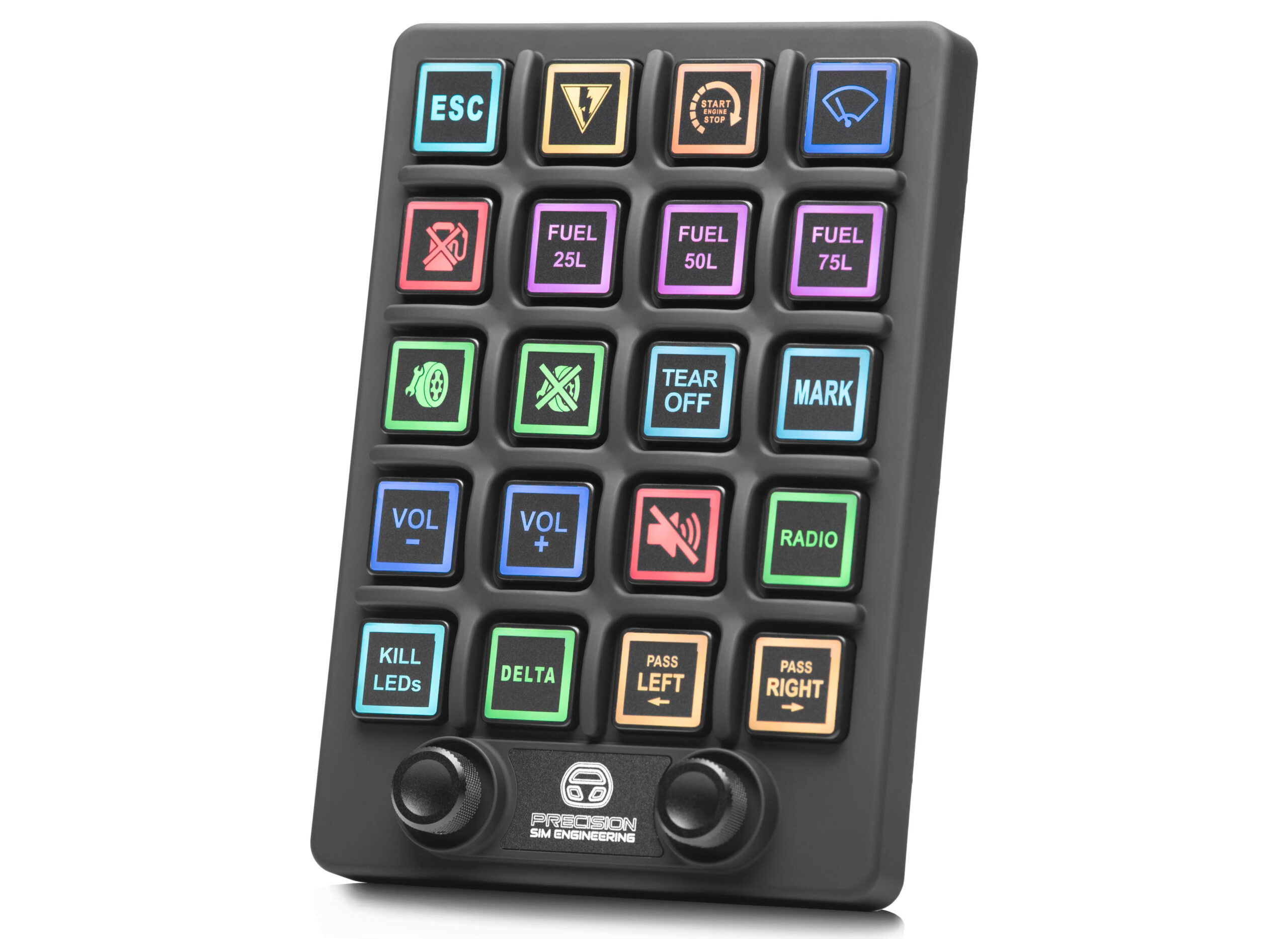
The BavarianSimTec ControlCenter is the alternative you can actually buy now. It has 20 illuminated buttons and two encoders in a CNC aluminium case, three USB-C hub ports, and a MagicArm in the box to mount it with. It needs SimHub to run, which also means it’s PC only.
RaceBox button boxes
RaceBox makes a whole range, and the plain end of it is the GT, with 24 inputs and plug-and-play USB. Above that, the GT-FLAG V2 has 27 inputs and an RGB flag display, and the GT3-PRO has 19 inputs with a flag display and a 20×4 LCD. The GTE adds a 5-inch display with 24 inputs, and the GT-LM flagship has a 6.8-inch display and 28 inputs, in 2mm carbon fibre.
The GTR houses a Stream Deck MK1 or MK2 alongside 19 inputs, so it’s RaceBox’s answer to the Race Deck. The GTS, with 21 inputs, bolts to the wheelbase itself, but it’s sold out.

The CF versions are real carbon fibre, and the others are acrylic with a carbon-look wrap. The display and flag models run from SimHub, while the plain ones are USB controllers that work as soon as you plug them in. Most of them take a VESA 75 mount.
ReaperWare 32-Elite
The ReaperWare 32-Elite has 32 inputs, made up of eight LED-backlit push buttons plus a 22mm illuminated start/stop button, a 6-way joystick, two heavy-duty momentary toggles, four two-way momentary toggles and two encoders with push. A dial sets the LED brightness, and there’s an integrated USB hub, plus mounting points for an iFlag and LED brows.

It’s plug and play in Windows, with VESA 100 on the back. It’s designed and hand-assembled in the UK, and you buy it direct from ReaperWare, where you choose the colours of the case, the LEDs and the toggle covers.
Button boxes on the wheel
I tested the Turn Racing BP2 button plate on loan in 2022. On the front, the two momentary push buttons at the top on either side make great pit limiter, headlight flasher or look left and right controls. The two funky switches make navigating the iRacing black box a breeze. It’s a minimal design, but it’s clean, user friendly and it works. The plate itself is incredibly thin, so it doesn’t add too much length to your steering column. With the rim and extension on, the whole thing is light, too, and lightness is a feature all in itself that so many wheel manufacturers ignore.
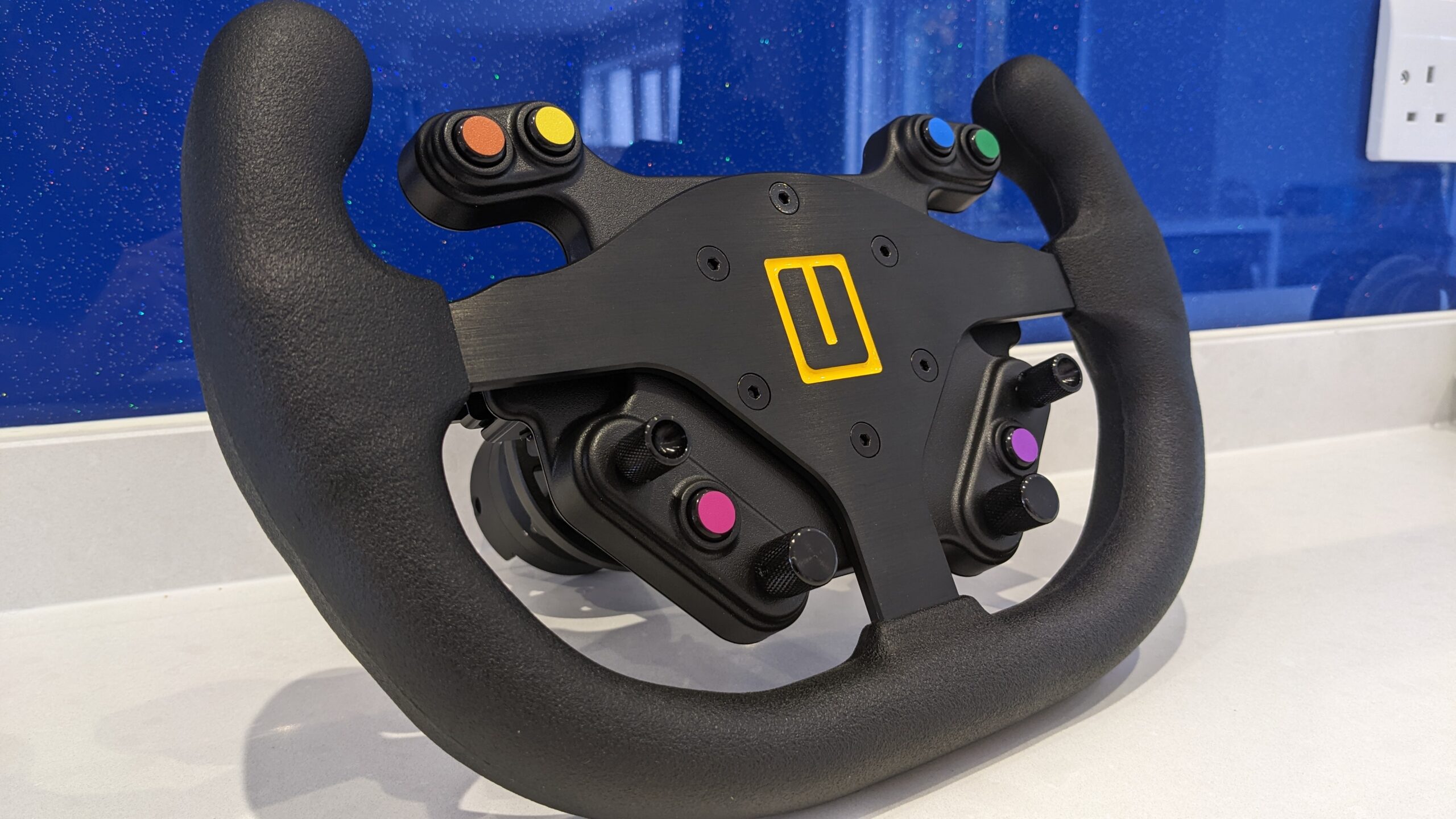
The Conspit 310 APEX, which I tested this year, is a wheel with its button box built in. The core of this wheel, the 310 button box, is SimHub compatible, and once you’ve downloaded and installed Conspit’s V2 Link software (and remembered to recentre your wheelbase) you’re ready to go racing. There’s more on that in my Conspit 310 APEX review.
Fanatec’s Podium Button Module Endurance fits a Podium Hub and adds ten buttons, two 12-position switches that also work as encoders, a funky switch, an analogue stick and an OLED display. Asetek’s “button boxes” are wheel hubs that you add rims to, and Simagic’s Neo X is another hub of this kind. On the Asetek wheels with a 4.3-inch RaceView display, Asetek’s free Virtual Button Box adds up to six on-screen buttons.
Fanatec discount code: use SIMRACINGCOCKPIT5 at checkout for 5% off at fanatec.com.
Mounting a button box
Most boxes have a VESA pattern on the back, 75 or 100, or threaded inserts you bolt into. Apex sells three button box mounts, starting with the steel V1, which takes VESA 50, 75 or 100. The V2 is steel and aluminium, takes the same patterns and comes with a short length of 15-series extrusion, and the V3 is an articulating VESA arm that fits 40-series and 8020 profile.
In 2021 I mounted my Stream Deck to my 8020 profile rig with a magnetic mobile phone holder, which is fine for something that light. A big button box needs more than that. The Sim Circuit found that the 44-input box he reviewed moved on its included clamp when he pressed the corner buttons, so bolt yours down firmly, ideally to the aluminium profile with T-nuts.
DIY button box
If you’d rather build your own, AMstudio‘s video “MAKE THIS BUTTON BOX | 32 FUNCTION w ENCODERS” builds one from scratch and wires it up step by step.
Apex sells the parts for this kind of build, including toggle switches, 12mm momentary buttons, button guards and a label kit. The toggles come latching or non-latching, so you can pick the kind for each job. And if the build gives you a taste for it, have a look at SimHub, which is a clever bit of software where you can add external hardware to your simulator, including dashboards, bass shakers and lots of home-made stuff with Arduino.
Which button box should you buy?
I run a Stream Deck in a Race Deck, because it covers the apps as well as the in-car controls. If what you want is lots of physical switches, go for a dedicated rig box from ignitiON, RaceBox or ReaperWare, any of which gives you more toggles and encoders than a Stream Deck. Building a Porsche Cup cockpit? Then it’s the Porsche console. If you race in VR, put the buttons on the wheel, where your hands already are. A plate like the BP2 or a Fanatec module keeps the controls you need under your thumbs with the headset on.
Back in 2021, the button I showed you how to set up on my Stream Deck was fast repair, #FR$ in iRacing chat, just in case there’s a problem during a race.
Related Articles
Should Sim Racers Wait for the Pimax Crystal Pro, or Buy Today?
Sim Racing Wheel Stands and Folding Cockpits: Why I’d Skip One, and What to Buy Instead
The Best Direct Drive Sim Racing Bundles (2026)
Best Thrustmaster Wheel and Pedal Mods (2026)
ButtKicker and Tactile Feedback for Sim Racing: The Highest-ROI Upgrade You Shouldn’t Skip (2026 Beginner’s Guide)