


I’m a sim racer and amateur racer with a passion for Motorsport, good racecraft and the technical and setup aspect of sim racing.
Featured image: Fanatec ClubSport Handbrake V2
The short version first: if you’re running a Fanatec wheelbase, the ClubSport Handbrake V2 is the one to have, and it’s the natural fit on a Fanatec base and wheel. On a budget it’s the Moza HBP, which is built to a standard well beyond what Moza ask for it. And if real accuracy is what you’re after, it’s still the Sim-Lab XB1 and its load cell for me. This is for rally drivers, drifters and anyone who runs road cars in the sim and wants a proper lever. I think the quality of shifters and handbrakes has shot up in the last year or so, mostly because of pressure from the Chinese market, and there’s a sensible handbrake at every budget now.

The manufacturers sent me all three of the handbrakes I’ve reviewed, the Sim-Lab XB1 in 2023, the Moza HBP in 2024 and the Fanatec ClubSport Handbrake V2 in 2025, and Moza sent their SGP sequential shifter the same way. Each one goes on the rig and I drive a good few hours with it to get a good feel for it. It either stays there if I like it or, when there’s a queue of review work, comes off and goes back in its box.
Get the sensor right before you think about a brand, because a button under a lever and a load cell are completely different devices, and the price of a handbrake mostly reflects which one you’re buying. Where you mount it changes the feel too – rally, drift and road cars all want the lever somewhere different. After that it’s the handbrakes themselves, those three first and then the rest of the market.
Quick Navigation
Jump directly to what you’re looking for:
When you need one |
Sensor tech |
Mounting |
Picks by use case |
Fanatec ClubSport V2 |
Moza HBP |
Sim-Lab XB1 |
Heusinkveld V2 |
Simagic TB-NEO |
Simagic TB-1 |
Simagic TB-RS |
CONSPIT H3 |
Simnet SHB-100 |
VNM V1.5 |
Thrustmaster TSS |
MME Bulletproof |
Honourable mentions |
Which should you buy?
When you need a handbrake
Most sim racers don’t need a handbrake. If you’re in the GT3s in iRacing or ACC, the handbrake gets used roughly never, and the same goes for F1 25 and Le Mans Ultimate. Where it earns its keep is rally: EA Sports WRC, DiRT Rally 2.0, Richard Burns Rally and the new Assetto Corsa Rally. You’re reaching for it at every hairpin, every Scandinavian flick and every tight chicane. A button on the wheel gives you all or nothing, and once you’re past the first stage that isn’t going to cut it.
Drifting is the other discipline that uses a handbrake properly. In CarX, Assetto Corsa with the drift mods and BeamNG’s drift maps, the throttle and the steering do most of the work, but the handbrake is what starts the slide, and a lever with some throw and some modulation in it is a very different thing from a button. Then there are the road cars: the MX-5 Cup in iRacing, Assetto Corsa’s road car list, Gran Turismo 7. You’ll use it at a hairpin here and there and at the odd race start where you want to flick the rear out. Marginal, but real, and rather nice to have.
If none of those apply to you, put the money into pedals instead. A handbrake on a GT3-only rig sits there looking pretty.
Sensor tech: Hall vs load cell vs hydraulic
There are four ways a handbrake can measure what your hand is doing, and they feel nothing like each other. I love a handbrake that’s accurate and sensitive, so you can make tiny adjustments in rally.
Button under a lever
The cheapest USB handbrakes are a button under a lever. Pull the lever, the switch closes, the handbrake is on; let go and it’s off. There’s no analogue range at all. It’s playable for drifting, at a push, and miserable for rally, because you can’t modulate the rotation of the car – you’re either locked or you’re not. I’d skip this tier entirely.
Hall-effect and position sensors
A Hall-effect sensor measures the angle of the lever with a magnet, so there’s nothing touching and nothing to wear out. Move the lever 30% and you get 30% handbrake. It’s analogue and accurate, and for most people it’s where I’d start – the Moza HBP uses a non-contact 15-bit angle sensor of this type and the Thrustmaster TSS uses one too. A good Hall-effect handbrake does everything most sim racers will ever ask of it.
Load cell
A load cell measures how hard you’re pulling, where a Hall sensor measures how far – the same idea as a load cell brake pedal. Your forearm learns “this much pressure is this much handbrake”, which turns out to be far more repeatable from session to session than “this much travel”, and the feel is tuned with springs and elastomers, with the software left to the curve. This is where the XB1, the Fanatec ClubSport V2, the Heusinkveld, the Simagic TB-1 and TB-NEO and the Simnet SHB-100 sit. Having run the XB1 and the Fanatec, I’d put the difference from a position sensor at the fine end of the input: the last few percent of the pull are as controllable as the brake pedal is under your foot.
Hydraulic
A hydraulic handbrake pushes fluid through a small cylinder and reads the pressure with a sensor, which is what a real rally car does. The pull is heavy from the start and builds progressively, with no soft zone before the engagement point. The Simagic TB-RS and the CONSPIT H3 are built this way, and the TB-NEO can be converted with its optional hydraulic module. The trade is maintenance: a hydraulic unit wants the occasional bleed if the pressure drifts over time.
How to mount it
A handbrake is the one peripheral where the position you bolt it in changes how it works. Rally drivers mount it vertical at roughly seat height, so the lever comes up and back toward you, which suits short, sharp pulls and getting straight back on the throttle. Drifters go vertical too, but high, because your hands are moving between the wheel and the lever constantly and you want it where you can grab it without looking, which usually means a post or an extension bracket. For the road cars it lies horizontal and you pull it back like a real handbrake. It’s awkward when you’re also turning the wheel, but it’s the authentic position for GT7 and the road cars in AC.

Most modern units ship with more than one set of mount holes so you can switch between these without buying anything – the Fanatec, the Moza, the Heusinkveld and the Simagics all do. The exception is the XB1, which stands upright unless you add Sim-Lab’s angled bracket.
Then there’s the rig. Nearly every handbrake is drilled for aluminium profile – Sim-Lab, Trak Racer, Sim Dynamics and the rest – and mounting to profile is usually a couple of T-nuts and two bolts (check the box, though: not every manufacturer includes the T-nuts). If you’re on a Playseat or a wheel stand, look for a side-mount option before you order, because some of those need a separate bracket and it’s annoying to find that out after the handbrake has arrived.
My picks by use case
If you’re shopping by what you drive, here’s the shortlist.
| Use case | Recommendation | Sensor |
| Fanatec base, or console | Fanatec ClubSport Handbrake V2 | Load cell |
| Best value | Moza HBP | 15-bit position sensor |
| Load cell accuracy | Sim-Lab XB1 | 150 kg load cell |
| Premium load cell, software curves | Heusinkveld Handbrake V2 | 120 kg load cell |
| Load cell now, hydraulics later | Simagic TB-NEO | 100 kg load cell, modular |
| Hydraulic rally feel | Simagic TB-RS or CONSPIT H3 | Hydraulic |
| Drift and rally specialist | VNM Rally and Drift V1.5 | Load cell |
| Handbrake and shifter in one | Thrustmaster TSS Handbrake Sparco Mod+ | Hall-effect |
| Motion rig or commercial use | MME Bulletproof | Load cell |
Fanatec ClubSport Handbrake V2 – for a Fanatec rig
The ClubSport Handbrake V2 is a very impressive bit of kit. Its construction centres around a cast and CNC-finished metal framework with ball bearings at the lever pivot, and it’s quite a heavy-duty device – that weightiness is what makes it easy to put precise movements through it. The standout feature is the load cell. As you might remember I was very much a fan of the Sim-Lab XB1 for exactly this reason: a load cell offers that “little extra” precision when you’re modulating partial brake force in a drift or on a rally stage. If you’re in the Fanatec ecosystem – a Fanatec base and a Fanatec wheel – the V2 goes together with that setup very nicely. I wrote it all up in my Fanatec ClubSport Handbrake V2 review.

The RJ12 connection to your wheelbase is the ideal one for the many of you invested in Fanatec: the cable is easy to deal with and tidy away, you get console support through the base, and if all of my equipment was Fanatec this is how I’d have everything connected. My one criticism at the time was that standalone PC use needed the ClubSport USB Adapter, sold separately, which seemed a very curious omission at this price. Fanatec have since fixed that – the adapter now ships in the box, so the V2 runs happily off a USB port on a non-Fanatec rig too.
Setup and adjustability feel polished. The base of the lever sits at three different angles, you can run it as a standard road car handbrake or in the vertical rally position, there’s fine-tuning via a bolt assembly at the rear, travel is adjustable between 60, 70 and 80 mm, and preload sets your initial resistance. It’s on the expensive side, and it needs to be good to justify that – I think it is, particularly with the load cell, and a look at eBay tells you Fanatec gear holds its value second-hand, so look after it. The V2 is a quantum leap in build quality over the old ClubSport V1.5 handbrake.

Moza HBP – the value choice
I cannot emphasise enough how good the build of the Moza HBP is. There’s no side to side play in the mechanism, the action is beautifully smooth and the endstops give a soft, quiet ending to a rapid handbrake input. It’s all-anodised aluminium, and having fitted and tested the SGP shifter I sort of knew what to expect when I opened the box – the HBP is every bit as solid. For what Moza ask for it, it’s an exquisitely good deal, and it runs on USB without needing a Moza wheelbase, which makes it a good investment whatever the rest of your rig is. My Moza HBP review has the full build.

Attaching the handle is a slightly more involved affair than the SGP. There are two long bolts, nuts and several washers, and the shaft is drilled with a few positions that set the angle of the lever once it’s mounted – I went for a few degrees forward, tightening the nut and bolt simultaneously with the two 10 mm spanners Moza supply. My only gripe is that there aren’t a huge number of angles to choose from, but I found something that works. Installation on the sim was easy too: I mounted mine directly to the aluminium profile of my Sim Dynamics rig with the bolts provided. There are no slide nuts in the box, so if you’re mounting to profile you may have to sort through your spares to find the right fittings.
There’s a spare spring and two elastomers in the spares bag, and the tools and instructions to swap them, so you can tune the resistance and the return speed if you want to. To be perfectly honest the HBP is really good out of the box and I doubt you’ll feel the urge. Configuration is through Pit House – activate the handbrake, calibrate if it asks (mine didn’t need it), then set the start and end points and the output curve. I like the non-linear options, with less of a ramp as I approach maximum pressure. I was a little disappointed that Pit House didn’t detect the HBP when I daisy-chained it to the SGP with the RJ11 cable; it seems RJ11 is only meant to go straight into a Moza wheelbase, so it’s USB and another port used up. But there you go. Kudos to you, Moza.
Sim-Lab XB1 – load cell accuracy
The XB1 packs a 150 kg load cell and its electronics into a very compact handbrake, and it sets a very high bar. In the XB1 the load cell sits behind a two-stage system: a tensioned metal spring under two preload nuts, then an elastomer stack pressing into the load cell chamber. You get an initial light resistance that hardens halfway through the pull while the signal ramps up. Sim-Lab supply elastomers in a range of hardnesses, and swapping them is much like changing the stack on a Heusinkveld Sprint. It’s plug-and-play, it needs no recalibration when you adjust the preload, and I’d still install Race Director once for the deadzone and curve settings. My Sim-Lab XB1 review covers the installation in photos.

Installation is a walk in the park. Because it’s so narrow it mounts on a single aluminium profile edge with two T-nuts and two bolts, and it’s PC only, over USB. One note from the elastomer swap: the force you need to unhook the lever exposes the load cell wire to a slip of the hands, so take care – though I doubt you’ll change the feel more than once or twice in its lifetime.
The XB1 just has this exquisite level of signal. The load cell really does make a big difference to a handbrake because you can modulate your inputs so finely: be forceful if you want to initiate a big drift, or be very smooth into a tight dirt corner and get some great rotation happening. For rallycross it’s an ace handbrake – your input on the lever can be as fine as it is on the brake pedal. If real accuracy is important to you, if you’re a competitive rally driver, the XB1 is the sweet spot, and I still haven’t changed my opinion on that. The cons: the lever stands upright and can’t be angled, the micro-USB port feels fragile, and on 4040 profile the angled bracket flexes a little when you pull hard.

Heusinkveld Handbrake V2 – premium load cell
The Heusinkveld Handbrake V2 sits at the top of the load cell tier. The cell is a 120 kg unit, which works out at around 22 kg of force at the lever, and the resistance is tuned with elastomers in the same way as the XB1. The lever sets vertical or horizontal, with up to 26 degrees of fine-tuning in either position, and the adapter plate in the box adds 22.5 degrees of yaw.
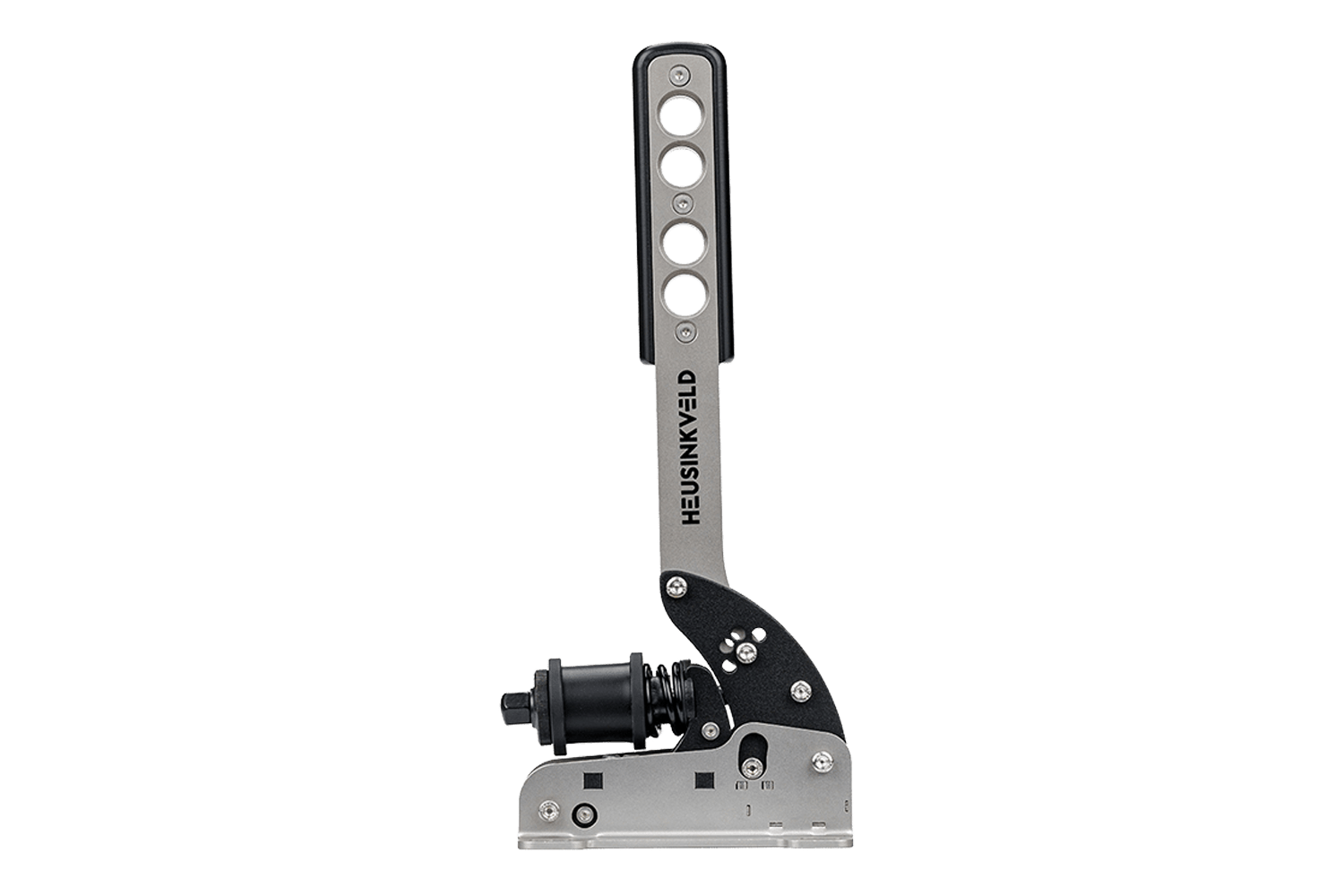
The difference is SmartControl, the same software Heusinkveld use for their pedals. You can shape the handbrake’s input curve – a deadzone at the start of the travel, a steeper ramp in the middle, a softer top end – and save it per car or per discipline. It’s PC only, and it’s the handbrake to pair with a set of Sprints or Ultimates if the rest of the rig is already Heusinkveld.
Simagic TB-NEO – modular load cell
The TB-NEO is Simagic’s new handbrake, launched in August 2026, and it’s built to be added to over time. The sensing is a 100 kg load cell read at 12-bit, and the resistance comes from a rubber-spring barrel that takes up to eight elastomers in any combination you like – the same logic, and the same elastomers, as Simagic’s P1000 pedals, with four recommended schemes to start from. Simagic then sell two bolt-on modules: a haptic reactor that vibrates the lever, and a hydraulic module that converts the TB-NEO into a hydraulic handbrake. Buy the base unit now, add the fluid later.
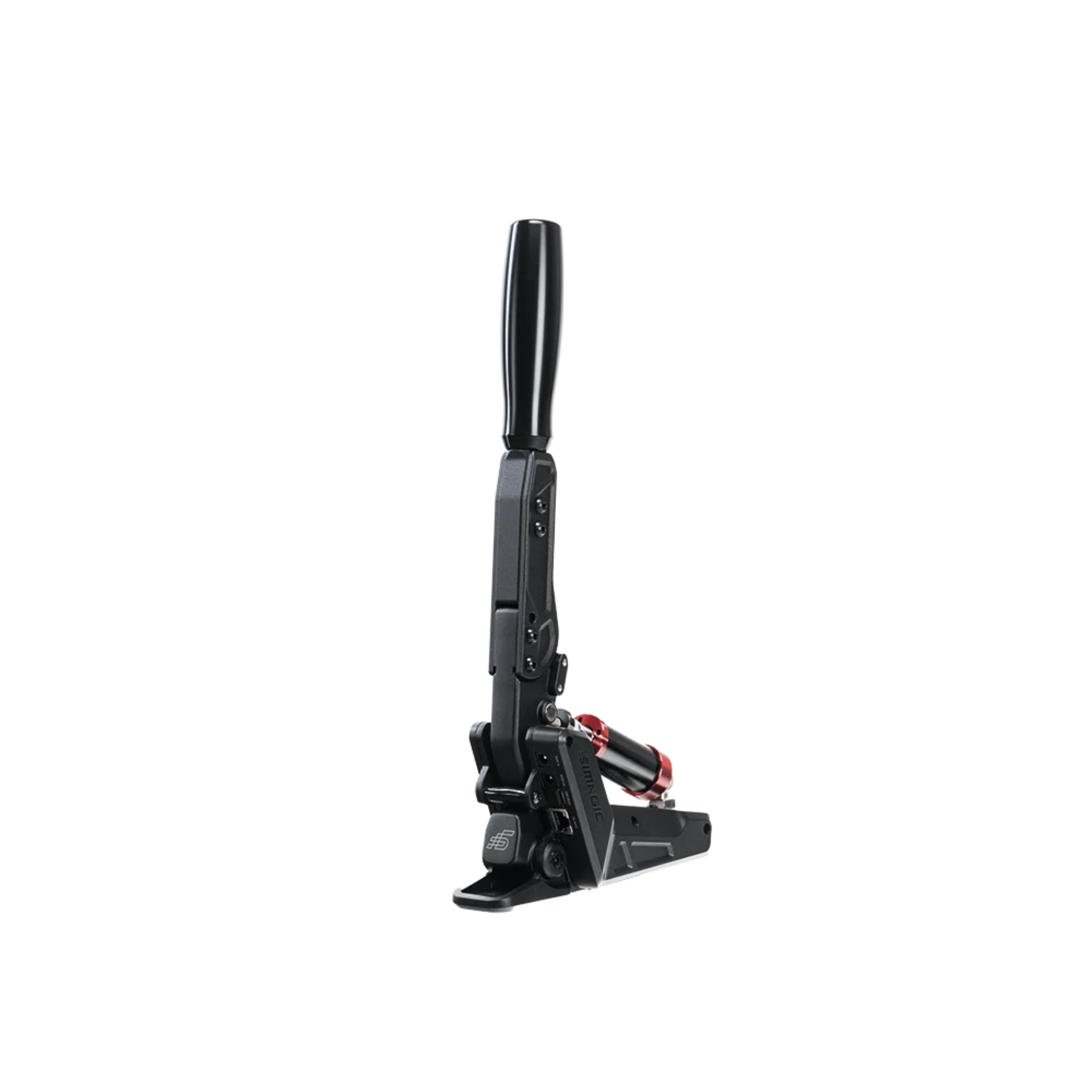
The lever mounts horizontal or vertical at any of five angles and can be converted to a pull-type action. Connection is USB-C to a PC or to an Alpha base, or RJ45 CANFD into an Alpha EVO, and the curves are set in SimPro Manager. It weighs 1.36 kg.
Simagic TB-1
The TB-1 is the TB-NEO’s predecessor and it’s still sold. It runs a 100 kg load cell behind a two-stage spring and elastomer in an anodised aluminium chassis, mounts horizontal or vertical, and connects over USB-C; Simagic describe the action as a soft initial pull into a firm engagement point, which is the same two-stage idea as the XB1. If you don’t need the modular upgrade path (the TB-NEO is the newer base to grow into), it’s a straightforward load cell handbrake at a keen price.
Simagic TB-RS Hydraulic
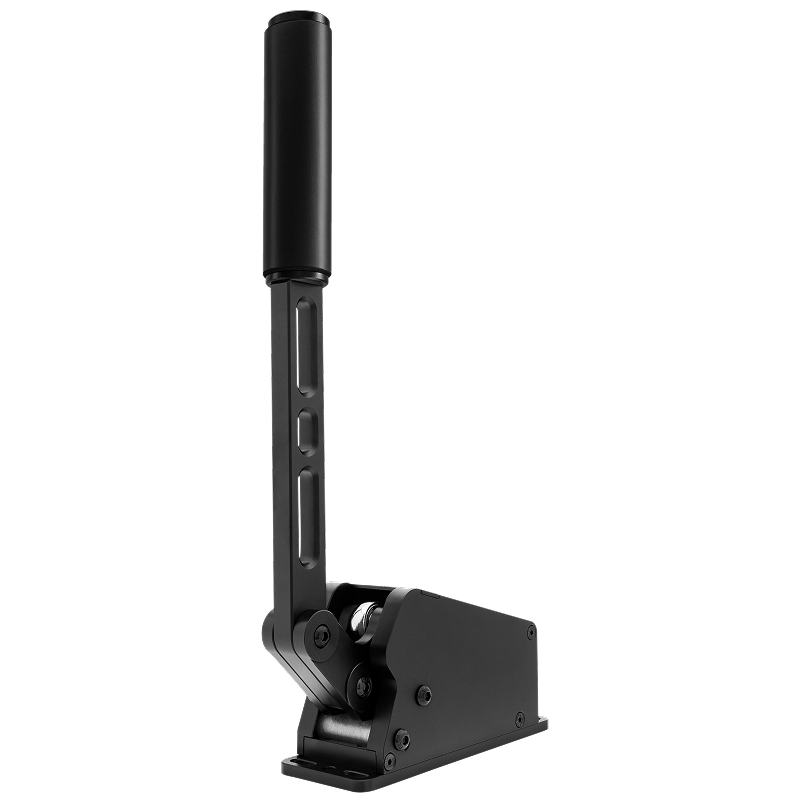
The TB-RS is Simagic’s hydraulic handbrake. The lever pushes fluid through a cylinder and a pressure sensor reads the result, so the pull is heavier from the first inch and builds in a straight line, with nothing soft before it bites – which is the mechanism a rally car uses. Nine elastomers and four stiffness settings let you tune that, it connects over USB or CAN, and the curves live in SimPro Manager.
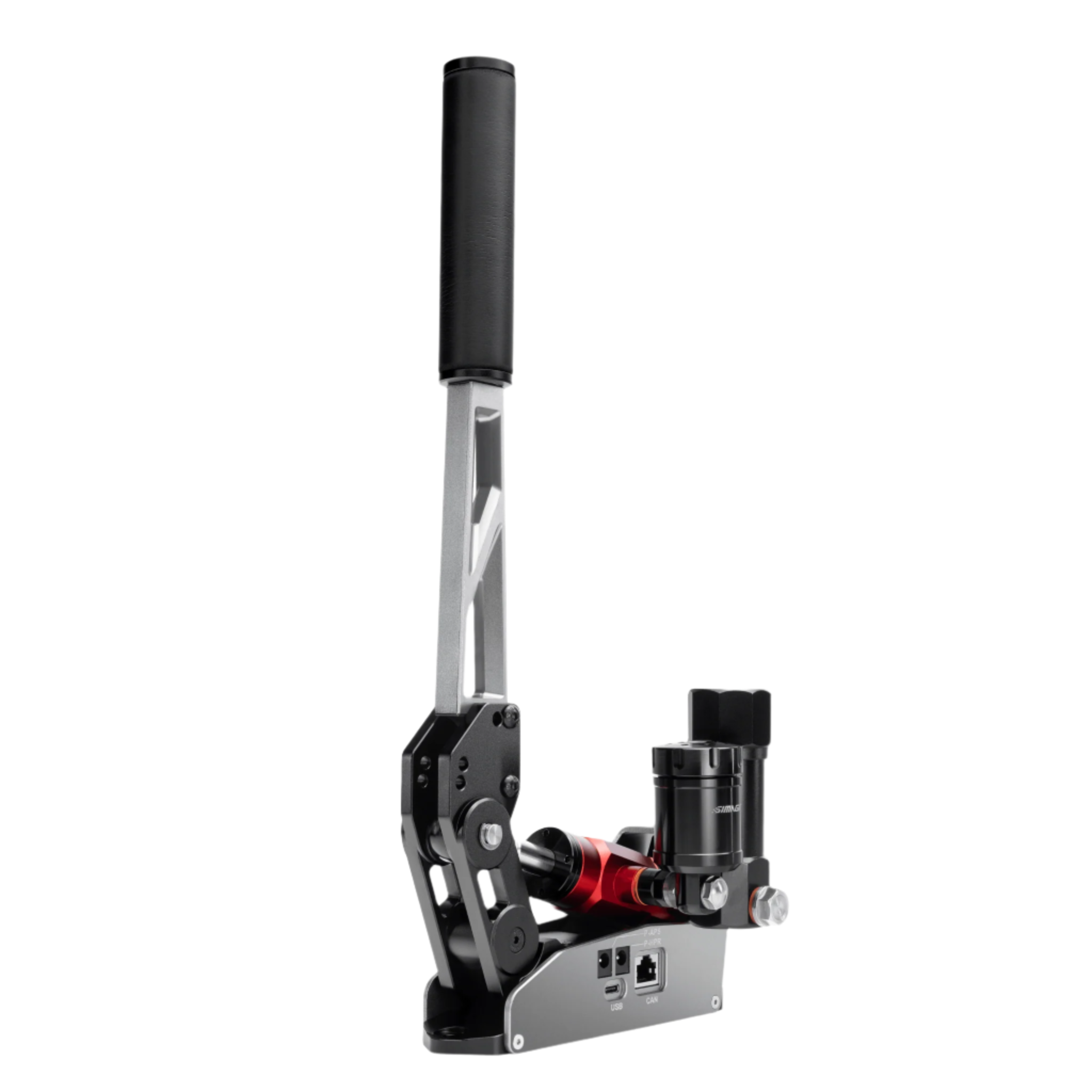
A hydraulic chamber needs the occasional bleed to keep the pressure consistent – Simagic supply the instructions, which is a quarter of an hour’s job where an elastomer swap takes a minute. For drift it’s more than you need: a drifter wants a light lever with some throw for repeated quick initiations, and a hydraulic isn’t that. For rally it’s the same mechanism a real car’s handbrake uses, at this money.
CONSPIT H3 – dual-mode hydraulic
The CONSPIT H3 is a hydraulic handbrake with a 5 MPa pressure sensor, a CNC alloy body on sealed bearings, and a lever that sets horizontal for road cars or vertical for rally and drift. It connects direct over USB or over CAN into the CONSPIT ecosystem, and it’s PC only. Stock comes and goes, so the daily price monitor below shows what’s available today, and CONSPIT sell it direct too.
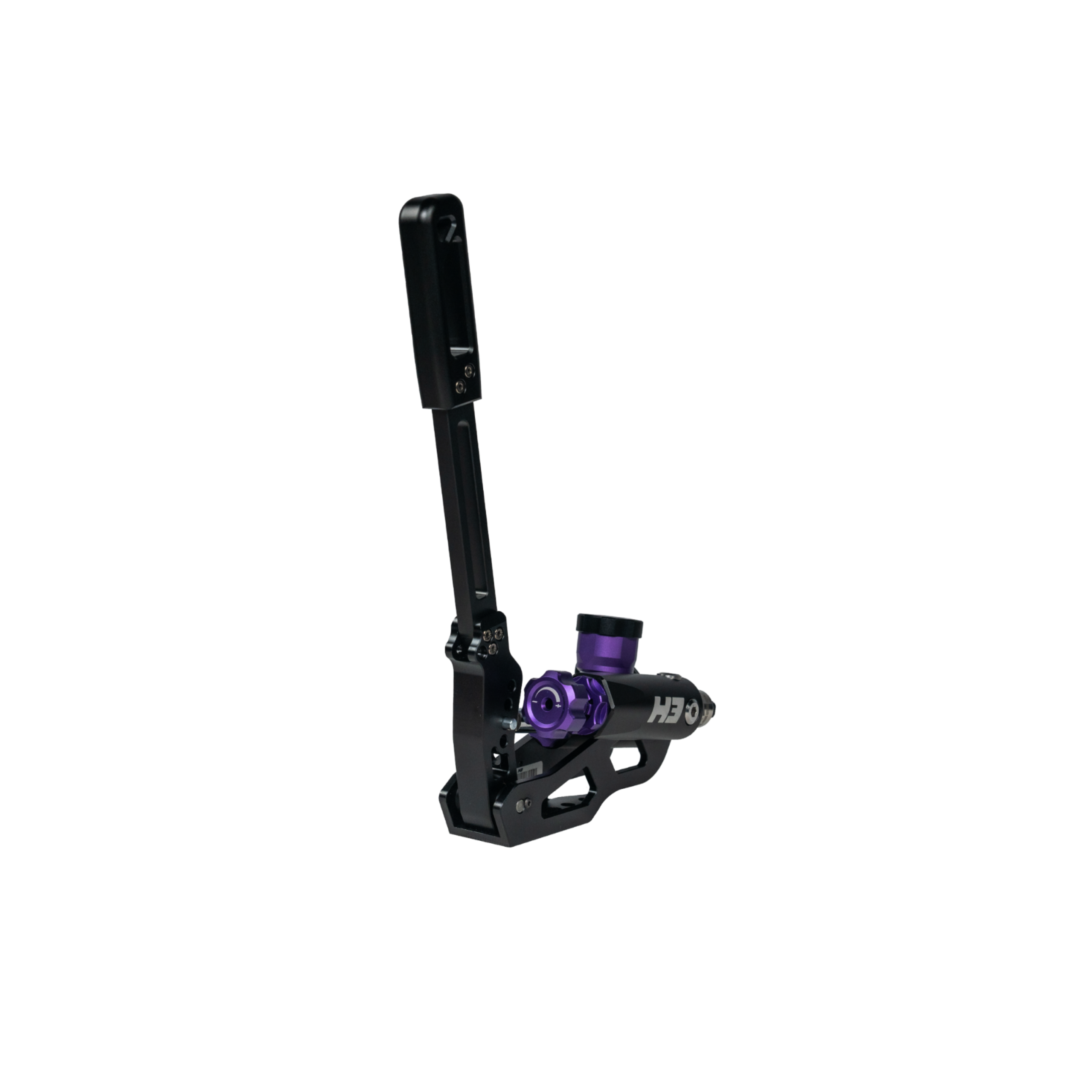
Exquisitely well made is my view of it. Everything CONSPIT have sent me recently has been incredible – the Apex 310 wheel, and the CHS shifter review that’s on the site now – and I think CONSPIT are going to have a very, very good year in 2027.
Simnet SHB-100 – budget load cell
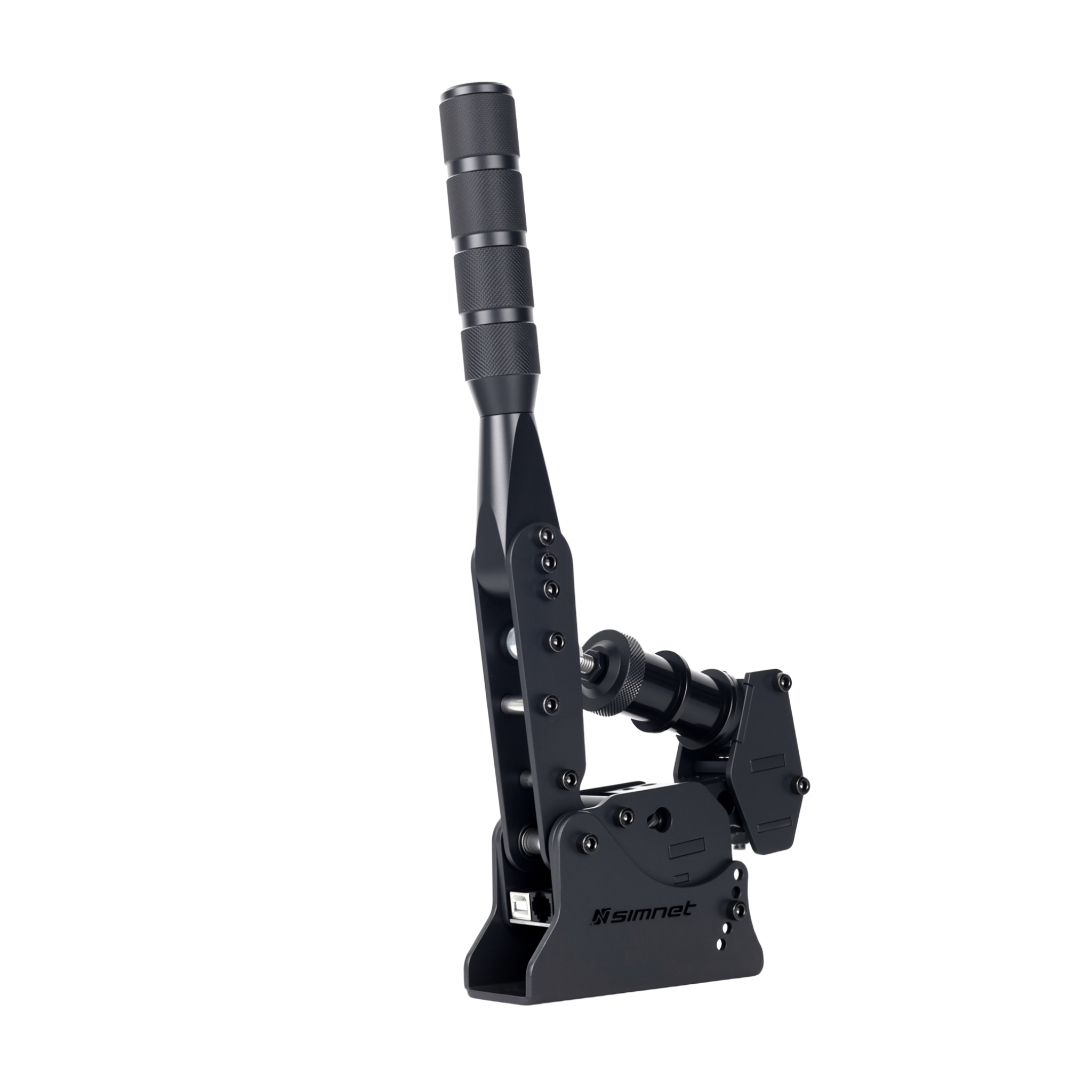
The Simnet SHB-100 is the entry end of the load cell tier, and Simnet sell an extension lever and a hydro-link kit as add-ons if you want to take it further later. It runs a 100 kg cell behind a two-stage spring and elastomer in a CNC alloy and galvanised steel body, mounts vertical or horizontal, and plugs into the PC over USB.
VNM Rally and Drift Handbrake V1.5
The VNM Rally and Drift Handbrake V1.5 is the specialist on this list. It’s a 200 kg load cell unit with a tall lever, which means you can mount it low on the rig and still have the grip at hand height for drifting, with swappable springs (red and blue in the box) for the resistance. The construction is all-aluminium and black-anodised, the handle sets to any of seven angles from vertical to flat, and it’s USB and PC only.
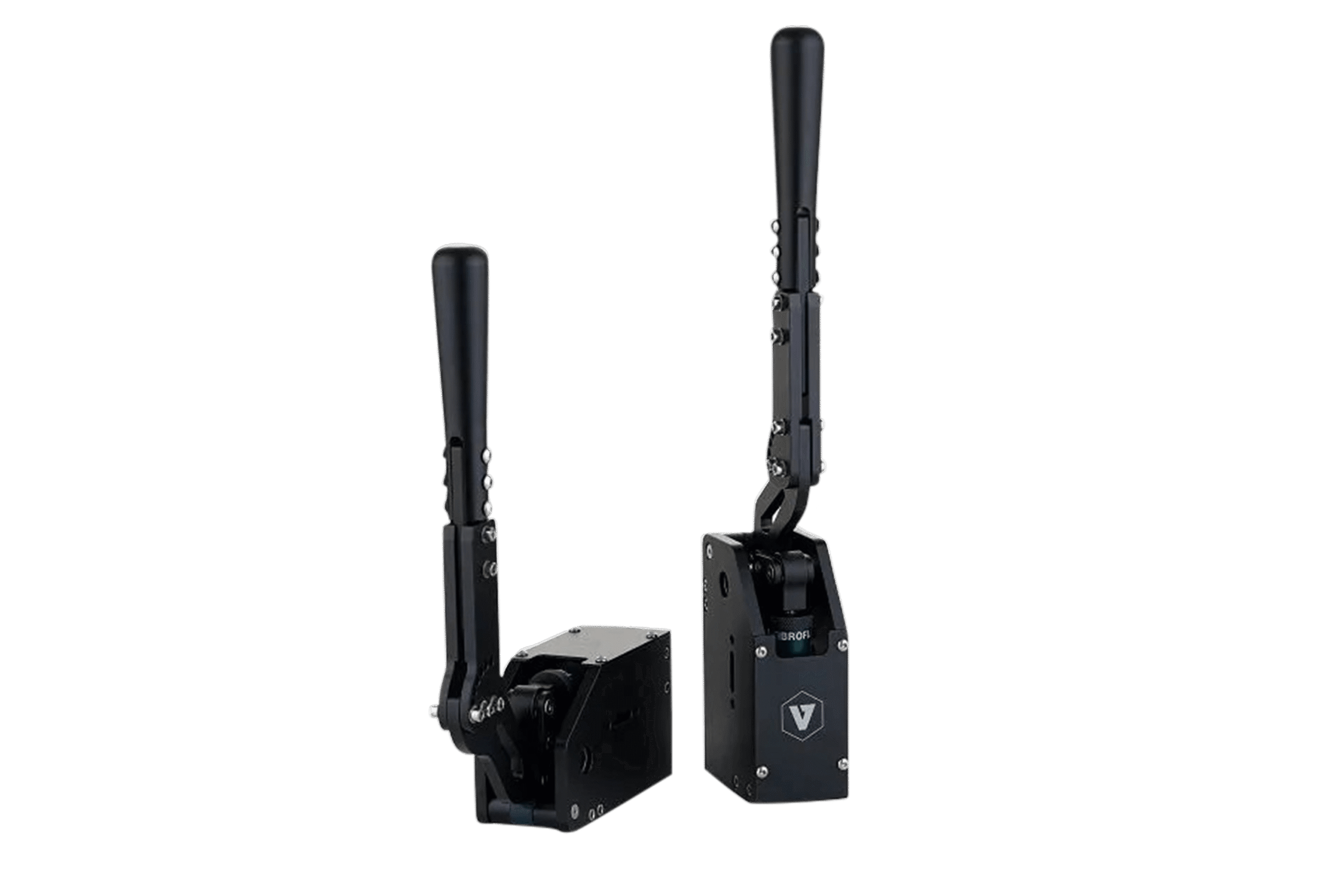
The springs in the box change the pull, and VNM sell a plate that bolts their shifter and the handbrake together as one unit. If you run EA WRC or DiRT Rally 2.0 seriously and nothing else, that’s a good way to buy; everyone else will find the more flexible units above easier to live with.
Thrustmaster TSS Handbrake Sparco Mod+ – handbrake and shifter in one
The Thrustmaster TSS Handbrake Sparco Mod+ does two jobs. In handbrake mode it’s a Hall-effect lever with 4 kg of resistance; a few seconds of mechanical reconfiguration turns it into a sequential shifter with a detent at each end. You give up one mount point for two functions, and it’s officially supported on PC, PlayStation and Xbox, which makes it the answer for a console rally driver who also wants a sequential for the road cars.
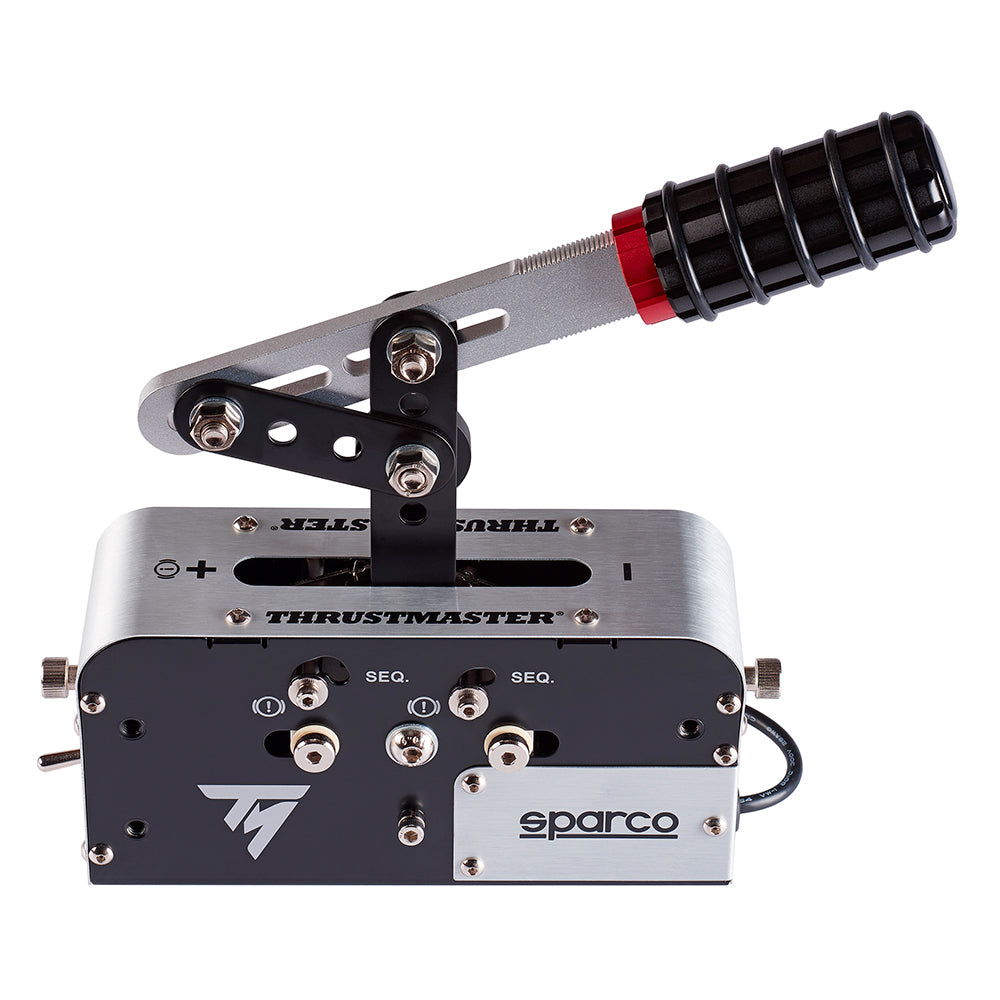
Doing two jobs means it isn’t the best at either. As a handbrake a Hall sensor is proportional by design but a load cell is finer at the top of the pull, and as a shifter it’s a compromise next to a dedicated sequential. If you only need one of those jobs, buy the dedicated unit; if you need both, it’s the TSS.
MME Bulletproof Handbrake
The MME Bulletproof is the top of the market and it’s built to that name: 7075 alloy, overbuilt for a home rig, USB to the PC, and a lifetime warranty.
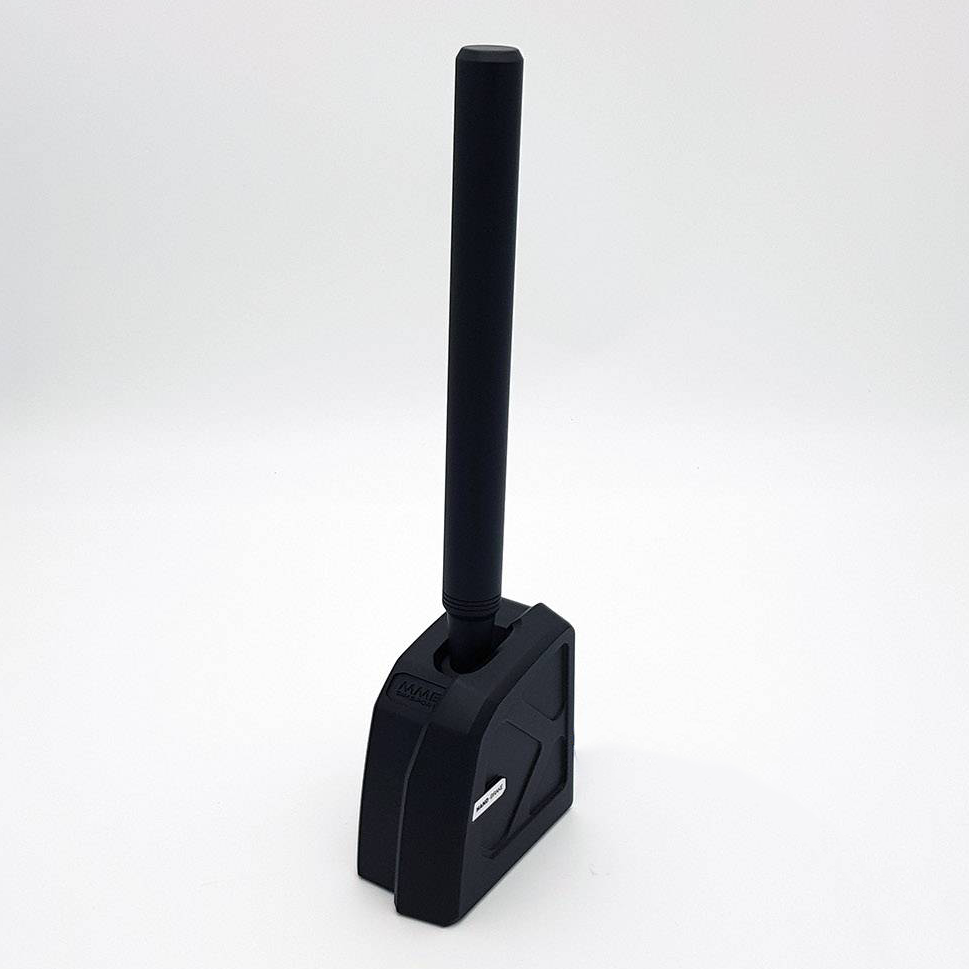
For a home cockpit it’s more handbrake than you’ll ever wear out. Where it makes sense is a commercial arcade installation or a motion rig where the whole platform is moving and everything bolted to it takes a beating – or for the owner who simply wants a handbrake that will outlast the rest of the rig.
Honourable mentions
There are a few more I’d have on the list, and for these you’ll be buying direct from the maker.
The Aiologs Sim Handbrake is an industrial-looking unit on a potentiometer, with a height-adjustable handle, and it ships with a desk clamp as standard, which is handy for trying a position before you commit to a permanent mount, and it’s sold direct. The Meca Evo is a big unit in 4 mm steel with a 200 kg load cell. The height lets you mount it low and still have the lever where a drifter wants it.
And at the entry end, Logitech’s RS shifter and handbrake combo covers anyone starting out on a G-series or Pro base.
Which handbrake should you buy?
On a Fanatec base, and especially on console, I’d buy the ClubSport Handbrake V2: the adapter’s in the box now and it holds its value. On a budget I’d buy the Moza HBP, and I doubt you’ll feel you’ve compromised. For accuracy it’s the XB1, because the load cell turns a handbrake from an on/off switch into something you can drive with.
If you want to grow into haptics or hydraulics later, the Simagic TB-NEO is the base to buy, and if you want the hydraulic lever now it’s the TB-RS or the CONSPIT H3, with the bleed on the calendar. At the top of the market the Heusinkveld V2 earns its price on the software and the adjustability, and the MME only if the rig is going to be moving under it.
Whatever you pick, a handbrake is only half of a rally or drift setup, and my sim racing shifters guide covers the other half, the sequential or the H-pattern. Enjoy!
Related Articles
Best Thrustmaster Wheel and Pedal Mods (2026)
ButtKicker and Tactile Feedback for Sim Racing: The Highest-ROI Upgrade You Shouldn’t Skip (2026 Beginner’s Guide)
Sim Racing Motion Platforms: A Beginner’s Guide to Adding Motion to Your Rig (2026)
D-Box Sim Racing: The FIA-Supplier Haptic System Explained (2026 Buyer’s Guide)
Best Throttle for Flight Simulator 2026: MOZA, Honeycomb, Thrustmaster, WinCTRL Compared
Best Joystick and HOTAS for Flight Simulators (2026)
Topic: Sim Racing Handbrakes