
I’m a sim racer and amateur racer with a passion for Motorsport, good racecraft and the technical and setup aspect of sim racing.
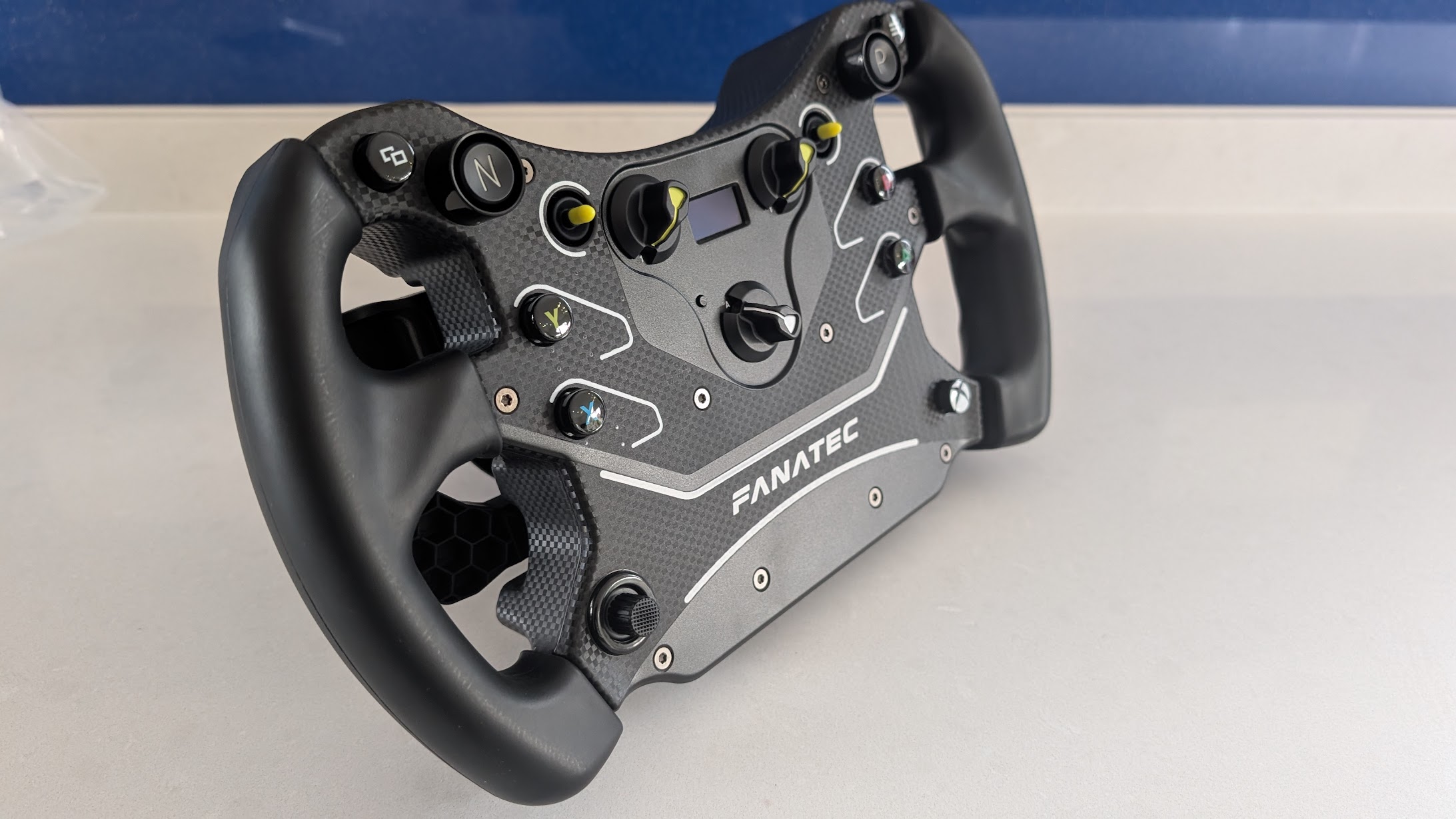
Fanatec’s CSL Steering Wheel GT3 costs $229.99 and gives you a 300mm GT3-style rim with an OLED display, dual clutch paddles, magnetic rocker shifters, and more button mapping options than you’ll realistically use. It’s the direct replacement for the hugely popular McLaren GT3 V2 – same proven layout, same price point, but with a QR2 Lite quick release and that OLED screen. If you’re putting together a Fanatec rig on a CSL budget, this is the wheel I’d grab first.
Quick Navigation
Jump directly to what you’re looking for:
Technical Specifications |
Compatibility and Ecosystem |
Build Quality and First Impressions |
Performance: How It Feels |
Issues and Things to Know |
How It Compares |
Who Should Buy This |
Pricing and Where to Buy |
Fanatec News
Technical Specifications
I weighed the CSL GT3 at 1,290g with the QR2 Lite fitted – light for a 300mm GT wheel, and that weight difference shows up immediately in force feedback. It’s light enough that even a CSL DD at 5Nm can push meaningful detail through it – kerbs, tyre slip, weight transfer – without the wheel’s own mass dampening the signal. That’s the engineering trade-off with heavier aluminium rims: they feel more solid in your hands but they eat force feedback nuance for breakfast.
| Specification | Value |
|---|---|
| Diameter | 300mm |
| Weight (with QR) | 1,290g |
| Quick Release | QR2 Lite (preinstalled) |
| Front Plate Material | Carbon fibre-reinforced composite |
| Grip Material | Overmoulded rubber (50 Shore A) |
| Buttons | 9 |
| FunkySwitch | 7-way (directional + push) |
| Rotary Encoders | 2x 12-position |
| Toggle Switches | 2x |
| Display | 1″ OLED (128×64, white) |
| Shifter Paddles | Magnetic rocker (aluminium) |
| Clutch Paddles | 2x analogue (dual clutch capable) |
| Platform Compatibility | PC, Xbox (native); PlayStation with compatible base |
| Release Date | October 2025 |
| Price | $229.99 / €199.95 |
Two specs that actually matter day-to-day: the OLED display and the dual clutch paddles. The OLED is a genuine step forward from the McLaren V2’s LED strip – I’ve got mine showing tyre temps, lap delta, and fuel data through FanaLab, and it’s properly useful mid-race. Dual clutch paddles at this price point is honestly still absurd – Fanatec have been doing this since the McLaren V2 and nobody else has matched it. You can set up a configurable bite point for standing starts, which is something you’d normally need to step up to ClubSport tier to get.
Compatibility and Ecosystem
This is a Fanatec ecosystem wheel, full stop. The QR2 Lite quick release is proprietary, it won’t fit on a Simucube, Moza, Simagic, or anything else. Nobody makes a QR2 adapter for other brands, and I doubt anyone will – Fanatec keeps this locked down. So buying this wheel ties you to Fanatec bases. Once you’ve bought in, you’re committed – and Fanatec know it.
Within the Fanatec world, though, it works with every current direct drive base in their lineup. The CSL DD (5Nm and 8Nm), GT DD Pro, ClubSport DD, ClubSport DD+, Podium DD1, and the new Podium DD – they’ll all take it. What it won’t work with: older belt-drive bases like the CSL Elite or ClubSport V2.5. Those use the old QR standard, completely different connection.
PC and Xbox work straight away – the Xbox compatibility lives in the wheel’s electronics, not the base, which is clever. PlayStation is trickier: you need a PS-compatible base, so either the GT DD Pro or a Podium DD1 PlayStation Edition. There’s no USB port anywhere on it – data and power both travel through the QR2 Lite into whatever base you’re running.
Software-wise, you’ll want the Fanatec Control Panel for firmware updates and button mapping, and FanaLab if you want the OLED display to do anything beyond basic rev lights. FanaLab is where the telemetry configuration lives – tyre temps, delta times, fuel data. Without it, you’re leaving the OLED’s best trick on the table. The Fanatec Control Panel and FanaLab both need Windows – there’s nothing for macOS or Linux, and given Corsair’s track record I wouldn’t expect that to change.
Build Quality and First Impressions
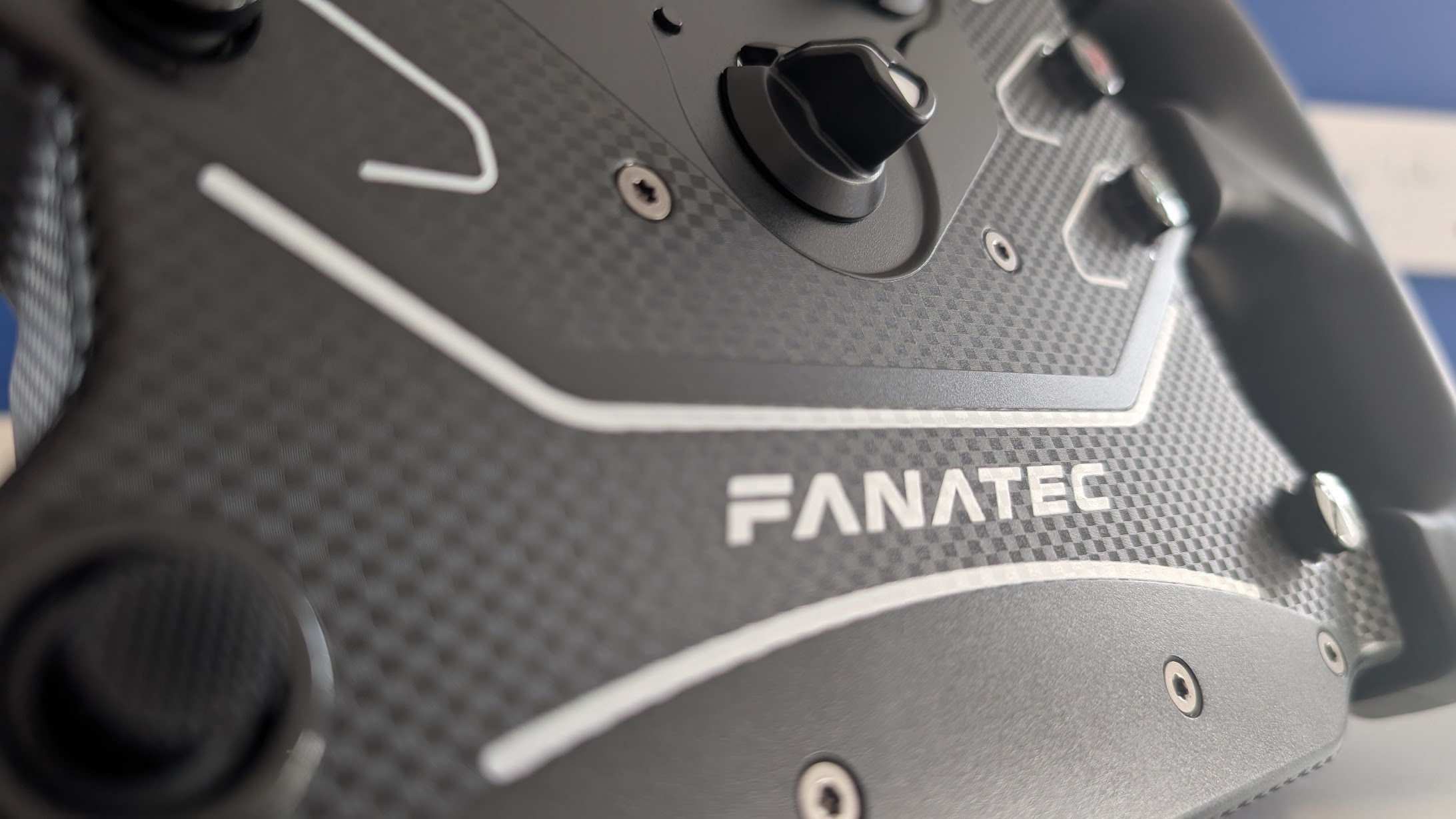
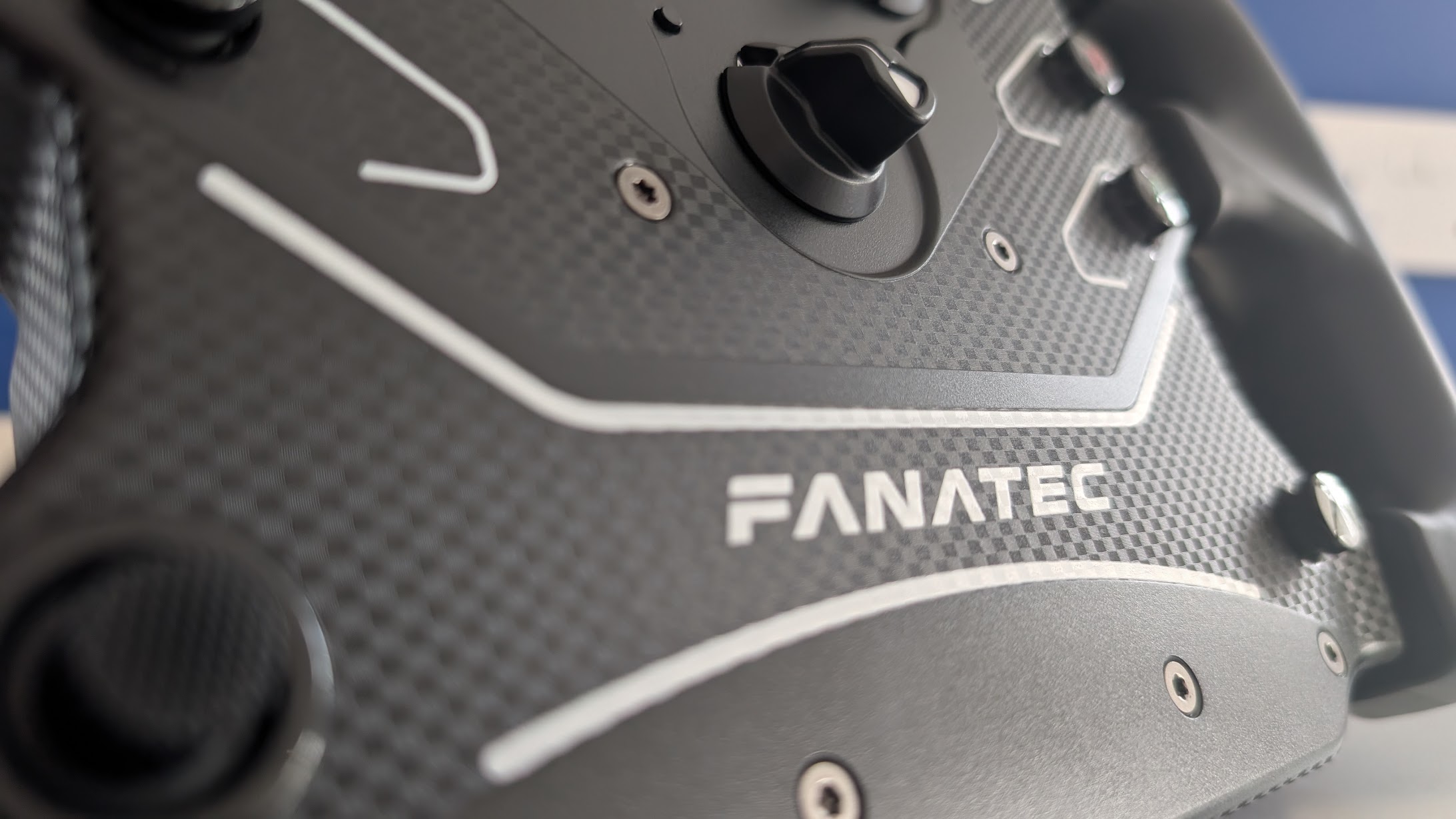
Pick it up and you’ll know immediately: plastic. Carbon fibre-reinforced plastic, sure, but plastic. Know that going in and you won’t be disappointed. I pushed on the front plate trying to find flex and there’s none. Stiff though – properly stiff – and at 1,290g nowhere near the heft of my ClubSport BMW M3 GT2 V2. That’s fine by me – lighter wheels let the base do its job.
The rubber grips are the same 50 Shore A compound Fanatec used on the McLaren V2. After a year on my McLaren V2 with identical rubber, the grip surface looked and felt the same as month one. They don’t go slick with sweat either, which matters during longer ACC endurance stints. One downside I’ve noticed: the grips collect every speck of dust in my sim room. You’ll be wiping them down constantly if you’ve got a dusty setup space.
The shifter paddles are precision-cut from a single block of anodised aluminium – one of the few genuinely metal components on the wheel. The magnetic rocker mechanism threw me off for the first couple of days – there’s no click point, just a smooth pull and return. Compared to my Simucube 2 Pro’s setup with Ascher paddles, they feel a bit softer in the actuation, but for the price I think that’s a fair trade.
Performance: How It Feels
I bolted the CSL GT3 on and ran it back-to-back against a heavier aluminium rim. Kerb strikes come through sharp and defined, tyre breakaway has a gradual build rather than a sudden snap, and the weight transfer through fast direction changes is readable in a way that matters for car control. Digit Racing made a good point in their review: the base can really push detail through because there’s so little mass fighting against it.
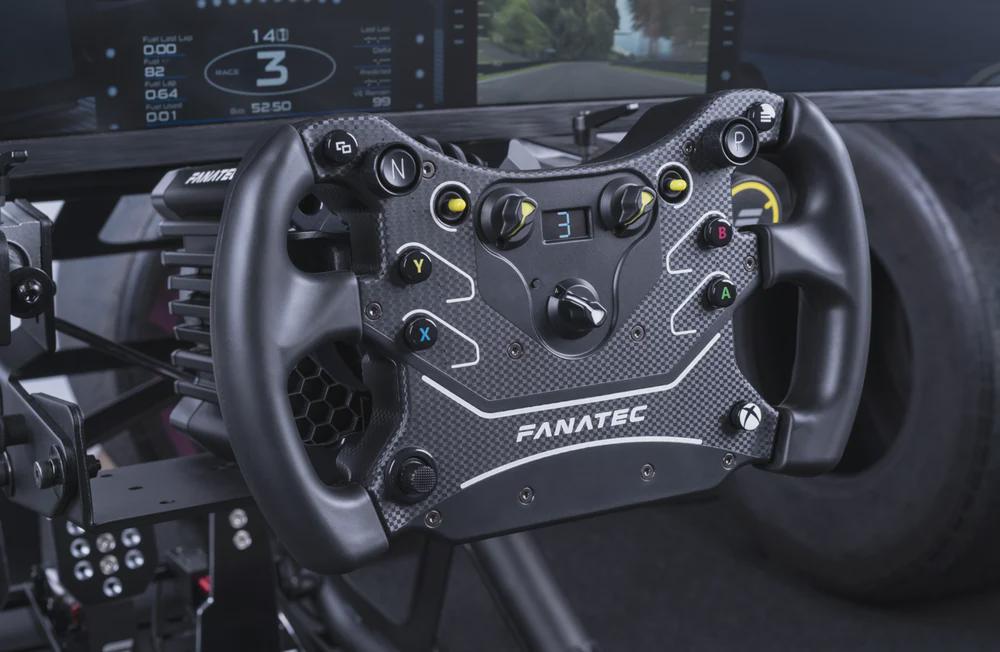
Took me about five sessions before the FunkySwitch clicked, but now it’s my go-to mid-race control – TC up two clicks, brake bias forward, pit menu – I’m doing all of that without lifting my thumbs off the grips. Seven functions on one control sounds cluttered, but the directional feel is distinct enough that you stop thinking about it after a few sessions. Ended up reaching for it more than the rotary encoders, which I didn’t expect. Same habit I had on the McLaren V2, honestly.
Where the CSL GT3 properly separates itself from the cheaper CSL P1 V2 is the dual clutch paddles. My setup uses independent bite points on each paddle, so standing starts in ACC and iRacing are a proper clutch dump rather than the game’s auto-launch doing the work. For €200, having that functionality is genuinely impressive – it’s something the CSL P1 V2 doesn’t give you at all.
Button quality sits at the “fine for the money” level. I wouldn’t call them satisfying – they don’t have the crisp snap you’d get from Ascher or Cube Controls hardware – but they register every time and the snap-dome feel doesn’t vary between buttons. The laser-engraved Pit and Neutral buttons have raised bezels – I can find them blind, which matters when I’m driving on my Samsung G9 and not looking down.
The OLED display is small – 1 inch, 128×64 pixels – but it’s positioned well and surprisingly readable at a glance. Through FanaLab, I’ve been running tyre temperatures and lap delta, and it’s enough information to be useful without being distracting. White on black, sharp enough that my overhead strip lights don’t wash it out.
Issues and Things to Know
The magnetic rocker shifters will bother some people – if you’ve spent years on click paddles, these feel like a completely different input. The travel is longer than a traditional click-style paddle shift, and the magnetic resistance takes about a week to feel natural. If you’re coming from sequential click paddles, the first few races will feel slightly off. Some people never warm to them, and that’s a valid reason to consider the CSL P1 V2 instead, which uses snap-dome click paddles.
The QR2 Lite is the composite version of Fanatec’s quick release, not the full metal QR2. It’s perfectly adequate for bases up to about 12Nm – I haven’t noticed any meaningful flex on the ClubSport DD. On a Podium DD1 at 20Nm or the new Podium DD at 25Nm, though, people are reporting slight play in the connection. Fanatec sell the metal QR2 upgrade separately for about €100, which is an annoying additional cost if you’re pairing this with a high-torque base.
Something I didn’t realise until setup day: the OLED needs FanaLab to show anything useful. Without it, you get basic rev lights and not much else. FanaLab is free but it’s Windows-only, so if you’re on a console-only setup, the OLED is largely wasted. Wish I’d checked that before the screen talked me into it.
OC Racing raised a fair point in their review: there isn’t much innovation here. Strip the branding and you’re looking at the McLaren V2 with a QR2 Lite and an OLED. The engineering underneath is mechanically identical – same magnetic paddle mechanism, same rubber compound, same weight distribution. If you already own a McLaren V2 in good condition, the upgrade case is thin unless you specifically want the OLED or the better quick release. random callsign made the point in his review that there’s no reason to hunt for a used McLaren V2 anymore when this exists at the same price – and he’s right, the CSL GT3 is just a better buy for new customers. But for existing V2 owners, you’re paying $230 for what amounts to a screen and a QR upgrade.
How It Compares
I’ve had three Fanatec wheels on my desk this month – the CSL P1 V2, this CSL GT3, and a ClubSport BMW – and comparing them side by side tells you everything about where the CSL GT3 sits in the range. Complete Fanatec wheels run from $169.99 to $264.99 at CSL tier, $369.99 upwards for ClubSport, and more for Formula-style. The CSL GT3 undercuts the lot on price but somehow has more features than wheels costing $150 more, which makes the rest of the lineup look a bit silly.
The obvious comparison within Fanatec’s range is the CSL P1 V2 at $169.99. You save $60, keep the same 300mm diameter, but you lose the OLED (replaced by a three-digit LED), lose the dual clutch paddles entirely, and get fewer rotary controls. If those features don’t matter to you – and they won’t for casual racers – the P1 V2 is genuinely excellent value. But if you want standing start technique and proper telemetry display, the GT3 is the one.
The ClubSport Steering Wheel BMW M3 GT2 V2 at $369.99 is the next step – Alcantara grips, metal throughout, and it feels heavier in the hand in a way that screams quality. I’ve held both side by side and the ClubSport is the nicer object, no question. Trouble is, the CSL GT3 has it beat on features despite costing almost half as much – OLED, dual clutch, more rotary controls. You’d have to genuinely care about Alcantara and metal to make that premium worth it.
Outside Fanatec, the comparison gets complicated by ecosystem lock-in. Moza’s GS steering wheel sits at a similar price point with full metal construction, but it’s Moza ecosystem only – no cross-compatibility. The Cube Controls GT Zero rim is properly cross-brand compatible at $168.75, but it’s a rim only. Factor in a Cube Controls hub at $340+ and you’re past $500 total – a completely different budget conversation. Simagic’s GT Cup wheel is another option if you’re in that ecosystem, around $380-$450 depending on retailer, but again, Simagic bases only.
The maths is pretty simple for Fanatec owners. Nothing else at $230 gives you OLED, dual clutch, and this many controls without swapping ecosystem. And if you’re choosing a new ecosystem from scratch, the CSL DD + CSL GT3 package is still one of the most cost-effective entry points into direct drive sim racing.
Who Should Buy This
If you’re building your first Fanatec setup around a CSL DD, this is the wheel I’d pair with it. The feature set at $229.99 is unmatched – OLED, dual clutch, magnetic shifters, rotary encoders, FunkySwitch. You’re getting ClubSport-tier functionality at CSL pricing, and the lightweight construction is genuinely ideal for lower-torque bases where every gram of wheel mass matters for force feedback clarity.
For base pairing specifically: the CSL DD 8Nm + CSL GT3 combo runs you about $710 total, and with Fanatec’s February 2026 price cuts on wheelbases, that’s dropped from closer to $900 six months ago. It’s a properly capable GT setup for under $750 all-in with the table clamp. If your budget stretches, the ClubSport DD at 12Nm is where I’d point you – the extra torque headroom pushes even more detail through this lightweight wheel. Above 12Nm, though, you’ll want to factor in the €100 metal QR2 upgrade, which changes the value calculation.
My McLaren V2 lasted over a year before I swapped it for this, and honestly the upgrade case was thinner than I expected. Your upgrade decision comes down to two things: does the QR1 wobble bother you, and do you want that OLED screen? If either of those bugs you, the CSL GT3 sorts it. If your V2 still feels solid and you don’t care about on-wheel telemetry, honestly, save your cash. Same paddle feel, same grips, same button layout under a different badge.
Hate rocker-style paddles? This isn’t the wheel for you, and no amount of breaking-in will change that. Get the CSL P1 V2 with its snap-dome click paddles, or step up to a ClubSport wheel. No amount of “give it a week” will fix it if you fundamentally prefer a click action – I’ve watched people try and give up.
Pros
- Dual clutch paddles with configurable bite point at $229.99 – still the best value in Fanatec’s range
- 1,290g weight keeps force feedback detail intact on lower-torque CSL DD bases
- OLED display with FanaLab integration for real telemetry data mid-race
- QR2 Lite preinstalled – no separate quick release purchase needed
- FunkySwitch, rotary encoders, and toggle switches give you more mapping options than you’ll probably use
Cons
- Magnetic rocker shifters aren’t for everyone – if you prefer click paddles, look at the CSL P1 V2
- Plastic construction throughout (expected at this price, but don’t expect metal)
- QR2 Lite may flex on high-torque bases above 12Nm – metal QR2 upgrade costs ~€100
- OLED display requires FanaLab (Windows only) for full functionality – basic without it
- Total Fanatec ecosystem lock-in – no cross-brand compatibility whatsoever
Pricing and Where to Buy
The CSL Steering Wheel GT3 costs $229.99 / €199.95 and you can only get it from fanatec.com. You won’t find it on Digital Motorsports, SimRacingPros, or any other third-party shop – Fanatec keep this one direct-sale only. Stock has been consistent since the October 2025 launch, and at the time of writing it’s showing as in stock with standard shipping. There aren’t bundle deals specifically for this wheel, but Fanatec have recently cut prices on their DD wheelbases by up to 30%, which makes the CSL DD + CSL GT3 combo significantly cheaper than it was six months ago.
Fanatec News
Corsair acquired Fanatec’s parent company Endor AG out of insolvency in September 2024, and the effects are starting to show. Stock availability has improved noticeably, warranty has been extended to 3 years across the board (longer than Moza and Simagic at 2 years each), and those February 2026 price cuts on DD bases suggest Corsair is pushing for more aggressive value positioning. The new Podium DD at 25Nm launched as their flagship, and the CSL GT3 slots in as the entry-level wheel that makes the whole ecosystem accessible. Whether Corsair’s gaming peripheral approach will push Fanatec toward more innovation or more badge-engineering remains an open question – but for now, the products are solid and the support is better than it was under Endor.
Digit Racing’s hands-on review covers the CSL GT3 paired with the ClubSport DD Plus, with good detail on the force feedback feel and build quality. Worth a watch if you’re specifically interested in how the wheel performs on a higher-torque base than the CSL DD.
Racing Cockpits Buyer’s Guide
Best VR Headsets for Flight Simulation
Fanatec ClubSport Steering Wheel GT3 for Xbox Review
Simagic Sim Racing: The Complete Buyer’s Guide (2026)
Corsair for Sim Racers: Ecosystem Buyers Guide 2026
Flight Sim Gear for Sim Racers: The Complete Buyer’s Guide (2026)
Topic: Fanatec Sim Racing Wheels