
I’m a sim racer and amateur racer with a passion for Motorsport, good racecraft and the technical and setup aspect of sim racing.
Chinese brand, launched around 2019, built quietly on word of mouth before most of the sim racing community had clocked them – and the Alpha EVO series, released in 2025, is the strongest value case in direct drive right now. I own a Simucube 2 Pro, so I haven’t personally run Simagic hardware. What I’ve watched, read, and heard from people who do own them keeps coming back to the same three things: FFB that’s eerily smooth, a build that holds up, and pricing that really unsettles the established brands.
Simagic pitches at the buyer who wants genuine direct drive quality without spending Simucube or VRS money. Their wheelbases start around £360 and top out around £730 for the Pro. That’s not entry-level budget territory, but compared to what you’d have paid for equivalent performance two years ago, it’s a different world. The full ecosystem – base, pedals, wheel, shifter – runs you somewhere between £800 and £1,500 depending on how far you go.
The Sport starts at $399 for 9Nm, the Standard is $549 for 12Nm, and the Pro tops out at $699 for 18Nm – that’s direct drive that competes with Simucube and Asetek at a fraction of what those cost. Under the hood they’ve gone with in-house 5-pole low-inertia motors and 21-bit encoders, which is what gets you that smoother, more responsive feel without the old trade-off between detail and harshness. And unlike Fanatec’s proprietary QR system, Simagic uses the D1-spec quick release – so you can bolt on pretty much any third-party wheel without hunting down expensive adapters.
Quick Navigation
Jump directly to what you’re looking for:
Why Simagic? |
Alpha EVO Wheelbases |
vs the Competition |
Legacy Alpha line |
Steering Wheels |
Zeus Wheel Range (new) |
Pedals (incl. HPR + P2000r) |
Accessories |
SimPro Manager V3 |
Compare by Investment
This page covers the full Simagic range – wheelbases, wheels, pedals, and accessories – with honest notes on where they sit in the market. For context on what Simagic competes against, see our direct drive wheels hub, the Moza guide, and the Simucube guide.
Why Simagic?
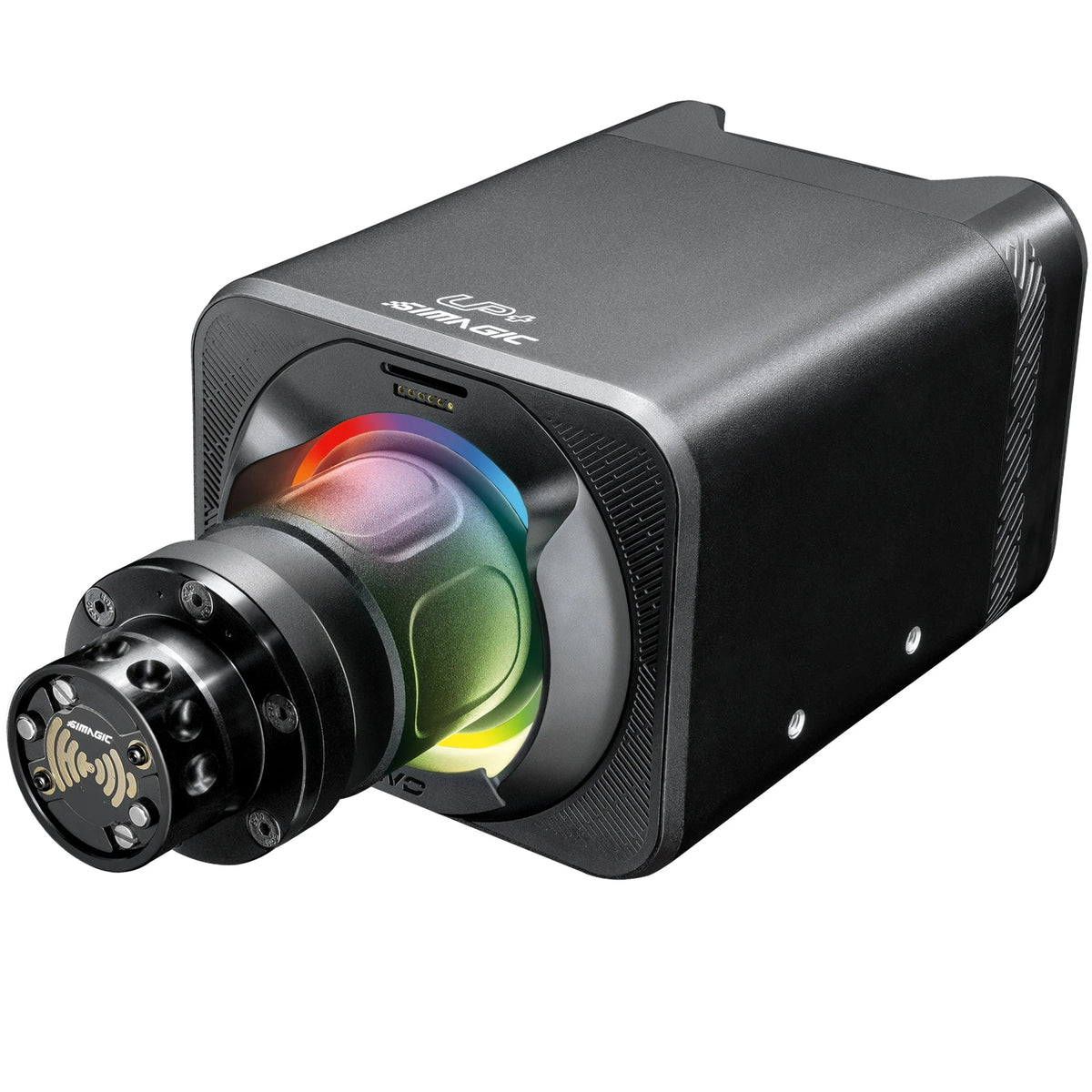
Simagic launched around 2019 and built their reputation on smooth, zero-cogging force feedback at prices that undercut the established names. The Alpha series was their first direct drive wheelbase. The EVO line is the second generation – 21-bit encoder, revised motor architecture, better build quality across the board. From everything I’ve watched and read, reviewers who owned the original Alpha treat the EVO as a properly different product, not an incremental refresh with a new badge on it.
The 21-bit encoder means 2,097,152 positions per revolution – up from 18-bit on the original Alpha, and above what most competitors at this price point are running. The practical upshot is a more detailed signal reaching your hands: tyre feedback, kerb texture, the edge of grip, rather than a smoothed-out approximation of those things. Whether you’d consciously feel that difference day-to-day is fair to debate, but it’s not a spec Simagic are padding to win a comparison table.
Community Sentiment
Broadly positive – but not uncritical. From the YouTube reviews I’ve watched, the consensus is that Simagic’s FFB is the smoothest at this price point. JACKZER, who runs Simagic hardware regularly, put it plainly: the Alpha EVO 12Nm is the money wheelbase for most people right now. The GT Neo is the wheel to pair with it.
The fair criticism comes from Danny Lee, who did a detailed breakdown of the EVO Pro and flagged that the firmware has built-in damping you can’t fully remove. Simagic added it after early customers complained about harshness, and Danny’s view is that it masks signal, particularly with heavier formula wheels. JACKZER sits in the opposite camp and treats that smoothness as a feature rather than a compromise. On a lightweight GT wheel like the Neo, most reviewers agree the smoothing isn’t really noticeable in practice; it’s the full-face formula wheels over 320mm where the damping starts to show up in the signal. I’ll plant a flag here, because the “smoothness is a feature” framing gets it backwards. A real racing car – a formula car especially – is a violent, physical, exhausting thing to drive. The wheel kicks, the front axle loads and unloads, the kerbs genuinely try to take it out of your hands. Nobody who has driven the real thing comes back and describes it as smooth. So a wheelbase that polishes all of that into a refined hum is moving away from realism, not towards it. The baked-in damping is a real fidelity trade-off, and treating it as a selling point usually tells you more about the reference frame of the person making the claim than about the hardware.
Simagic recently extended the warranty to 2 years globally, and made it retroactive for existing owners – which is the kind of customer-facing decision that builds brand trust properly. Warranty support on sim hardware at this price point matters more than spec-sheet bullet points – you’re spending real money on this.
Alpha EVO Wheelbases
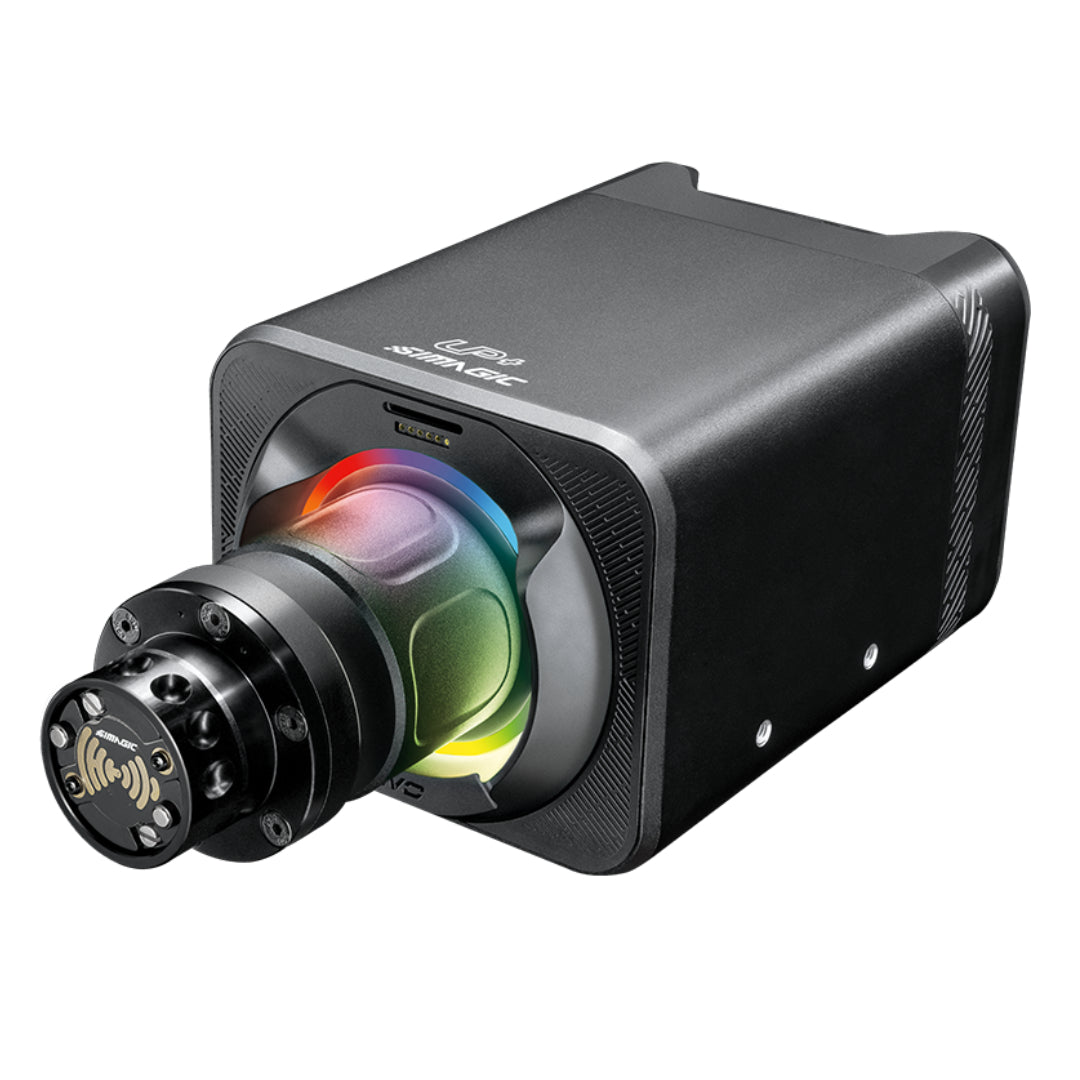
Three models, same encoder, same motor architecture underneath, different torque ceilings. Sport tops out at 9Nm, Standard at 12Nm, Pro at 18Nm. The teardown findings go further than you’d expect – Sport and Standard share the same processor, the same motherboard, the same braking resistor, and the difference between them is firmware-locked. The Pro shares the motherboard too – only the motor itself changes between Sport and Pro. The practical takeaway is that Simagic aren’t cutting corners on the cheaper models – you’re getting the same hardware with a different output ceiling, not a different motor in a cheaper casing.
Alpha EVO Sport (9Nm)
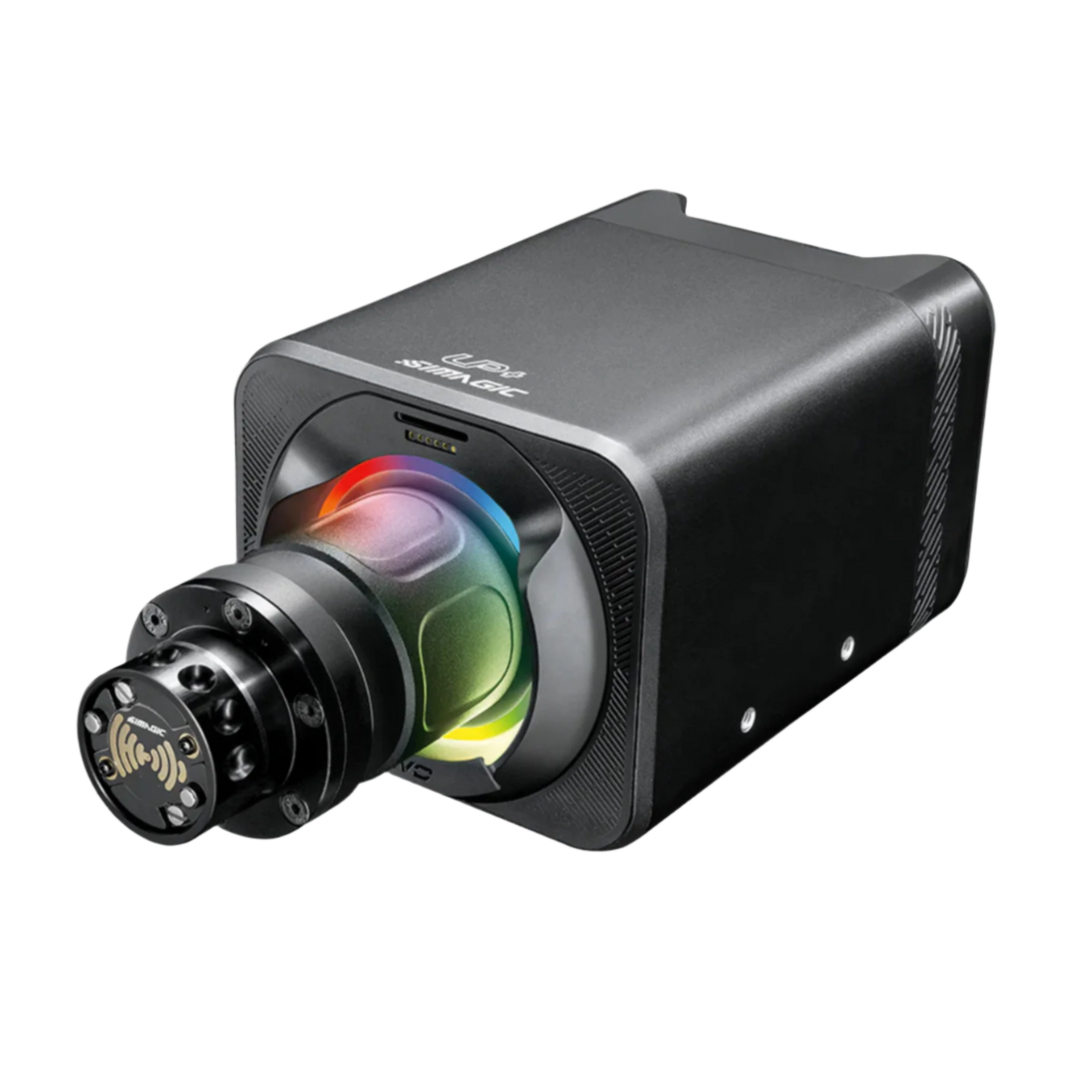
Around £360. In independent comparisons the Sport comes out ahead of both the MOZA R9 and the Fanatec CSL DD at their equivalent price points – which is a claim worth sitting with, given those are the two most popular bases at that tier. Nine Newton-metres covers most sim racing comfortably. JACKZER makes the case for stretching to the 12Nm Standard if you can – running well under the torque ceiling in everyday use means the FFB character stays cleaner and the base doesn’t run as warm in long sessions. If the budget tops out at the Sport, it’s still a proper starting point.
- Peak torque: 9Nm
- Encoder: 21-bit (2,097,152 CPR)
- QR: D1-spec (compatible with MOZA wheels and wide third-party range)
- Mounting: standard desk/rig. No front mount without optional bracket
- Warranty: 2 years, now global and retroactive
Alpha EVO (12Nm)
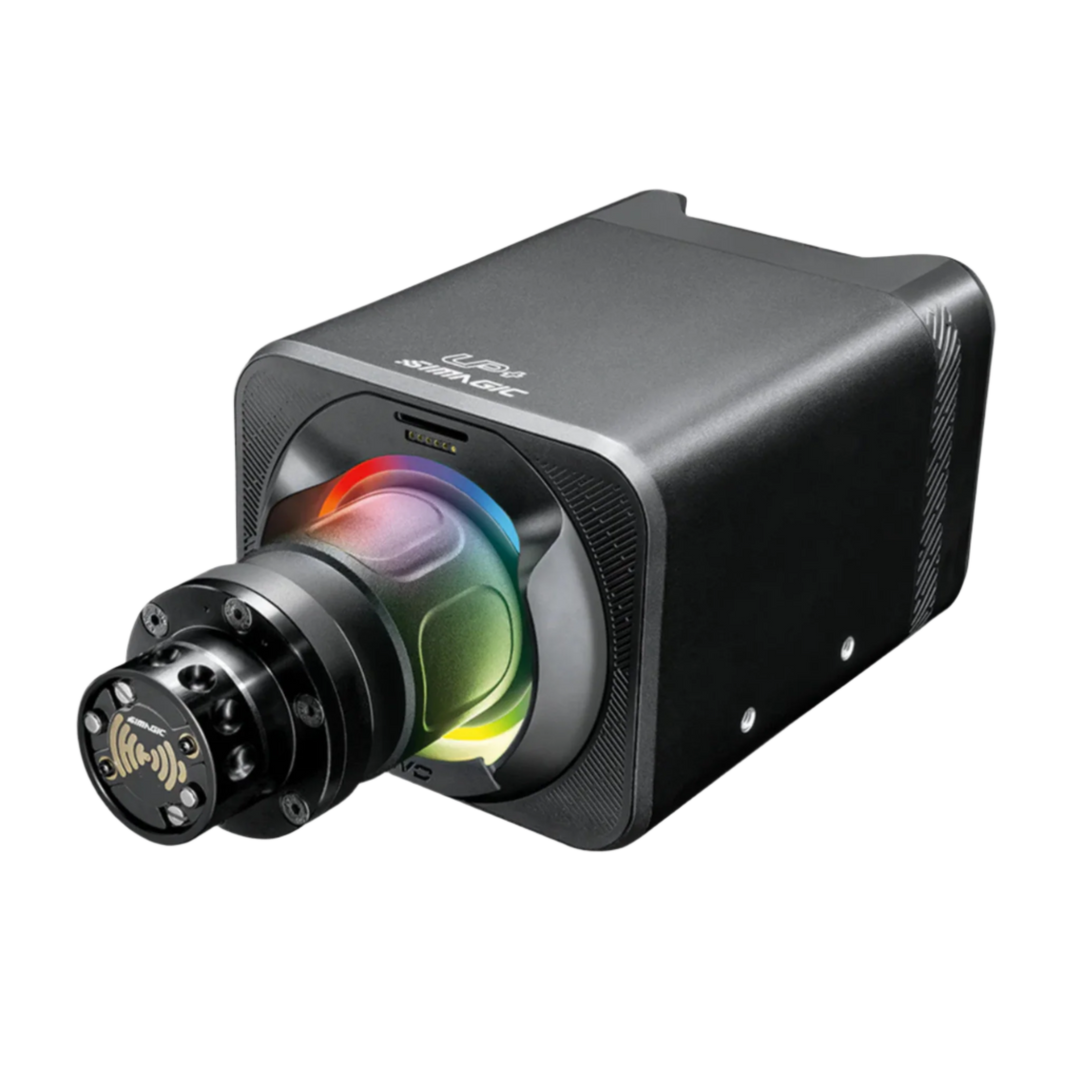
Around £480. Same internals as the Sport, firmware-unlocked to 12Nm. From what I’ve read, this is the one most buyers settle on – you spend the majority of your sessions well under the torque ceiling, the base stays cooler, and the FFB character stays consistent. Multiple reviewers have benchmarked the Standard’s feel against the Asetek La Prima and landed it in the same bracket – the La Prima costs noticeably more, so this comparison keeps surfacing in independent reviews of both bases.
- Peak torque: 12Nm
- Encoder: 21-bit
- Mechanically identical to Sport (firmware difference only)
- D1-spec QR
- PC only – no console support
Alpha EVO Pro (18Nm)
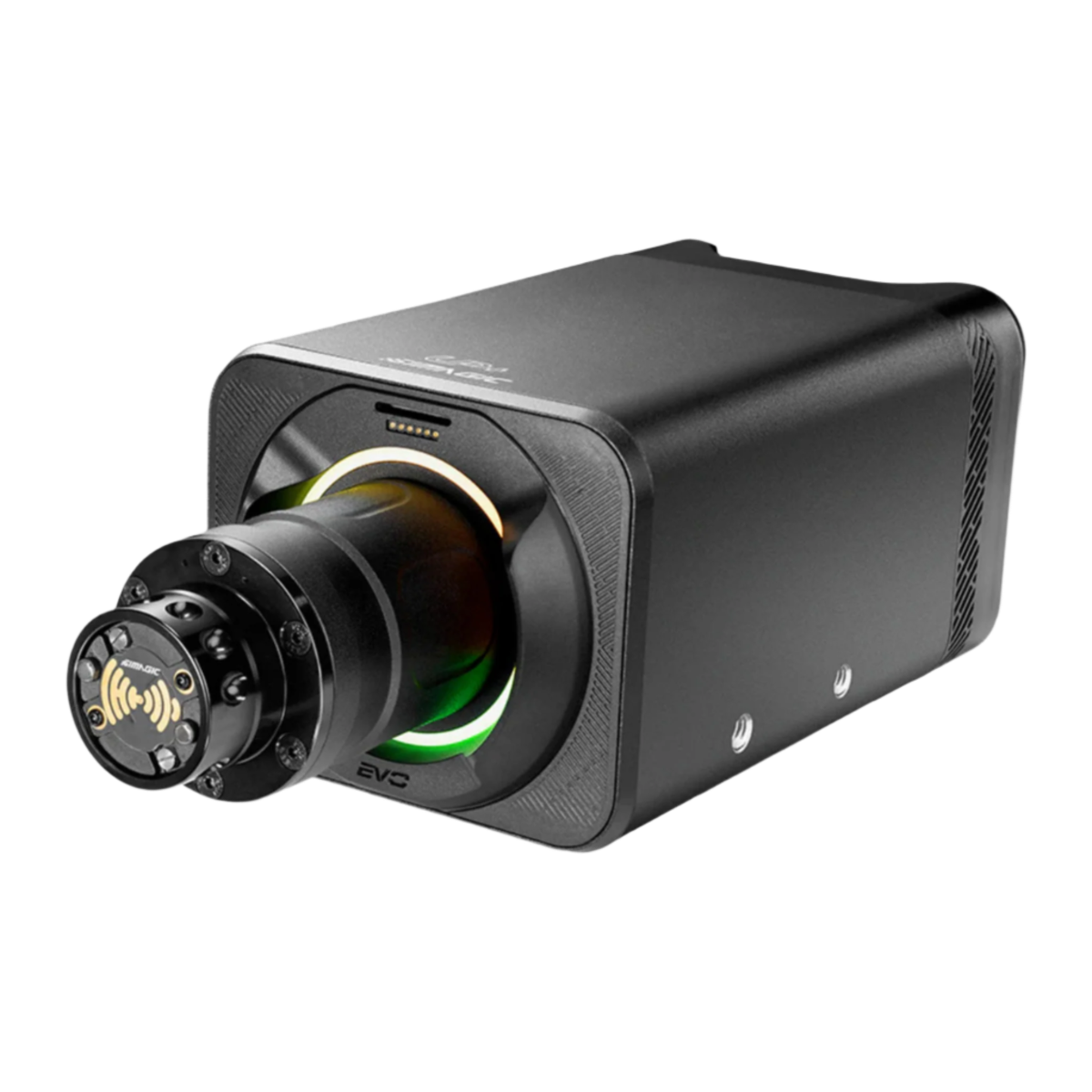
Around £731. That works out at $38.83 per Newton-metre at the $699 US price – outstanding value, and the context helps – the Asetek Forte is $899, the MOZA R21 is $849, the Conspit Ares $799. The EVO Pro is the cheapest of the serious 18Nm+ options. What I’ve read consistently is that the Pro matches Simucube 2 Sport quality of feel, which is a meaningful benchmark given the price gap.
Worth flagging the way owners run this base. Run it at 14 Nm against a Simucube 2 Ultimate and an Asetek Invicta – both also at 14 Nm – and they’re very hard to tell apart in the seat. Jaxer turns his down to 14.6-14.8 Nm in everyday use. The pattern across both reviewers is the same: a higher-rated base run below its ceiling feels faster and cleaner than a lower-rated base maxed out, because the headroom is what gives you the slew rate, not the headline torque number. So if you’re stretching for the Pro and worried you’ll never use 18 Nm – you probably won’t, and that’s fine. The caveat from Danny Lee about baked-in damping applies here more than at lower torque levels, particularly if you’re running heavy formula wheels above 320mm.
- Peak torque: 18Nm
- Encoder: 21-bit
- RGB ring (note: obscured by full-face formula wheels)
- Contact pads for future magnetic accessories (no compatible products yet)
- D1-spec QR
- Firmware V219 adds built-in damping – cannot be fully removed
Alpha EVO vs the Competition
Quick thing on the D1-spec QR system before you spend any money – and one nuance the headline claim glosses over. Mechanically, Simagic and MOZA use the same quick-release standard, so any third-party rim built around D1 (Cube Controls, Ascher, the substantial aftermarket scene) bolts onto either base. That part of the claim holds up. What doesn’t hold up is the assumption that this means a branded MOZA wheel just works on a Simagic base. The two brands use different pin layouts and different proprietary 2.4GHz wireless protocols for button data and display info, so a MOZA wheel with its own electronics won’t talk to a Simagic base unless that wheel can also be plugged directly into the PC via USB to bypass the wheelbase. The third-party rim ecosystem is properly cross-compatible. Branded electronic wheels aren’t.
On the console question – Simagic is PC-only across the board for the EVO line, and that’s the right thing to know going in. Fanatec’s PlayStation and Xbox support remains the main argument for paying their premium over Simagic or MOZA at similar torque levels. There’s also a third-party angle worth understanding here: the Sigma Cortex is an external adapter (made by Sigma Integrale, not Simagic) that some owners use to spoof console compatibility on the older Alpha-line bases. The EVO range broke that compatibility, because Simagic changed the USB and firmware protocols on the new bases. So if you’ve read about Sigma Cortex working with Simagic gear and assumed it’d carry across to the EVO – it doesn’t, and there’s no current workaround.
The legacy Alpha line – what’s still in stock and when to consider it
Three older Simagic bases are still on retailers’ shelves and worth knowing about, because the EVO range hasn’t quite filled the entire spec ladder yet. The Alpha Mini (10 Nm, around $399) sits at the same price as the EVO Sport but feels older – traditional outrunner servo motor, not the new in-house 5-pole motor. The Alpha (15 Nm, around $649) is the awkward middle child – more torque than the EVO Standard but less polish in the FFB. And the Alpha U (23 Nm, around $899) remains Simagic’s highest-torque base by raw spec, sitting above the EVO Pro on torque but below it on slew rate and FFB resolution.
The honest framing: if you really need more than 18 Nm right now (heavy formula wheels, drift discipline, deliberate over-spec for endurance racing), the Alpha U is the only Simagic option until an EVO equivalent lands. For everyone else, the EVO range is the right choice on a fresh buy – sharper FFB at any given applied torque, longer firmware-support runway, and the new motor architecture that earns the EVO badge in the first place. Jaxer puts the rule of thumb plainly: see yourself in two, three, four years. If you’re saving on the base now and planning to upgrade later, you’ll regret it twice – once when you outgrow the cheaper base and again when you sell it second-hand at a discount.
Used Alpha stock is a different conversation – second-hand prices on the older line have settled meaningfully, and if you find an Alpha at the right number, it’s a perfectly capable starting base. The thing to avoid is paying near-RRP for an Alpha when an equivalently-priced EVO Sport is available new.
Looking further up the range: there is now an Alpha EVO Ultra (28 Nm) sitting above the Pro for anyone who genuinely needs that ceiling. RandomCallsign reviewed it at roughly $970 / £720-780 – mid-pack on price for 28 Nm, pricier than a MOZA R25 or VRS but cheaper than an Asetek Invicta or Fanatec Podium DD. His honest read is worth repeating: outstanding in Assetto Corsa, AC Rally and iRacing, “phenomenal” for drifting, but the Le Mans Ultimate FFB came across as an over-reactive high-frequency mess until he had a tuning call with Simagic, and his unit had some coil whine. It is not a default buy – the 12 Nm Standard remains the sweet spot for the overwhelming majority – but the headroom is there if your discipline demands it. (Don’t confuse the Ultra wheelbase with the new Zeus range, which is a line of steering wheels, not a base.)
Simagic Steering Wheels
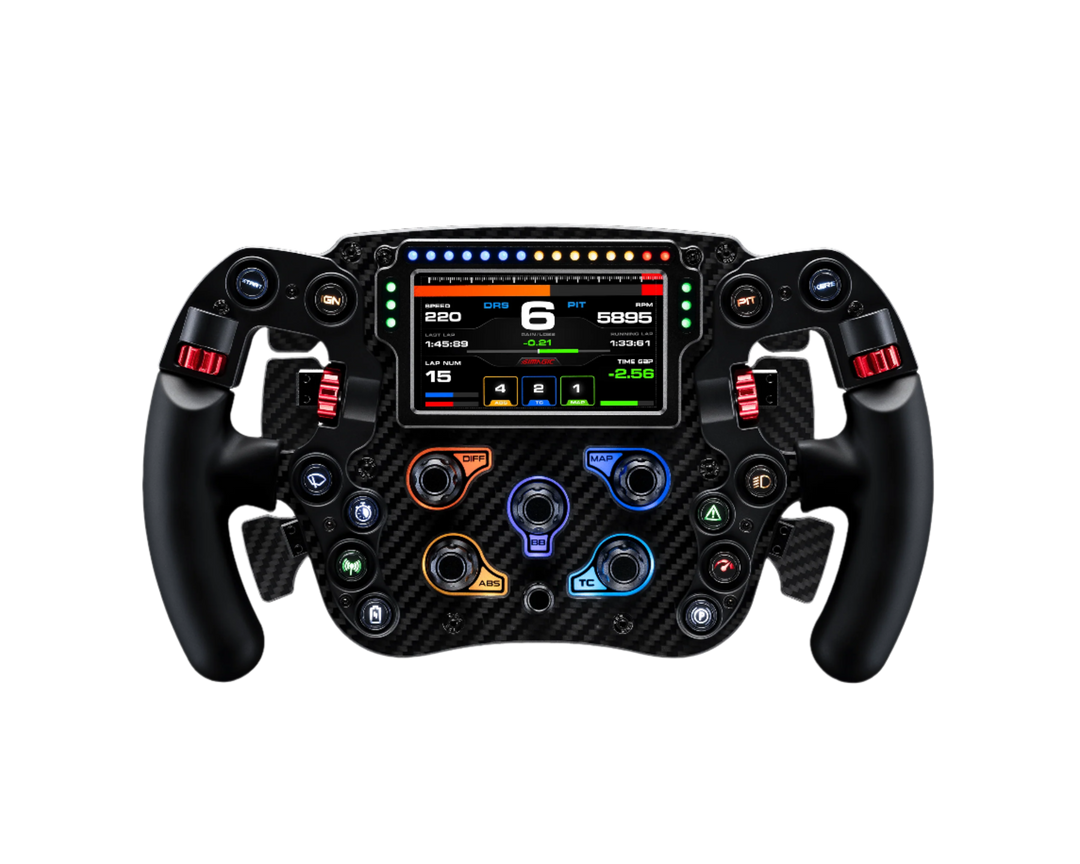
The GT Neo is the one that keeps coming up. It’s a 300mm GT-style wheel – road and circuit racing is what it’s built for – and JACKZER’s view is blunt: “the goat of steering wheels, I don’t care what anyone says.” That kind of language comes up repeatedly from people who’ve actually run one. It’s lightweight, which matters more than the spec sheet suggests: a light wheel on an EVO base shows the FFB at its best, whereas a heavier formula wheel can expose the firmware damping that Danny Lee flagged. The GT Neo and the Alpha EVO are a specifically good pairing, not just a marketing bundle.
We have a full Simagic GT Neo review if you want the detailed breakdown – the short version is that it earns the reputation. One caveat worth flagging honestly, because it has come up more than once: there are reports of the GT Neo’s handles breaking. It is still the value-wheel hero at around $269, and RandomCallsign rates it “probably the best deal in sim racing right now for wheels” – but go in knowing the failure exists, and keep the warranty paperwork.
Beyond the GT Neo, Simagic makes the GT1 (320mm, more budget-oriented) and the FX Pro formula wheel (around €732, aimed at open-wheel racing). The FX Pro is the one with the RGB ring – though as noted, full-face formula wheels block the ring on the Pro base anyway, so it’s more decorative than functional in that combination.
The Zeus Wheel Range – Simagic’s New Flagship
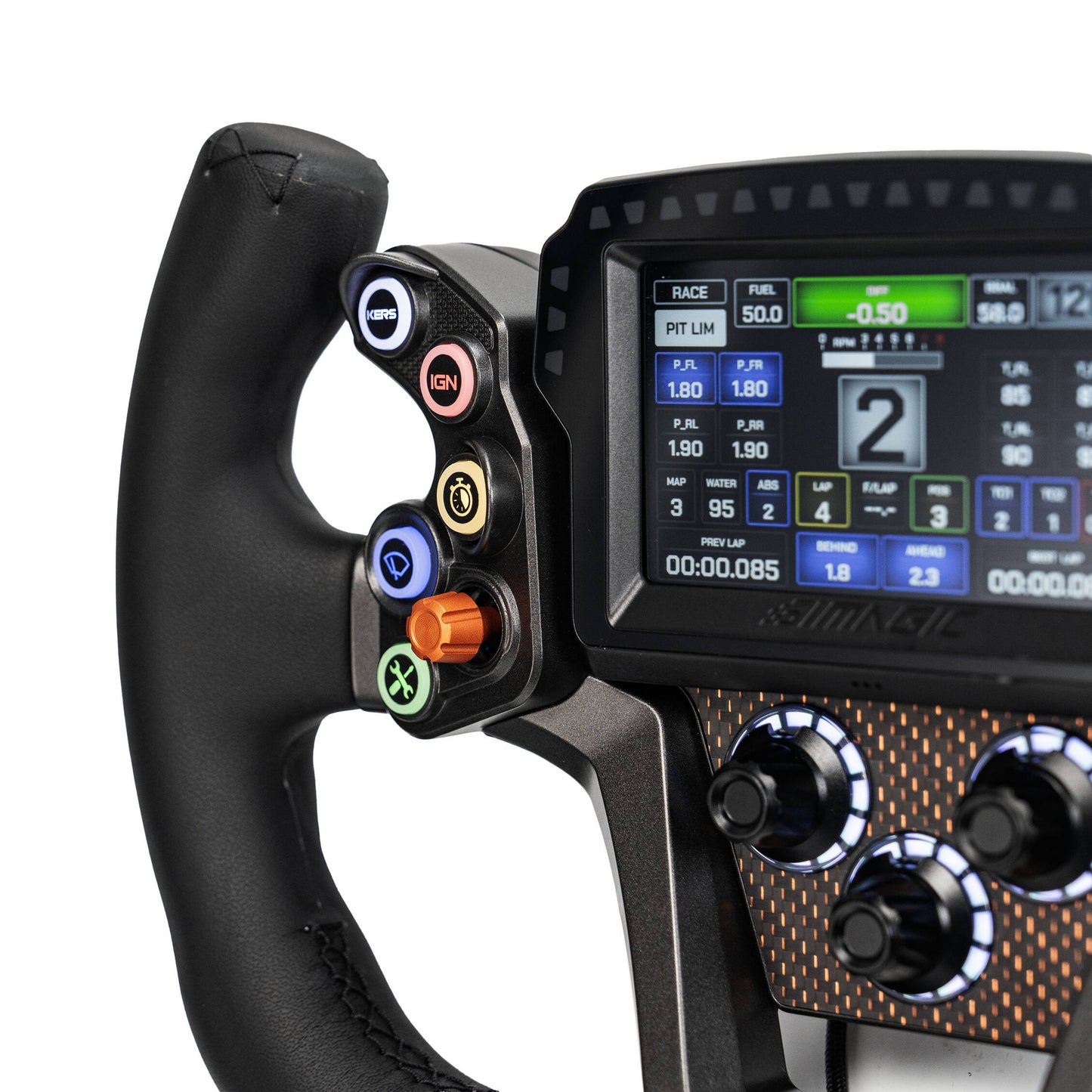
Zeus is the headline launch for 2026 – a modular flagship wheel series in CNC aluminium, carbon and ABS that sits above the GT Neo and FX Pro in the line-up. Pre-orders opened on 22 May, with the official launch set for 10 June 2026, so by the time you read this the range should be shipping. There are three rims, and the clever part is what they share rather than what separates them.
- Zeus Formula (ZF) – the high-end open-wheel rim. Heavy, premium, with carbon-fibre shifter paddles and aluminium clutch paddles. In the unboxing coverage it was the one reviewers most looked forward to, and the one that “needs the screen” to look right.
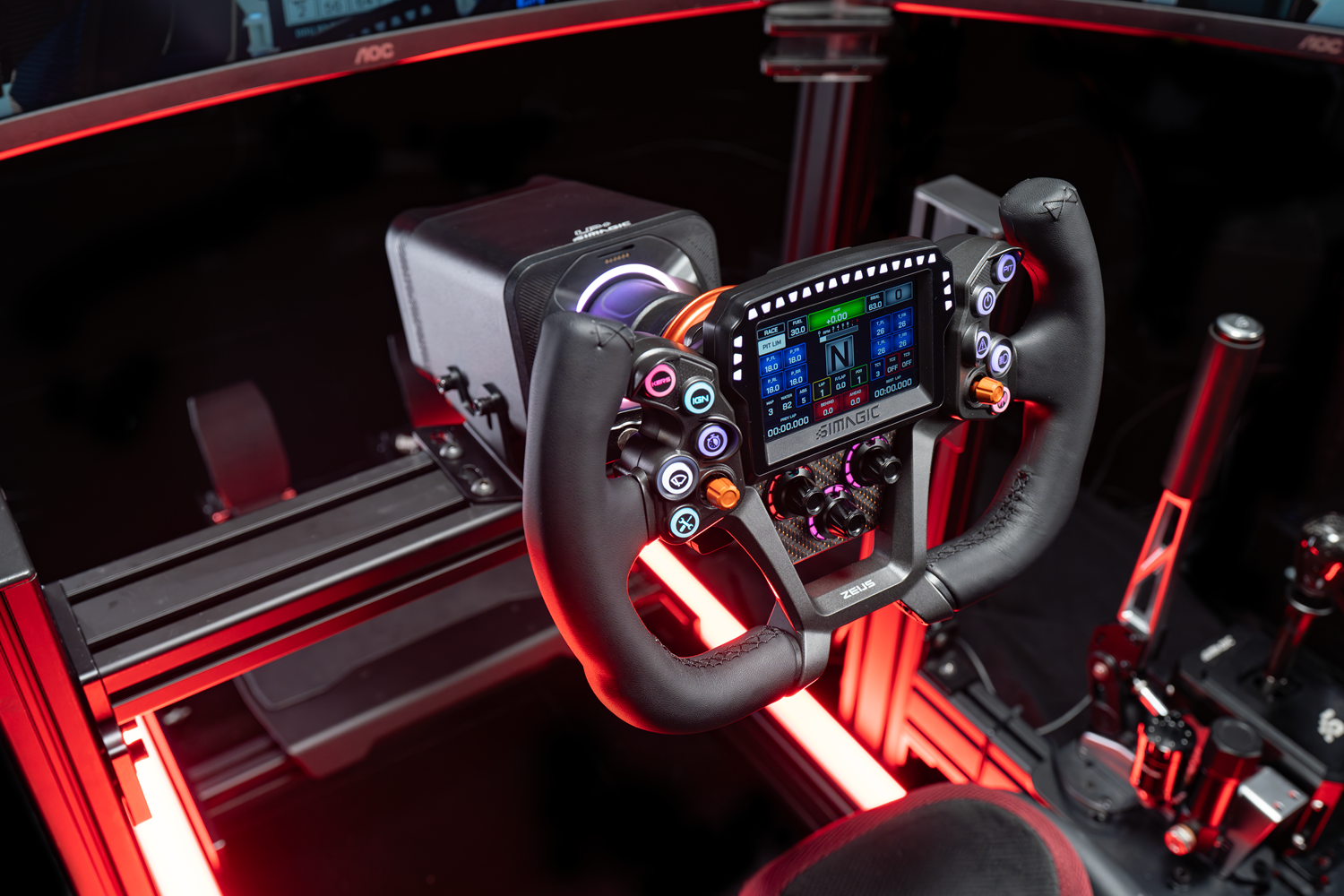
- Zeus GT (ZGT) – the modular hub wheel, with multiple interchangeable rim options (rubber, suede, leather; round, D-shape and cut-off, 300-320mm). Up to nine rim combinations. The best-looking of the three to most eyes, pictured above.
- Zeus Sport (ZS) – the round, versatile rim. Suede top section with rubber grips.
The unifying piece is the MagicDash 4 – a modular telemetry screen that pops off one wheel and clips onto another, or onto the base. One dash, three wheels. It replaces the integrated screen approach of the older FX Pro, and it is genuinely the reason to look at Zeus over the cheaper wheels if you want a dash at all.
The honest caveats before you pre-order
Two things worth knowing that the marketing won’t lead with. First, the shifter paddles on the two hub wheels (Sport and GT) are plastic – the same shifters as the Neo X. On a top-of-the-range wheel that drew fair criticism from reviewers who’d have expected aluminium at this tier; only the Formula gets the metal paddles. Second, and more important for cost: using the MagicDash on an Alpha EVO base requires the AirLink module, and it is mandatory, not optional. That caused real backlash when it was announced, because it adds cost to get the dash working on the base most buyers already own.
The connection story is the other thing to get straight. Zeus talks to the base either over the wireless AirLink protocol or via the wired Maglink Pro – a revised, backwards-compatible replacement for the old Maglink, with a chunky dedicated power supply, aimed at Alpha bases and third-party wheelbases. The important compatibility note: the old Maglink is not compatible with Zeus, so existing owners can’t assume their current cable carries over. Zeus is not yet listed in the apexsimracing catalogue (it is too new), so there’s no live shortcode for it here yet – check the GT Neo and FX Pro entries above if you want a Simagic wheel you can buy today.
Simagic Pedals
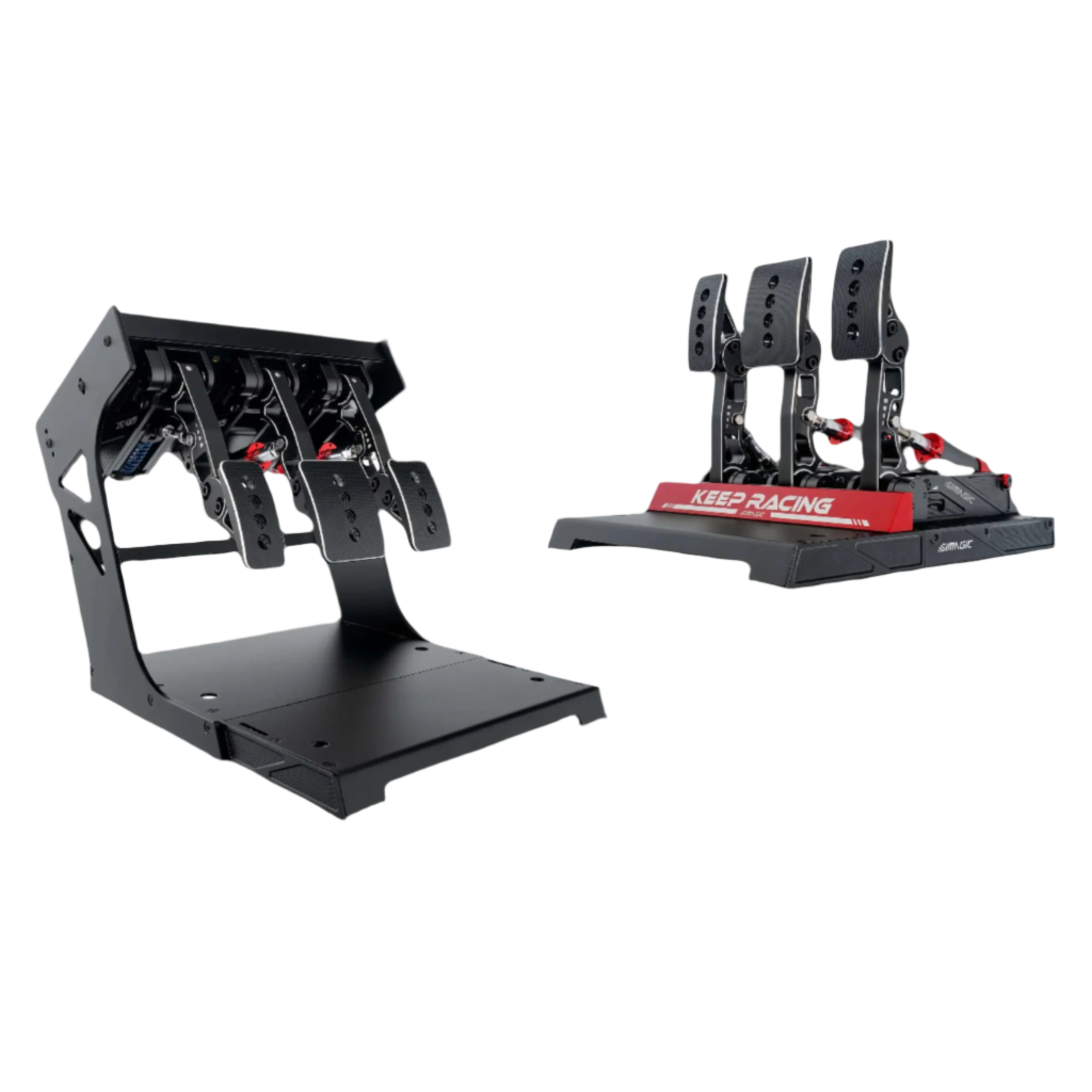
The pedal range is broader than most articles give it credit for. The P1000 is the recommendation to pair with an Alpha EVO base for most buyers, but it’s not the only option worth knowing about – and the haptic accessory and hydraulic flagship are both worth a paragraph in their own right before settling on any pedal set in this price bracket.
P500 (entry load cell, ~$149)
If you’re building a Simagic ecosystem on a tighter budget, the P500 is the entry into proper load cell territory – 100 kg load cell, three-pedal set, around $149. It won’t match the P1000 for adjustability or refinement, but it’s a meaningful step above potentiometer pedals and significantly cheaper than the P1000 jump. Reasonable starting point if pedals are a “next year’s upgrade” line item rather than the centrepiece of the build.
P1000 (modular load cell, ~$469)
Around £420-470 for the three-pedal set, the P1000 is a load cell pedal with hydraulic-feel via a stack of springs and elastomers – swap pieces in and out to tune the bite point and the resistance curve. The performance kit (extra springs and preload options) is essentially mandatory if you want to dial them in properly – Jaxer flagged that as the unwritten rule on the P1000 setup. Plug straight into the wheelbase via Type-C; the P1000i is the inverted-mounting version for rig-mounted setups.
Haptic Pedal Reactor (HPR) – the cheap add-on worth a paragraph
The HPR is a small linear vibration motor that bolts to the back of a P1000 (or a P2000r) for around $49. Driven by SimPro Manager V3 or SimHub via telemetry, it vibrates the pedal face – ABS judder when the brake locks, traction-loss flutter on the throttle. The mechanism is fundamentally different to a Simucube ActivePedal (which uses a servo motor to physically generate the pedal’s resistance and travel from scratch, for around 40x the price), but Jaxer’s framing – “active pedal feeling ABS for $70” – is fair to the user experience side of it. You won’t mistake it for an ActivePedal in engineering terms. You will get noticeably better brake feedback for not much money.
One concrete piece of advice from Jaxer worth passing on: if you race iRacing, buy one HPR and put it on the brake. Don’t bother with the throttle one – iRacing doesn’t model traction control output in a way the throttle reactor can use, and the clutch reactor is overkill for almost everyone. ACC and other sims with richer telemetry get more out of the full set; for iRacing it’s a one-pedal purchase.
P2000r (hydraulic flagship, ~$689)
The P2000r is the proper hydraulic flagship – and it’s a properly different pedal to the P1000, not a pricier variant. Where the P1000 measures braking force via a load cell with springs and elastomers tuning the feel, the P2000r uses CNC-machined master and slave cylinders and measures brake force via a fluid pressure sensor inside the hydraulic line. The brake feels stiffer, smoother, and more linear under heavy loads – closer to a real GT3 or formula brake pedal than to a standard sim pedal. Comparison-wise, it lands in a different camp to the Heusinkveld Sprints (elastomer/spring only, no fluid) and slightly different to the Heusinkveld Ultimate+ (load cell with hydraulic damper rather than fluid pressure measurement). The buyer choice is fundamental: P1000 if you want a tunable modular platform; P2000r if you want true fluid pressure measurement and don’t need to fiddle with the brake’s character once it’s set up.
Other notable pedal pieces in the Simagic range: the P-HTS Hydraulic Throttle System ($139) and P-HYS / P-HYSi Hydraulic Brake systems ($159 / $179) are upgrade kits that retrofit hydraulic feel onto an existing P1000 chassis. The Inversion Kit ($189) is the conversion piece for inverted mounting. None of those are first-purchase items but worth knowing exist if you’re already in the ecosystem.
Accessories – Shifter, Handbrake
The DS-8X is the shifter worth getting. Around £330-350 in the UK – JACKZER described it as the best sequential he’s run, and that view comes up in a few independent reviews of the Simagic ecosystem. I’ve done a full DS-8X review if you want chapter and verse. The TB-1 handbrake sits around £190 and covers the drift and rally crowd, with hydraulic feel options in the range.
SimPro Manager V3
Simagic’s proprietary software. It handles wheelbase calibration, FFB tuning, wheel profiles, button mapping, firmware updates, and RGB. The current version is SimPro Manager V3, and it is a meaningful step on from the SimPro Manager 2 most existing owners will have used. The interface is functional rather than beautiful, but the depth is there – per-game profiles, adjustable damping curves, separate friction and inertia controls.
The headline addition in V3 is native SimHub integration. You can now link the RGB button and encoder backlights on the wheel directly to live car telemetry – ABS activation, DRS availability, flag states – rather than treating the lighting as static decoration. It is the same open-ecosystem thinking behind the D1-spec quick release: Simagic leaning into third-party compatibility rather than walling their hardware off. RandomCallsign, reviewing the EVO Ultra, put the software “top of the line in sim racing with the Asetek ones” – high praise given how good Asetek’s preset manager is. It is more capable than MOZA’s Pit House on the tuning side, if a little less polished to look at.
Worth stating plainly: the hardware and the software are both PC-only. Console support for the EVO series hasn’t been confirmed, and it’s not something Simagic have indicated is coming. PlayStation and Xbox users need to look at Fanatec or Thrustmaster – Simagic is built for PC sim racers and makes no pretence otherwise.
Compare by Investment Level
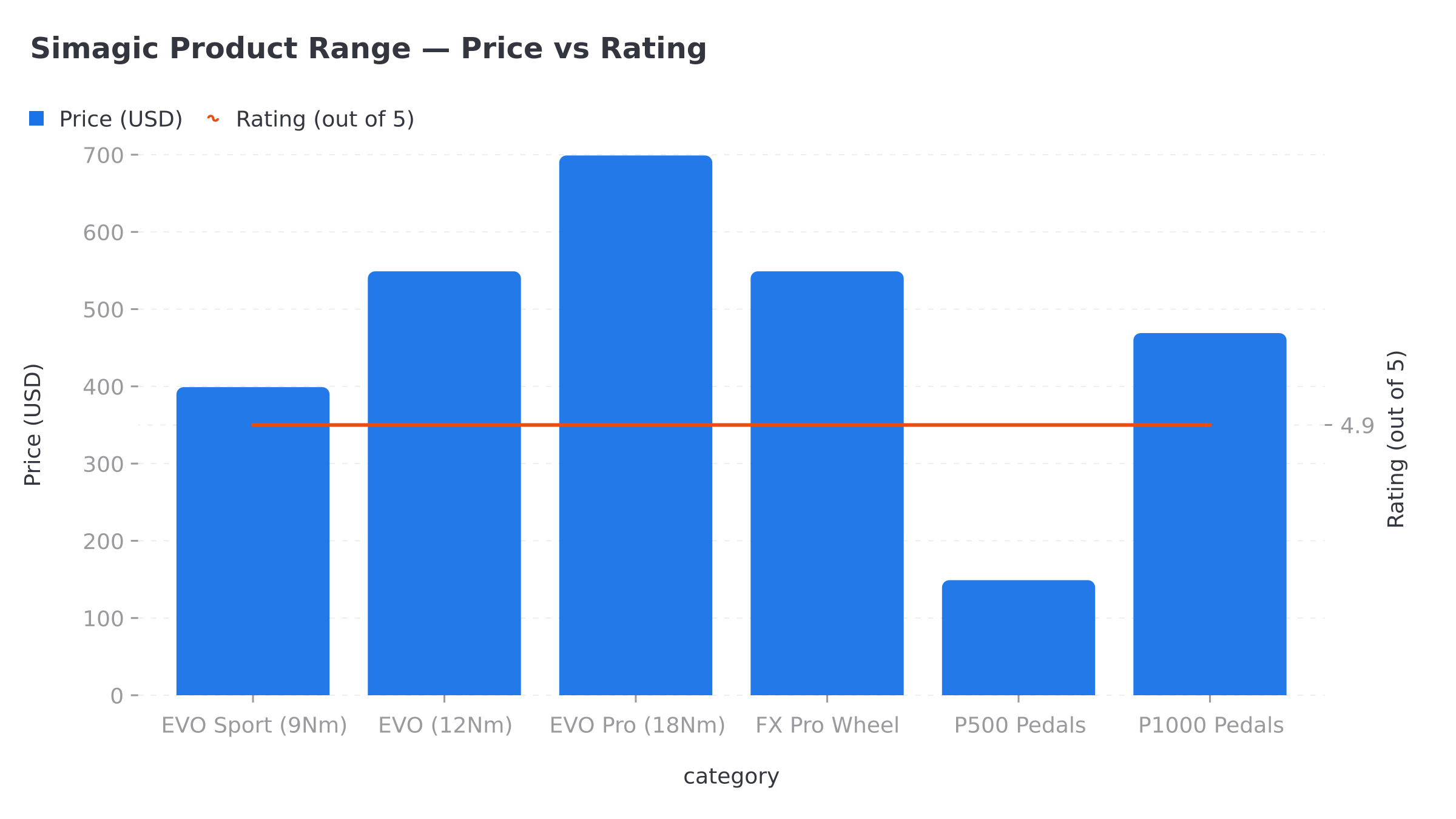
Entry point is the Alpha EVO Sport at around £360, paired with a GT1 wheel and a basic set of pedals. Somewhere between £500 and £600 all-in for a complete PC direct drive setup. The build most buyers end up at is the Alpha EVO Standard (12Nm, ~£480) with the GT Neo (~£200) and the P1000 pedals (~£450). That’s roughly £1,100 all in – a properly serious PC sim racing setup – not beginner money, but the hardware underneath it sits well above what you’d have got for that spend two years ago.
The no-compromise version adds the EVO Pro base (~£731), the P2000 pedals, and the DS-8X shifter – budget £1,500 to £1,800 depending on which wheel you go with. At that spend, you’re in Simucube 2 Sport territory on the wheelbase alone – and that’s a fair comparison to make. The EVO Pro punches at that level from everything I’ve read, with the firmware damping caveat noted above for heavy formula wheel users.
Second-hand Simagic is starting to appear more regularly now, particularly older Alpha series hardware. Worth watching if you want to try the brand without committing to new prices – just be aware the Alpha line isn’t getting the same firmware development as the EVO going forward.
Related Posts
Should Sim Racers Wait for the Pimax Crystal Pro, or Buy Today?
Sim Racing Wheel Stands and Folding Cockpits: Why I’d Skip One, and What to Buy Instead
The Best Direct Drive Sim Racing Bundles (2026)
Best Thrustmaster Wheel and Pedal Mods (2026)
ButtKicker and Tactile Feedback for Sim Racing: The Highest-ROI Upgrade You Shouldn’t Skip (2026 Beginner’s Guide)
Sim Racing Motion Platforms: A Beginner’s Guide to Adding Motion to Your Rig (2026)
Topic: Direct Drive Wheels