
I’m a sim racer and amateur racer with a passion for Motorsport, good racecraft and the technical and setup aspect of sim racing.
Thrustmaster’s range looks bewildering from the outside – dozens of model numbers, most of them old news. In practice only a handful are worth buying in 2026, and they now stretch from a £150 beginner wheel all the way to a proper 10Nm direct drive base. This guide runs through the current line, cheapest to dearest, and tells you which one fits where. Prices and stock are pulled from our affiliate partners and checked regularly.
Quick Navigation
Jump straight to a wheel:
The 2026 range |
T128 (beginner) |
T248 (entry) |
T598 (budget DD) |
T818 (enthusiast) |
T300 / TX (belt) |
Modding an older one |
Which to buy
The Thrustmaster wheel range in 2026
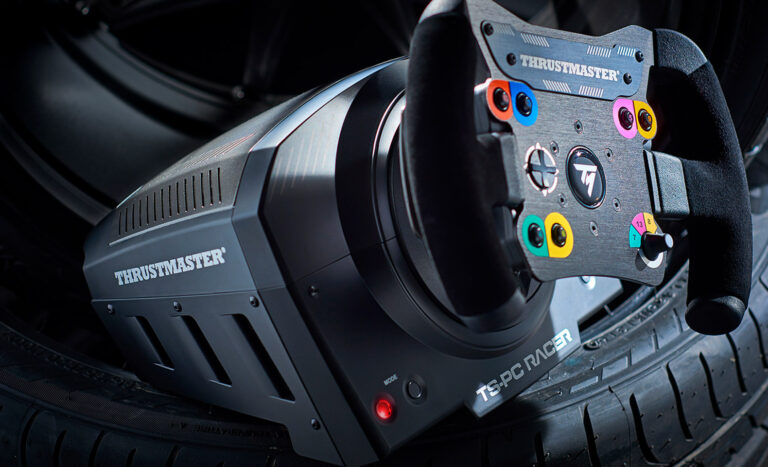
Thrustmaster spent years selling belt-driven wheels while the rest of the market moved to direct drive. That has changed. The T598 brought their own take on direct drive down to a genuinely affordable price, the T818 covers the higher-powered end, and the older belt and hybrid wheels still fill out the budget rungs below. A lot of the classic model numbers – the TS-XW, TS-PC Racer and T-GT II – have been quietly discontinued, so ignore them unless you find one heavily discounted second-hand.
Here is the short version of what is actually on sale, and who each wheel suits.
| Wheel | Drive | Force | Platforms | Price | Best for | Buy |
|---|---|---|---|---|---|---|
| T128 | Hybrid gear/belt | ~2.5 Nm | PS or Xbox + PC | ~£150 | Absolute beginners | Check price |
| T248 | Hybrid gear/belt | ~3.5 Nm | PS or Xbox + PC | ~£270 | Entry-level with a dash screen | Check price |
| T300 RS GT | Belt | ~4 Nm | PS + PC | ~£350 | Belt-drive holdouts | Check price |
| T598 | Direct drive (axial) | 5 Nm | PS or Xbox + PC | ~£450 | Best budget direct drive | Check price |
| T818 Black Edition | Direct drive | 10 Nm | PC (base only) | ~£500 | Enthusiasts, older-rim reuse | Check price |
Thrustmaster T128: the cheapest way in
The T128 is the entry point, and at around £150 with a pedal set included it is one of the cheapest force-feedback wheels worth owning. It uses Thrustmaster’s hybrid drive – a small motor helped along by a belt and gear – which gives you roughly 2.5Nm. That is not a lot of force, but it is enough to feel the front tyres load up and to learn where the grip is, which is really all a first wheel needs to do.
It comes in a PlayStation flavour and an Xbox one, both of which also work on PC, so buy the version that matches your console. The magnetic paddle shifters are a nice touch at this price, and the included pedals are basic but fine for getting started. If your budget is firmly under £200 and you just want to start racing, this is the one.
Thrustmaster T248: the sensible entry-level pick
Step up to the T248 (around £270) and you get more of everything. The hybrid drive is stronger at roughly 3.5Nm, so the wheel pushes back with more authority and the detail through a corner is clearer. The headline feature is the built-in dash screen on the wheel, which shows revs, gear and lap information – genuinely useful once you start caring about consistency rather than just staying on track.
As with the T128 there is a PlayStation and an Xbox version, both PC-compatible. It is the wheel most people should look at if they have decided sim racing is going to stick but they are not ready to spend direct-drive money. The one caveat: once you have felt a direct drive wheel, a hybrid like this starts to feel a little vague, so if you can stretch the budget, read the T598 section before you buy.
Thrustmaster T598: the budget direct-drive one to buy
The T598 is the wheel that makes this whole guide worth writing. It is Thrustmaster’s own direct-drive design – they call it axial drive – and it delivers 5Nm of force straight from the motor, with no belt or gears smoothing the feel away. For around £450 with a wheel and pedals, that puts direct drive within reach of people who would previously have bought a belt wheel and wondered what the fuss was about.
5Nm is modest next to a 10 or 15Nm enthusiast base, but for most sim racers on a desk or a mid-sized rig it is plenty – enough to feel the car move under you without wearing your arms out over a long stint. It comes as a standard PS-and-PC model and a T598-X for Xbox, and there is a base-only T598P if you already have rims and pedals. If you are buying one Thrustmaster wheel in 2026 and you can afford it, this is the one to get.
Thrustmaster T818: the enthusiast base
The T818 is the powerful end of Thrustmaster’s range – a 10Nm direct drive base, sold on its own for around £500 in the current Black Edition. That doubles the force of the T598 and puts it in the same power bracket as the mid-range direct drive wheels from Fanatec, Moza and Simagic. It is PC-first: console support only comes through specific Ferrari-branded bundles, so a pure PlayStation or Xbox racer should look elsewhere.
Where it makes the most sense is if you already own Thrustmaster wheel rims. The T818 takes the older ecosystem rims through a quick-release adapter, so long-time Thrustmaster owners can upgrade the base and keep the wheels they have. Bought as a base alone with no rim, though, it is worth cross-shopping against a Moza R9 or a Fanatec CSL DD before you commit – our direct drive wheels guide lays those out side by side.
Thrustmaster T300 RS GT and TX: the belt-drive holdouts
The T300 RS GT (PlayStation) and the TX (Xbox) are the survivors of Thrustmaster’s belt-drive era. Both give you around 4Nm through a smooth dual-belt system, and for years they were the default recommendation in this bracket. At around £350 with pedals they are still perfectly good wheels, and the belt delivers a fluid, quiet feel that some drivers genuinely prefer to a raw direct drive motor.
The trouble is the T598 now sits close to the same money and gives you real direct drive. So the belt wheels only really make sense if you find one discounted, or if you specifically want that softer belt character. Stock comes and goes as Thrustmaster winds these lines down, so treat them as a here-while-they-last option rather than a long-term buy.
Should you mod an older Thrustmaster instead?
If you already own an older Thrustmaster – a T300, TX or T-GT – you do not necessarily need a new base at all. A big aftermarket scene has grown up around these wheels, with replacement rims, formula-style wheels, quick-release adapters and magnetic shifter upgrades that transform how the old bases feel and look for a fraction of the price of a new wheel. It is often the smarter money if the base itself still works.
That is a whole topic in itself, and we cover it properly in a dedicated Thrustmaster wheel and pedal mods guide rather than cramming it in here. If your base is fine and you just want it to feel better, start there.
Which Thrustmaster wheel should you buy?
For most people the answer is one of three wheels. On a tight budget, the T128 gets you racing for £150. If you want a wheel to grow into with a dash screen, the T248 at around £270 is the sensible middle. And if you can afford it, the T598 is the pick of the range – real direct drive for roughly £450, which not long ago was unthinkable from Thrustmaster.
The T818 is there for enthusiasts and existing Thrustmaster rim owners who want 10Nm, and the belt-driven T300 and TX are worth a look only if you find one cheap. Whichever you land on, pair it with a decent set of pedals and a solid mount – our pedals guide and wider wheels guide cover what goes around the wheel, and if you are weighing Thrustmaster against the other direct drive brands, the direct drive wheels guide is the place to compare.
Related Posts
Sim Racing Wheel Stands and Folding Cockpits: Why I’d Skip One, and What to Buy Instead
The Best Direct Drive Sim Racing Bundles (2026)
Best Thrustmaster Wheel and Pedal Mods (2026)
ButtKicker and Tactile Feedback for Sim Racing: The Highest-ROI Upgrade You Shouldn’t Skip (2026 Beginner’s Guide)
Sim Racing Motion Platforms: A Beginner’s Guide to Adding Motion to Your Rig (2026)
D-Box Sim Racing: The FIA-Supplier Haptic System Explained (2026 Buyer’s Guide)
Topic: Sim Racing Wheels