
I’m a sim racer and amateur racer with a passion for Motorsport, good racecraft and the technical and setup aspect of sim racing.
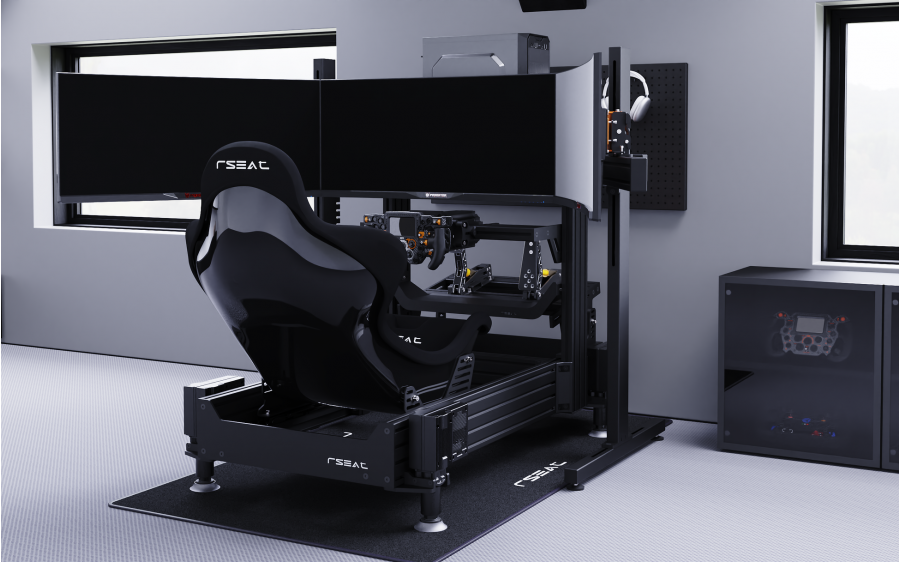
Featured image: Formula Pro Motion Race Simulator (£24,000!)
D-Box sits in a category of its own in sim racing – it isn’t a motion platform in the conventional sense and it isn’t a tactile transducer either. It’s a haptic actuator system that combines large-scale chassis movement with high-frequency vibration in a single unit, with the whole library of car-and-track effects pre-coded against thousands of real-world references rather than generated on the fly from generic telemetry curves. That distinction is the entire reason the FIA picked them as the exclusive official supplier of haptic systems for sanctioned motorsport esports, and it’s the reason a serious sim racer’s question about D-Box is rarely “is it good enough” and almost always “is it the right next purchase for me specifically”.
This guide walks through what D-Box is, what the GEN 5 architecture delivers, how the 3250i and 4250i kits differ in real driving terms, what you need to install one properly, and the honest comparison against pure motion platforms like Qubic System and DOF Reality.

Quick Navigation
Jump directly to what you’re looking for:
What D-Box is |
The FIA partnership and what it means for you |
The GEN 5 architecture |
Pre-coded haptics vs telemetry-driven motion |
3250i vs 4250i – the decision |
Setup reality |
D-Box vs Qubic vs DOF Reality |
Should you buy D-Box? |
Where to buy
What D-Box is
D-Box is a Canadian haptic-system manufacturer (head office in Longueuil, Quebec) that has been building actuator-driven motion-and-haptic systems since the early 2000s. Their products started out in cinemas – the D-Box motion seats you’ve sat in for an action film at certain Showcase or VOX chains are powered by the same actuator technology – and migrated into sim racing as the consumer rig market matured. The current product family for sim racing is the G5 system, a step up from the earlier G3 actuators (there was no G4 – D-Box skipped that number), and it’s the lineup you’ll be quoted on if you buy today.
The thing to understand about D-Box that doesn’t apply to other motion brands is that each actuator is doing two jobs simultaneously. Yes, it’s lifting and tilting the rig through pitch, roll and heave in the same way a Qubic QS-220 or DOF Reality H3 would. It’s also vibrating – delivering high-frequency haptic detail at the same time as the large-scale movement, through the same single unit. The actuators have 1.5 inches of physical stroke per the manufacturer’s own technical page, and they’re rated for 250 lbs (114 kg) of load per corner, so a four-actuator install will comfortably handle the heaviest aluminium-profile rig with a heavy driver in it. The plug-and-play side is real – these are sealed units that connect to a control box and a piece of D-Box software, not actuators you bolt to an arbitrary motion controller.
What that combined haptic-plus-motion architecture means in practice is that you feel more event-resolution per millimetre of physical movement than a pure motion platform delivers. A kerb strike through a Qubic comes as the rig heaving and pitching to indicate the impact; a kerb strike through a D-Box comes as the rig heaving and pitching AND vibrating at the specific frequency of that kerb’s textured edge, all from the same actuator at the same instant. The two are not strictly comparable because D-Box is doing two things and the others are doing one. Whether the second thing is worth the price premium is the actual decision this guide exists to help with.

The FIA partnership and what it means for you
The line that gets repeated everywhere about D-Box is that they’re the FIA’s exclusive official supplier of haptic systems. That’s documented straight from D-Box’s own certifications page, from the original FIA endorsement announcement, and from the later renewal coverage at Auganix. D-Box became the first haptic system to obtain FIA endorsement, then renewed the partnership. The status is exclusive – no other haptic system carries the FIA-licensed label – and it covers the sanctioned esports championship circuit specifically.
What this means as a buyer matters less than the marketing makes it sound. It does mean the system is being maintained against a long-term standard, which has implications for software support, telemetry integration with FIA-affiliated sims, and (if you ever do compete in sanctioned-tier esports) consistency with the rigs the events are running. It does not mean D-Box is “the best” in some absolute sense, because best-in-class for a home sim racer’s day-to-day experience is a different question to best-in-class for a championship-event standardised platform. The FIA chose D-Box for the standardisation reasons, not because they comparison-tested every consumer motion product and ranked them.
That FIA endorsement is a credibility signal that the engineering is taken seriously by the people who run real motorsport, and a long-term-support signal that the platform isn’t going to be discontinued in three years. It is not, on its own, a reason to choose D-Box over Qubic or any other premium-tier system. The reasons to choose D-Box are about what the haptic-plus-motion architecture delivers in your living room, not about which logo is on the spec sheet.
The GEN 5 architecture, in plain English
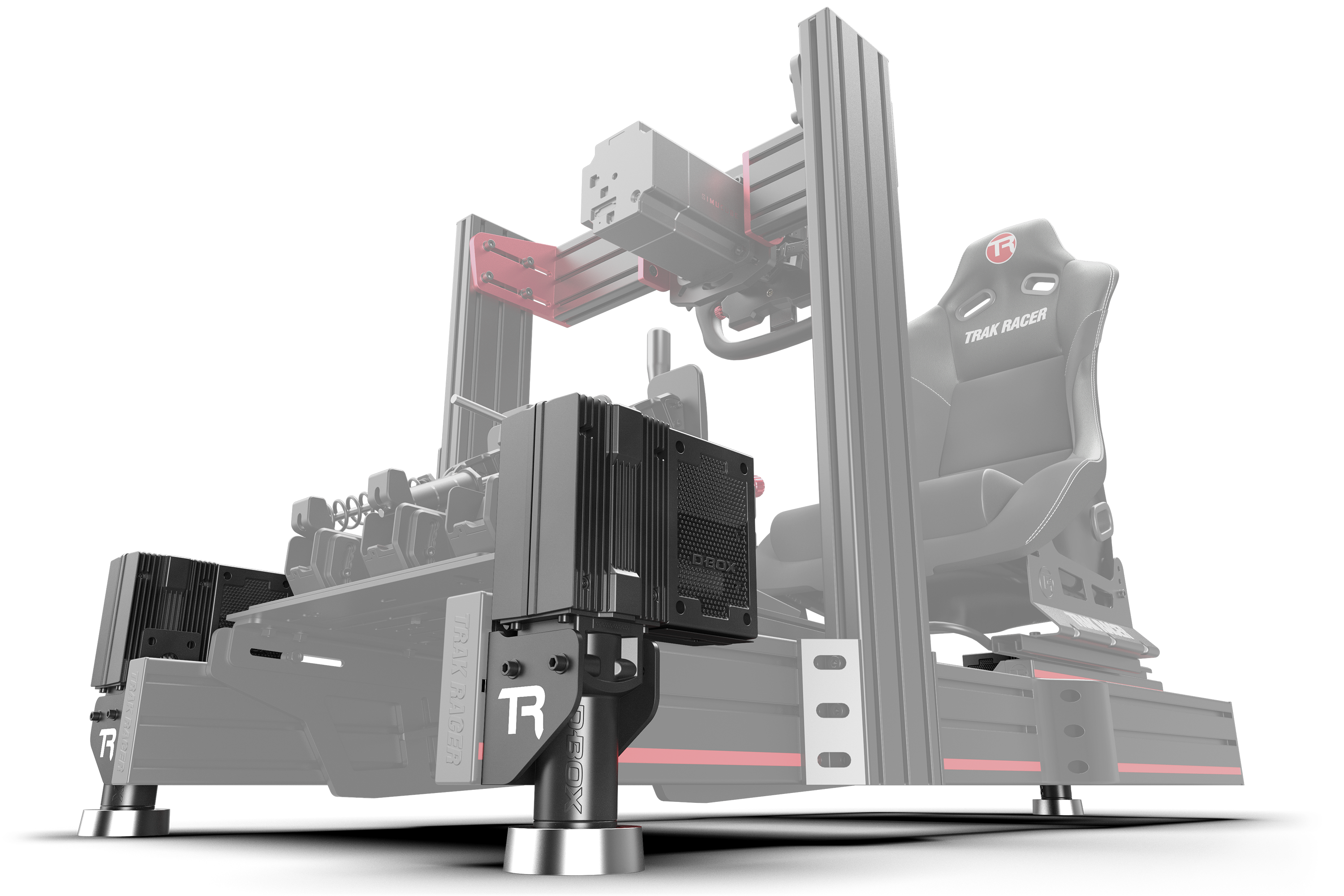
The G5 actuator is the current generation of D-Box’s home-and-prosumer hardware, a step up from the G3 that was the previous reference (there’s no G4 in the lineage – D-Box skipped that number). The headline architecture: each actuator is a sealed linear unit with 1.5 inches of vertical stroke, rated for 250 lbs of load at the corner. The system is described by D-Box as silent (their own marketing language, and reviewer reports broadly support this – quieter than the entry-tier consumer platforms by a clear margin, though not literally silent). Each actuator connects to a central control box, the control box connects to a PC via USB, and the PC runs D-Box’s own software to play the pre-coded effects.

The model numbers – 3250i and 4250i – are about actuator count, not stroke length. The 3250i kit ships with three actuators (a tripod configuration, usually two at the front and one at the rear, or vice versa). The 4250i kit ships with four actuators in a conventional four-corner layout. The “250” appears to be an internal product-code reference rather than a stroke length, and the lowercase “i” is consistent across the range. Both kits use the same 1.5-inch-stroke actuator unit – what changes between them is how many of them you have and the resulting motion geometry. Three actuators give you a lighter-weight install with simpler power requirements; four actuators give you a more uniform motion envelope and the proper independent corner control that the high-fidelity install depends on.
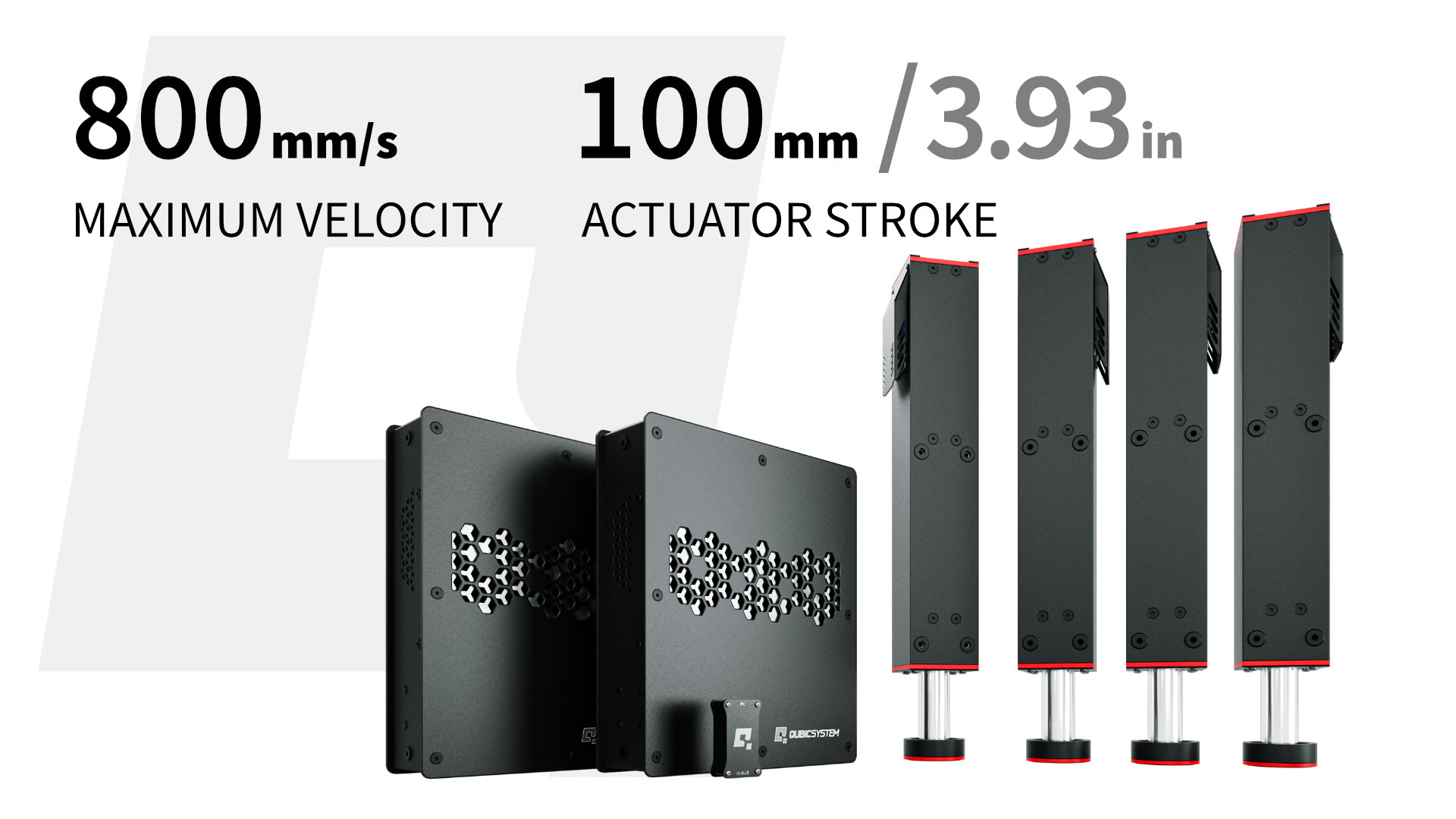
The published payload numbers from Trak Racer’s spec sheets are worth pinning down because they decide whether your rig and your body weight are in spec. The system holds 460kg / 1,012 lbs in full 4-actuator configuration, 345kg / 759 lbs in 3-actuator configuration, and 130kg / 286 lbs in 2-actuator configuration. Max actuator velocity is 100 mm/s and max acceleration is 1G – those are the numbers that limit how aggressive the motion can be, not the static loading. For most home rigs with one driver in them, all three configurations have more than enough headroom.
Pre-coded haptics vs telemetry-driven motion
A pure motion platform – Qubic QS-220, DOF Reality H3, NLR Motion Plus – reads telemetry from the sim (suspension travel, yaw rate, G-forces) and translates those numbers into actuator commands using a generic effects engine. The same telemetry curve produces broadly the same actuator response across every car and every track. It’s clever, it works, and it scales gracefully to new sims because the bridge software (SimHub, Sim Racing Studio) doesn’t need to know anything specific about the car you’re driving.
D-Box does something architecturally different. Their library is pre-coded against specific car-and-track combinations – thousands of them, built up over years of recording reference data from real vehicles and real circuits. When you drive the Porsche 911 GT3 R at Spa in iRacing on a D-Box rig, the system isn’t running a generic “GT3 car on a fast circuit” effects curve. It’s running the specific D-Box profile for that car at that track, with the kerb impacts at Eau Rouge keyed to the actual kerb geometry, the surface texture changes through Pouhon mapped to the actual track surface, the suspension behaviour through Stavelot tuned to what that specific car does on that specific corner.
The result you feel is a level of event-resolution that telemetry-driven platforms genuinely cannot match. The flip side: anything that isn’t in the D-Box library doesn’t get the same treatment. New cars, new tracks, modded content, and lesser-supported sims all run a generic profile until D-Box catches up. For iRacing, AC, ACC, F1, and the other top-tier titles, the library is deep and mature. For Le Mans Ultimate (still expanding) or Assetto Corsa Evo (still in early access), library coverage is patchier and you’ll hit the generic profile more often. The decision shape is: if your sim diet is mainly the established titles, the pre-coded library is a genuine perceptual advantage. If you’re chasing the newest releases or running heavy mods, the difference narrows.

3250i vs 4250i – the decision
The choice between the three-actuator 3250i and the four-actuator 4250i is the most common D-Box buying question, and the honest answer depends on three things: how independent you want the corner movements to feel, how much weight is on the rig, and how much you’re prepared to spend. The 3250i runs at $4,489.99 for the full kit with brackets through Trak Racer; the 4250i runs at $5,990. The ~$1,500 gap is what one extra actuator and the additional control-box capacity costs. If you ever want to expand a 3-actuator install to four, single D-Box GEN 5 actuators are available standalone at $1,499 each.
The three-actuator configuration delivers convincing pitch and roll. It can’t deliver the same fully-independent corner-by-corner motion that four actuators do, which means certain effects – the specific feel of a single rear wheel going light over a kerb, the diagonal weight-transfer pattern through a tight chicane – read as more averaged than they would on a 4250i. For most sim racers who race GT and prototype cars on standard circuits, the 3250i is enough to deliver a transformative experience and the savings are real. For drivers who race Formula cars with very high-frequency suspension behaviour, or for anyone who has the budget headroom and wants the cleanest possible motion envelope, the 4250i is the technically correct answer.
The community pattern – drawn from the long threads on r/simracing is that owners who started with the 3250i are mostly happy and don’t feel they’re missing something; owners who started with the 4250i are mostly happy and feel they made the right call. Almost nobody upgrades from 3250i to 4250i mid-life; once you’ve installed and tuned a kit, the swap-up isn’t usually worth the disruption. Buy the right one the first time. If your budget is tight enough that the difference matters, the 3250i is the sensible buy. If the difference is irrelevant to you, the 4250i is the cleaner answer.
Setup reality
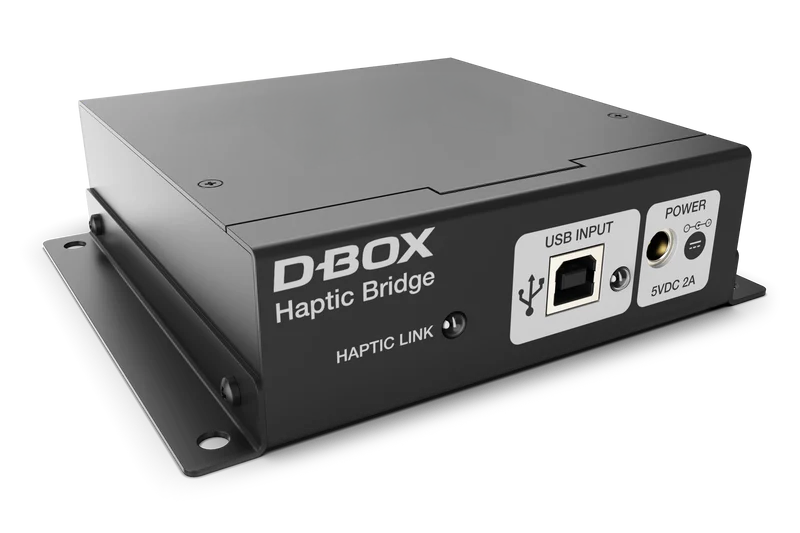
D-Box’s plug-and-play branding is real but conditional. The actuators themselves are sealed units that connect to the control box and the control box connects to your PC via a single USB – the wiring is genuinely simple compared to a Qubic or DOF Reality install. What you do need to organise is the structural side. D-Box actuators mount at the corners of an existing aluminium-profile cockpit (40x80mm or 40x160mm profile, the stiff stuff). They will not work on a tubular steel rig or a folding cockpit – the actuators will twist the chassis instead of moving the driver, and the entire haptic resolution that justifies the price will be lost to chassis flex.
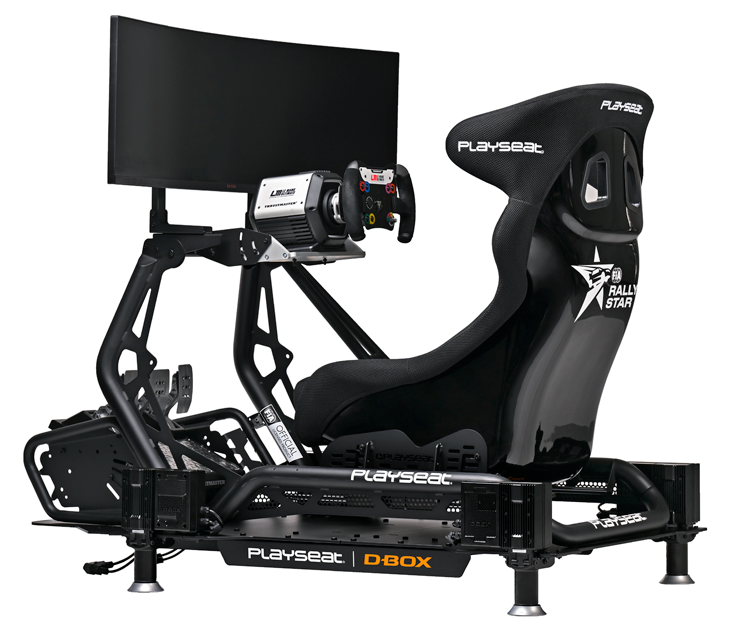
The two clean integration routes in the UK and US are through Trak Racer and through Playseat. Trak Racer’s TR Move platform is the heavy-duty integration kit specifically designed to accept D-Box GEN 5 actuators under their aluminium-profile cockpits – the TR8 Pro, TR40S, TR80S, TR120S and TR160 V5 all support the Move + D-Box stack out of the box. Their bundles run from around $4,989 (3-actuator system on a Move base) to $6,520 (TR160 V5 racing simulator with the full 4250i kit included). Playseat’s D-Box bundle is the alternative for people who prefer Playseat’s frame aesthetic – the integration is less customisable but the install is genuinely faster.
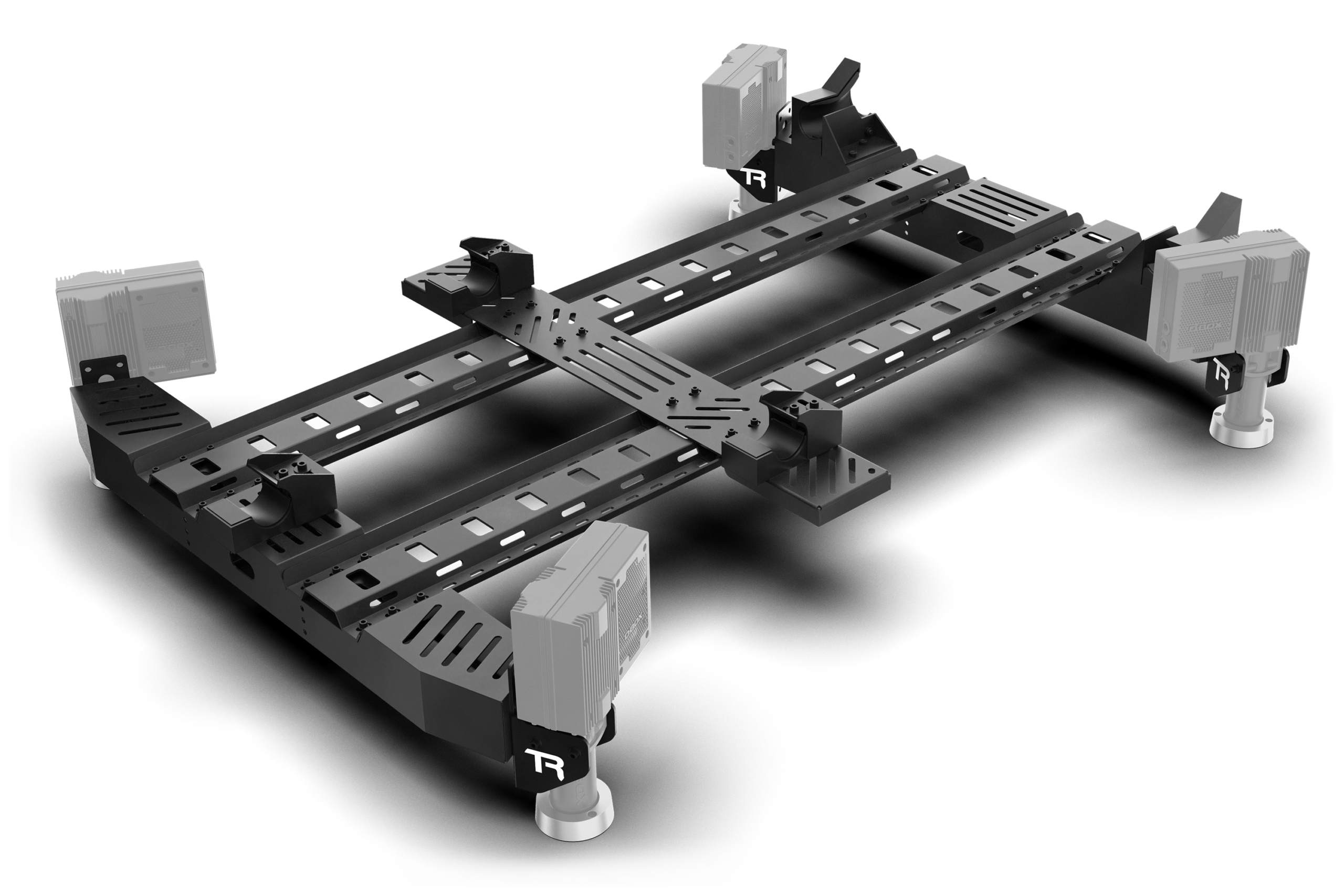
The other practical realities. Actuators raise the rig 10-15cm off the ground, which puts your monitors and triples out of alignment if they’re freestanding (Trak Racer rigs with integrated monitor stands solve this; freestanding setups need to be re-levelled). Power draw is real – four servo-driven actuators in a sim rig with a high-end PC and triples is the kind of load that can trip a UK 13-amp ring main if everything shares one socket. Noise is the lowest in the consumer-tier motion category but it isn’t zero, particularly under hard cornering when multiple actuators are moving simultaneously. For shared-wall flats this is the realistic limiting factor on D-Box ownership, the same as it is for any motion system.
D-Box vs Qubic vs DOF Reality – the honest comparison
The three credible options at the £5,000-£8,000 mid-to-upper-mid tier are D-Box (GEN 5 3250i around £4,500-£5,500 in the UK depending on integration), Qubic System (QS-220 3DOF set around €4,615 / £4,000 for the intro, €8,880 / £7,500 for the full 3DOF), and DOF Reality (H6 6DOF in the same general band depending on configuration). All three deliver convincing motion. They differ in what they’re best at, and the honest buying question is which of those bests matches what you specifically want.
| What you want | Pick | Why |
|---|---|---|
| Maximum event-resolution per pound, established sims (iRacing, AC, ACC, F1) | D-Box GEN 5 | Pre-coded library delivers car-and-track-specific haptics that telemetry-driven platforms can’t match. |
| Modular upgradability and the lowest published actuator latency | Qubic System QS-220 | 8ms latency (interactive demo on their product page), 2DOF intro that upgrades to 3DOF with another actuator pair. EU-engineered with EMC-shielded brass connectors. |
| Full 6DOF including surge, sway and yaw at the lowest entry price | DOF Reality H6 | Only consumer-tier product that does all six axes in a single kit. Tubular frame trades some rigidity for affordability. |
| FIA-aligned long-term-support guarantee | D-Box GEN 5 | Exclusive haptic supplier to the FIA’s sanctioned esports championship circuit. Software maintained against a published standard. |
| Easiest install on an existing aluminium-profile rig | D-Box (via Trak Racer Move) | Trak Racer Move bracketing is purpose-built for D-Box GEN 5 mounting. The single-USB control box keeps wiring trivial. |
| Heaviest cars and warbird sims with high-G sustained loading | Qubic System | 350 kg max payload (highest in the comparison) and the industrial-grade actuator construction comfortably handles the heaviest rigs. |
The pattern that emerges from talking to people who’ve owned more than one: D-Box wins for sim racers who race the established titles and value the detail of the pre-coded effects; Qubic wins for sim racers who value the engineering specifics (latency, build, EU manufacturing) and want a clear upgrade path; DOF Reality wins for sim racers who want the full 6DOF experience at the lowest possible entry. None of them is the wrong choice for the right buyer. The question that decides it is what you race and what you value, not which has the higher headline torque or stroke number.
Should you buy D-Box?
The same honest filter applies to D-Box that applies to any premium motion purchase. You shouldn’t buy D-Box if you don’t already have a stiff aluminium-profile cockpit (the haptic detail will be absorbed by chassis flex); if you race two hours a week or less (the cost-per-hour doesn’t pencil); if you’re in a shared-wall flat where the noise will end the relationship with your neighbours; or if you haven’t yet upgraded to load-cell pedals, a direct drive wheel, and triples or VR (the upgrade ladder consensus has motion as the last step, not the first). You also shouldn’t buy D-Box if your sim diet is dominated by new releases or modded content where the pre-coded haptic library is thin – in that case Qubic or DOF Reality’s telemetry-driven approach scales more gracefully to whatever you’re playing.
You should buy D-Box if: you race the established titles (iRacing, AC, ACC, F1, the major ones) regularly enough that the pre-coded library delivers a genuine perceptual advantage; you’ve got a Trak Racer or similar stiff aluminium-profile cockpit ready to take the actuators; you’ve worked up the upgrade ladder properly and motion is genuinely the next sensible step; you’ve got the budget to do it right (3250i at minimum, 4250i if you can stretch); and the FIA-licensed credibility and long-term software support matter to you as a values position, not just as a marketing point. If all those apply, D-Box delivers the highest haptic-detail-per-pound in the prosumer motion category, full stop.
The positioning for the £5,000+ tier of any motion system, D-Box included: nobody at this price point is buying motion to win championships. The lap-time evidence on motion is well-documented (motion does not make you faster, see the main motion platforms hub for the longer treatment). The reason to buy D-Box specifically is that the haptic-plus-motion architecture delivers a richer felt experience of driving the cars and tracks you already love. That’s a legitimate reason. It is not the reason the marketing leads with, and being clear about which reason applies to you will save you the wrong-product disappointment.
Where to buy
D-Box sells through distributors rather than direct-to-consumer. The cleanest UK and international consumer routes in 2026 are two: Trak Racer’s D-Box lineup (the GEN 5 3250i 3-actuator kit at $4,489.99 and the GEN 5 4250i 4-actuator kit at $5,990, both bundled with Carbon Steel mounting brackets for direct aluminium-profile install) and the Playseat D-Box bundles (Playseat-branded cockpit integration, less customisable than Trak Racer but a faster install). Apex Sim Racing also stocks the 4250i system as an alternative US/Canadian route.
For direct technical questions or commercial conversations (review unit, partnership, sales enquiry), D-Box’s Sales contact route is the right starting point. Head office is in Longueuil, Quebec (+1 450 442-3003, Mon-Fri 9-5 Eastern); they have additional offices in Los Angeles and Beijing for region-specific enquiries. The actuators ship globally through the distributor network rather than being warehoused locally in every market – lead times vary depending on which distributor you’re working through and what configuration you’re ordering.
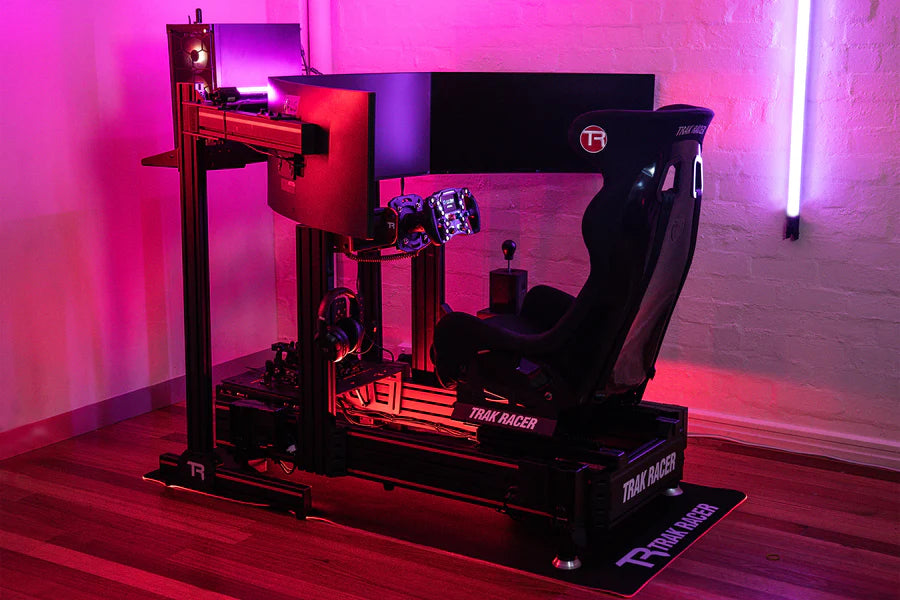
If you’re starting from scratch and want a single sensible recommendation: the Trak Racer TR160 V5 + D-Box GEN 5 4250i bundle at around $6,520 is the cleanest “this is my serious motion rig” buy. The TR160 V5 is properly stiff, the Move integration is purpose-engineered for the D-Box actuators, and the bundle pricing is competitive against assembling the components separately. The 3-actuator equivalent (Trak Racer Move base + D-Box GEN 5 3250i) at around $4,989 is the budget-conscious version of the same thinking. Below that, you’re better off in the Qubic QS-220 2DOF intro tier or the DOF Reality H3 – those are credible 3DOF motion at lower entry, just without the D-Box haptic library to back them up.
Sister content and where to read next
Next head to the main hub on sim racing motion platforms covers the full chassis-moving category – DOF Reality, Next Level Racing Motion Plus, Qubic System QS-220, SimXperience and the rest – the comparison context for D-Box specifically and the right starting point if you’re new to physical feedback in sim racing. The companion piece on ButtKicker and tactile feedback covers the £150-£500 entry that almost every motion-rig owner says is the highest-ROI sim racing upgrade – read it before you spend at the D-Box tier, because tactile is the foundation D-Box’s haptic detail rides on. The three hubs together cover the complete physical-feedback picture in sim racing.
For the wider upgrade ladder, the SimRacingCockpit hubs on direct drive wheels, sim racing pedals, VR headsets and sim racing cockpits cover the upgrades that consensus puts above motion in the priority order. D-Box is a great purchase when the rest of the rig is ready for it. It’s a poor purchase when it isn’t.

The Best Rally Games in 2026

The Best PS5 Racing Games in 2026
The Best VR Flight Games and Sims
Best Pimax VR Settings for F1 25 in 2026: A Damage-Control Guide
Best Pimax VR Settings for Le Mans Ultimate in 2026
Best Pimax VR Settings for Automobilista 2 in 2026
Topic: Sim Racing Motion Platform