
I’m a sim racer and amateur racer with a passion for Motorsport, good racecraft and the technical and setup aspect of sim racing.
Corsair is an interesting one. They’re not a sim racing company in the traditional sense – they make gaming PCs, monitors, and peripherals. But, when they acquired Fanatec back in September 2024, the company became the only company on the planet that can manufacture everything from the cockpit frame to the wheelbase to the gaming PC that runs it. Whether you’re looking at a direct drive wheelbase, a new monitor setup, or a full sim rig build, Corsair now touches every part of the chain – and to be fair they’ve kind of slipped into the space by stealth.
Today’s guide lifts the lid on the Corsair ecosystem specifically. We’re looking at the gaming PCs, monitors, and the sim racing cockpit they announced at Gamescom 2024 and have been shipping since. For Fanatec hardware (wheelbases, pedals, steering wheels), check the Fanatec buyer’s guide separately. The two brands operate independently, but the complementary overlap is worth understanding. Case in point: the Stream Deck manufacturer, Elgato, is owned by Corsair – and there’s now a Stream Deck profile specifically built for Fanatec cockpits.
Anyway – shall we?
Quick Navigation
Jump directly to what you’re looking for:
Why Corsair? |
The Sim Racing Cockpit |
Gaming PCs for Sim Racing |
Monitors for Your Sim Rig |
The Fanatec Connection |
Building a Complete Corsair Setup
Below I’ll walk through what Corsair offers for sim racers right now, what’s coming, and where the ecosystem makes sense as a whole. I’ll also cover the cockpit they’ve built, because it’s a properly interesting piece of kit that deserves a closer look.
Why Corsair?
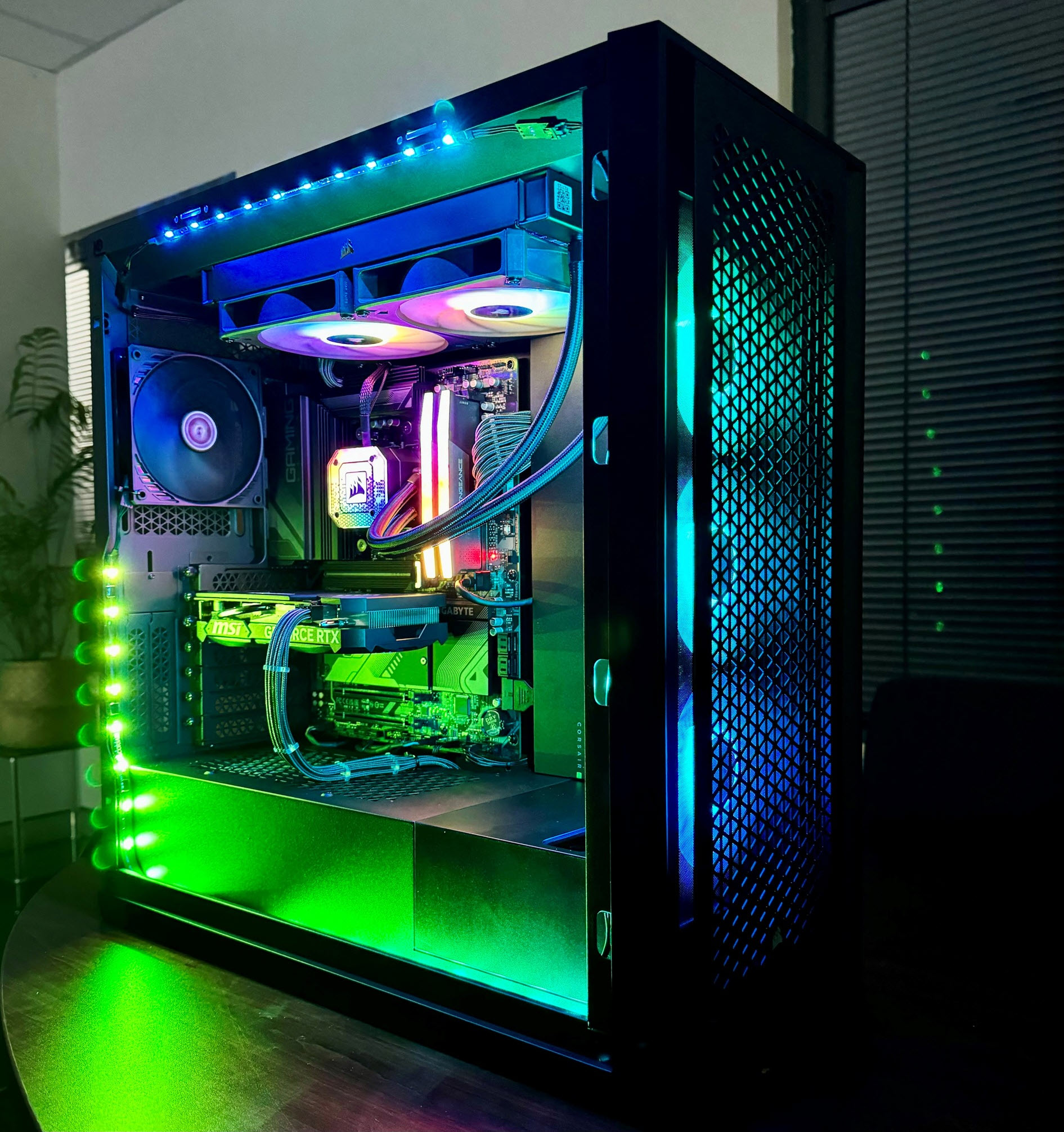
Corsair has been making gaming hardware since 1994. RAM, PSUs, cases, keyboards – the bread and butter of PC gaming. They know how to build systems that run reliably under a sustained load, critical for sim racing. A three-hour endurance race on triple 4K screens is a proper stress test for any PC, and Corsair’s VENGEANCE desktops are built for exactly that kind of sustained workload.
The sim racing play is newer. The cockpit was announced at Gamescom 2024, designed by Mark Puck (known in the community as “Aussie Stig”). Then the Fanatec acquisition landed a month later. Suddenly Corsair went from “PC company dipping into sim racing” to “the only brand that can sell you a complete rig top to bottom.” That’s PCs, monitors, cockpit, wheelbases, pedals, steering wheels, and even Elgato streaming gear for your sim racing content.
What the Community Thinks
From what I’ve read across forums and YouTube reviews, the reaction has been cautiously positive. The cockpit impressed people at Gamescom – GamerMuscle called the build quality “genuinely impressive” and noted zero flex at 27Nm of torque. The OverTake_gg crew confirmed it felt stable with no vibration. The main concern? Whether Corsair will support the sim racing community long-term or treat it as a side project. The Fanatec acquisition answered that question fairly decisively.
If you’re already invested in the Corsair ecosystem for your PC – iCUE lighting, VENGEANCE RAM, Corsair case – then adding their sim racing gear creates a genuinely cohesive setup. If you’re coming from a Simucube or Moza background, the hardware story is less compelling, but the PC and monitor side absolutely stands on its own.
The Corsair Sim Racing Cockpit
This is the product that got the sim racing community paying attention. A steel cockpit from a major brand, priced to compete with aluminium profile rigs. It’s now shipping – though availability has been staggered rather than a clean global launch – and it’s worth covering in detail because it’s a central part of the Corsair sim racing story.
Build and Design
The cockpit uses 50mm steel tubing throughout – not aluminium extrusion profiles. Mark Puck designed it around a triangle construction principle, which is how you get lateral rigidity without the weight of solid plate steel. It handles wheelbases up to 27Nm without any reported flex or vibration. That’s enough for a Simucube 2 Pro or a Fanatec Podium DD – basically anything short of the absolute top-tier industrial bases.
The toolless adjustment system uses lever handles throughout. Pedal distance, seat position, steering column angle – all adjustable without reaching for an Allen key. It fits drivers from 5’0″ to 6’6″, which covers virtually everyone.
What’s Included and What’s Optional
The base frame comes with an onboard 100mm VESA mount for a single monitor from 27″ up to a 49″ ultrawide. That’s your starting point. From there, the accessory list gets interesting.
- Two-piece racing bucket seat (optional, or bring your own with standard 290mm bolt pattern)
- Direct drive wheelbase front mount
- Inverted pedal mount system
- Front-mounted PC/console tray
- Shifter and handbrake accessory mounts
- Built-in cable management channels
- T-slot compatible channels for custom mounting
- Elgato product compatibility (Stream Deck, Key Light, Facecam)
The monitor stand is a separate purchase. It supports triple screens from 27″ to 55″ with a fourth overhead monitor simultaneously. Worth noting – the stand is freestanding, which means it’s not attached to the cockpit frame. That’s quite a good design choice because it eliminates vibration transfer from the wheelbase to your monitors.
Pricing
The frame comes in at $799 on its own, $999 with the two-piece seat. The triple monitor stand is a separate purchase in the $400-500 range. That puts it squarely in the mid-range – more expensive than a basic Playseat or GT Omega, but competitive with aluminium profile rigs from Sim-Lab and Trak Racer. The difference is that steel construction handles higher torque loads without needing corner brackets and reinforcement plates.
Gaming PCs for Sim Racing
This is where Corsair’s existing expertise shines. The VENGEANCE desktop line has expanded significantly with the RTX 5000 series – you’re now looking at a full stack from RTX 5070 machines up to RTX 5090 flagships at $7,499. For sim racing specifically, the GPU is the bottleneck. Triple monitors or VR headsets need serious graphics processing, and the RTX 5080 and 5090 are the first GPUs to handle triple 4K at high settings without breaking a sweat.
The Flagship: VENGEANCE i8300 (RTX 5090)
At $7,499, this is the no-compromise option. The RTX 5090 handles triple 4K monitors at high settings in ACC and iRacing without breaking a sweat. If you’re running a Pimax Crystal or a high-resolution VR headset, this is the level of GPU you need to avoid reprojection artefacts. It’s expensive, obviously. But sim racers who’ve already spent $3,000+ on a direct drive base, pedals, and cockpit tend to understand that the PC is the foundation everything else depends on.
The Sweet Spot: VENGEANCE a7500 (RTX 5080 + AMD 9800X3D)
The a7500 pairs the RTX 5080 with AMD’s Ryzen 7 9800X3D – and that CPU choice matters for sim racing specifically.
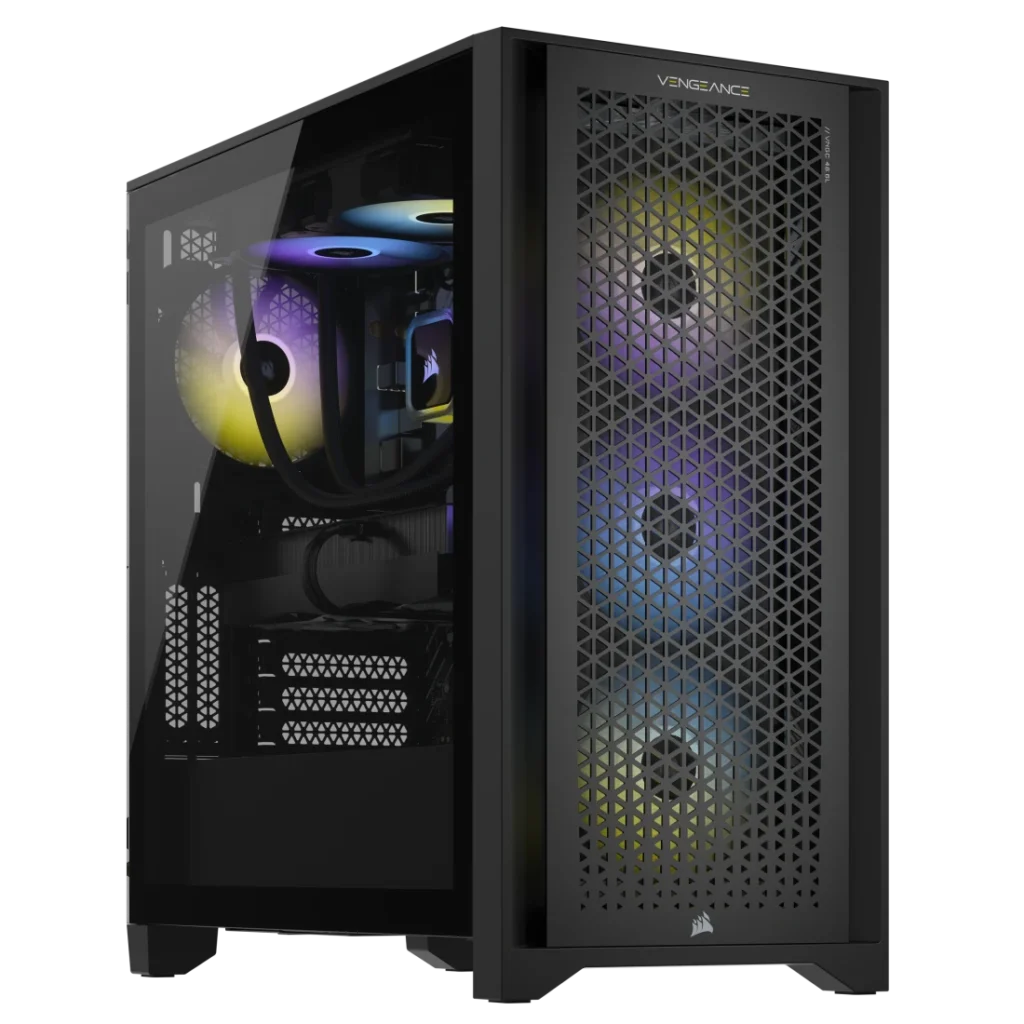
The 9800X3D’s 3D V-Cache gives it a meaningful advantage in physics-heavy games like iRacing and ACC, where single-thread performance directly affects how many cars can be on track without stuttering. The RTX 5080 handles triple 1440p monitors comfortably – and at 1440p resolution, it’s genuinely not the bottleneck. This is the build I’d point most serious sim racers toward.
Step Up: VENGEANCE a8200 (RTX 5090 + Ryzen 9 9950X3D)
If you want the RTX 5090 but prefer AMD, the a8200 at $6,999 pairs Corsair’s highest-spec GPU with the 9950X3D. There’s also the a7500 AIR variant at the same price with better cooling for sustained loads. Honestly? The 9800X3D in the a7500 is the better gaming CPU for sim racing – the 9950X3D’s extra cores don’t meaningfully help single-threaded physics workloads. But if you’re also doing video editing or content creation on the same machine, the 9950X3D earns its place.
The Compact Option: CORSAIR ONE
Worth knowing about if you’re space-constrained: Corsair also makes the ONE series – compact form factor PCs that pack RTX 5080 and 5090 hardware into a much smaller chassis. The i600 (RTX 5090) sits at around $6,999, the i500 (RTX 5080) at $5,499. Same internals as the VENGEANCE tower, fraction of the footprint. Under your sim rig, you’d barely notice it’s there.
Budget Entry: Getting Started
The VENGEANCE range now starts around the $2,099 mark with RTX 5070 options. These are capable machines for single-screen sim racing and will handle 1080p and 1440p triple setups at moderate settings. Not the powerhouses the a7500 or i8300 are, but a solid entry point into the ecosystem without spending four grand on a PC.
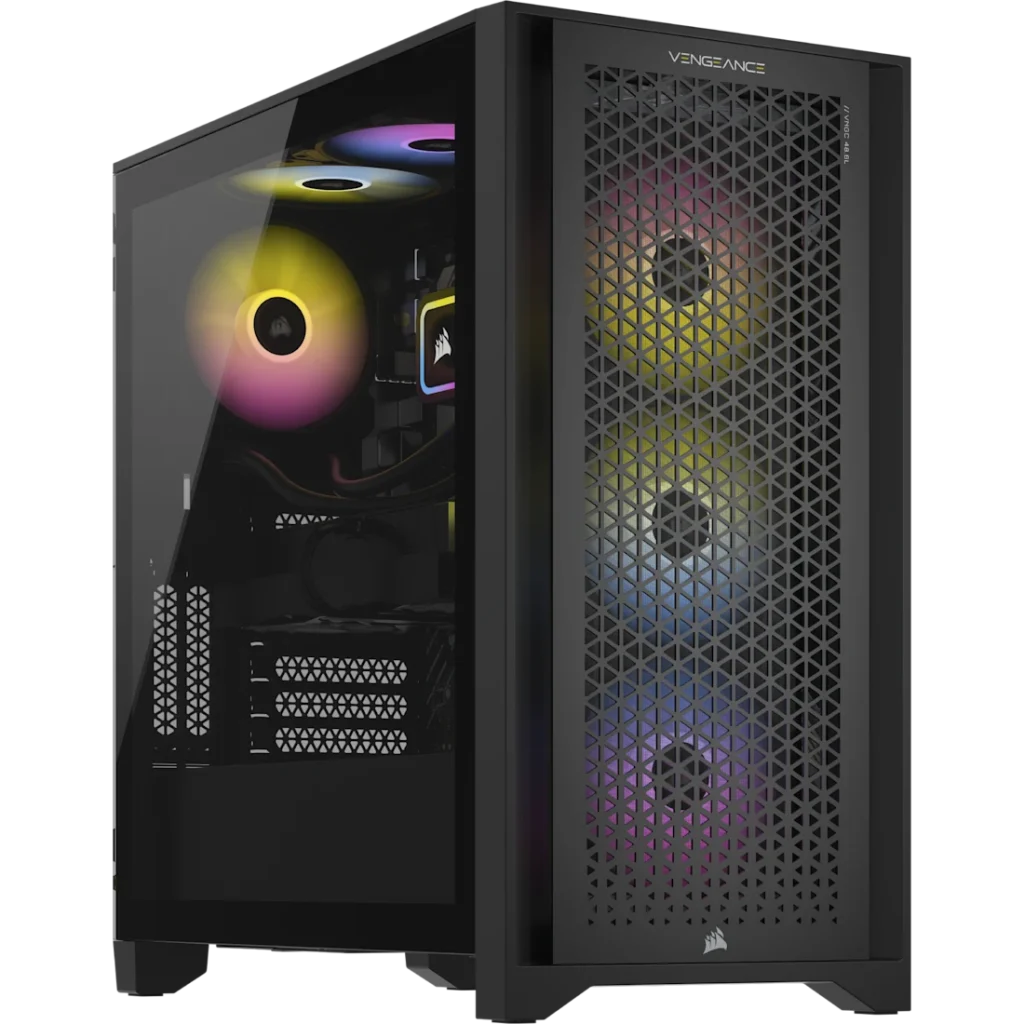
If you’re on a tighter budget, this gets you into sim racing without compromising on build quality. Worth knowing that Corsair also has ORIGIN PC – their subsidiary that builds dedicated Racing Simulator PCs with optimised cooling for long sessions.
Monitors for Your Sim Rig
Corsair’s XENEON monitor range is genuinely strong for sim racing. They cover every use case – single ultrawide, triple setup, budget triples, and even a dedicated dashboard display. The range starts at $249 and goes up to $1,999 for the bendable OLED. And since August 2024, there’s a new curved 34″ QD-OLED that deserves its own mention.
XENEON FLEX 45WQHD240 – The Showpiece
A 45″ OLED that physically bends. At $1,999, it’s not cheap, but as a single-screen sim racing display it offers something nothing else does – you can curve the panel to wrap around your peripheral vision. OLED contrast means night racing in ACC looks absolutely stunning, with proper black levels instead of the grey glow you get from IPS panels. The 240Hz refresh rate means input lag is minimal.
XENEON 34WQHD240-C – The Curved QD-OLED Ultrawide
Launched in August 2024, this one didn’t get enough attention. A 34″ QD-OLED panel at 3440×1440, curved at 1800R, running 240Hz. For a single-screen sim racing setup, this is where I’d put my money right now. Wide enough to give you meaningful peripheral vision without needing a triple setup, and the 1800R curve pulls the edges into your sightline naturally. QD-OLED means the contrast is exceptional – not quite the deep blacks of the FLEX, but close. If you’re not ready to commit to a triple rig or want something cleaner on your desk, this is the one.
XENEON 32″ Panels – Triple Monitor Sweet Spot
For triple monitor setups, the 32″ XENEON panels make a lot of sense. The 32QHD240 (1440p, 240Hz) at $799 each – three of those gives you a properly immersive setup for around $2,400 in monitors alone. The 32UHD144 (4K, 144Hz) is the same price if you prefer resolution over refresh rate. Your GPU budget determines which makes more sense.
XENEON 27QHD240 OLED – Budget OLED Triple
At $299 per panel, three of these 27″ OLED monitors costs under $900. That’s an OLED triple setup for less than a single high-end 4K monitor. The contrast and response times are excellent for sim racing, and 1440p at 27″ is a sweet spot for pixel density. If I were building a new triple setup on a budget, this is where I’d look first.
XENEON EDGE 14.5″ – Your Sim Dashboard
This one keeps getting more useful. The XENEON EDGE is a 14.5″ touchscreen display at $249 – mount it below or beside your main monitors and run SimHub or any telemetry dashboard on it. Corsair has an official guide on using it as a sim racing dashboard. But the bigger news is the August 2025 update: the EDGE now has Virtual Stream Deck functionality built in, with a specific Fanatec profile that puts cockpit controls, bias adjustment, and session management on the touchscreen. It’s the kind of integration that actually makes the Corsair/Fanatec/Elgato triangle make sense in practice.
The Fanatec Connection
In September 2024, Corsair acquired Fanatec – one of the biggest names in sim racing hardware and a group of people I’m honoured to call friends. This is the acquisition that turned Corsair from a PC company with a cockpit project into a full sim racing ecosystem provider. Fanatec continues to operate as its own brand, but the integration is already visible. At Gamescom, every Corsair cockpit demo station was running Fanatec equipment, and Fanatec equipment is getting a much needed development refresh after years of financial woes killed their R7D and opened the door for Moza racing to get a foothold.
What this means practically: Corsair can now bundle deals across the entire stack. A VENGEANCE PC, XENEON monitors, Corsair cockpit, and Fanatec wheelbase/pedals/wheel – all from one parent company. Whether that translates to actual bundle pricing remains to be seen, but the potential is there.
Fanatec also released the ClubSport GT Cockpit in January 2025, separate from the Corsair-branded cockpit. Two cockpits from the same parent company, positioned differently. The Corsair cockpit targets the broader gaming audience with its steel construction and tool-free setup. The Fanatec ClubSport GT targets the dedicated sim racing enthusiast. Different design philosophies under one roof.
For the full Fanatec product range – wheelbases, pedals, steering wheels – see our dedicated Fanatec buyer’s guide.
Building a Complete Corsair Setup
Here’s where the ecosystem argument becomes compelling. Three realistic builds at different budgets, all staying within the Corsair/Fanatec family:
Entry Build (~$5,500)
VENGEANCE RTX 5070 entry (~$2,099) + single XENEON 27QHD240 OLED ($299) + Corsair cockpit with seat ($999) + Fanatec CSL DD + CSL Pedals (~$800). That gets you a complete rig with a direct drive base, load cell brake, OLED monitor, and a cockpit that won’t flex. Updated pricing from the previous entry build reflects where the VENGEANCE line sits now with the RTX 5000 transition.
Enthusiast Build (~$10,000)
VENGEANCE a7500 (RTX 5080 + 9800X3D) + triple XENEON 27QHD240 OLED ($899) + XENEON EDGE dashboard ($249) + Corsair cockpit with seat ($999) + Fanatec DD2 + ClubSport V3 pedals + steering wheel (~$3,000). Triple OLED, a proper direct drive base, and a PC that won’t struggle with the resolution. This is the sweet spot where everything works together without feeling like you’ve overspent on any single component.
No-Compromise Build (~$20,000+)
VENGEANCE i8300 (RTX 5090, $7,499) + triple XENEON 32UHD144 at 4K ($2,399) + XENEON EDGE dashboard ($249) + Corsair cockpit with seat and triple monitor stand (~$1,500) + Fanatec Podium DD + ClubSport V3 Inverted + multiple steering wheels (~$5,000+). This is the build where you stop worrying about compromises. Triple 4K with an RTX 5090 means everything runs at maximum settings. The 9800X3D in the AMD a7500 variant would be my preference for pure sim racing – but if you’re running the full stack and want Intel, the i8300 is the one.
The honest caveat with any ecosystem “buy-in” is that you’re trading some flexibility for convenience. But if Corsair’s cockpit doesn’t suit your body type, or their monitors don’t match your preference, there’s no rule saying you have to go all-in. Mix and match. But if you like the idea of a cohesive setup from one family of brands – and the products genuinely stand on their own merits – the Corsair ecosystem is positioned rather well to deliver that.

Racing Cockpits Buyer’s Guide

Best VR Headsets for Flight Simulation
Fanatec ClubSport Steering Wheel GT3 for Xbox Review
Simagic Sim Racing: The Complete Buyer’s Guide (2026)
Corsair for Sim Racers: Ecosystem Buyers Guide 2026