

I’m a sim racer and amateur racer with a passion for Motorsport, good racecraft and the technical and setup aspect of sim racing.
Sim-Lab is the cockpit brand I’d buy if I were starting from scratch. They’re a Dutch company that builds aluminium profile rigs – the same industrial extrusion system used in factory automation – and they’ve slowly expanded into a full sim racing ecosystem covering seats, steering wheels, pedals, and now direct drive wheelbases. If you’re comparing cockpit options, you’ll want to look at Trak Racer and the broader market too, but Sim-Lab is where I’d point most people first.
Sim-Lab sits in the mid-to-premium bracket for aluminium profile rigs. The GT1 Evo starts around $899 and the P1X Ultimate tops out near $1,200. They’re not the cheapest option, but the build quality and adjustability justify the price for most sim racers. The sweet spot is probably the P1X Pro if you want long-term flexibility.
Quick Navigation
Jump directly to what you’re looking for:
Why Sim-Lab |
Flagship Cockpits |
Seats & Mounting |
Steering Wheels & Electronics |
Shifters & Peripherals |
Accessories & Ecosystem |
Compare by Investment Level
This guide covers the full Sim-Lab ecosystem – cockpits, seats, steering wheels, electronics, shifters, and accessories. Flagship products, what sets them apart from the competition, and where the value sits across the range. If you’re looking at direct drive wheelbases, their DD TorqueSync range is covered too.
Why Sim-Lab?
Sim-Lab was founded in 2015 in Tholen, Netherlands. The original product line was aluminium profile cockpits built on industrial-grade 6063-T5 extrusions – the same T-slot system you see in factory production lines and CNC machine enclosures. Rigs use 40x80mm and 40x160mm profiles with a universal T-nut mounting system: every component adjusts without drilling a single hole.
What makes them technically different is the construction approach. Whilst most budget rigs use stamped steel or welded tube frames, Sim-Lab’s extrusions bolt together with precision. The powder coating is well done – durable and consistent. The P1X Ultimate added a black anodised option for people who want the industrial look. Standard T-slot profiles throughout means you’re not locked to proprietary brackets – generic hardware works fine.
Community Sentiment
What I’ve read from P1X owners is that the rigidity is properly impressive – people describe it as feeling like industrial equipment rather than a gaming accessory. The most common praise is the adjustability and the quality of the powder coating. On the criticism side, assembly takes a few hours (this isn’t a bolt-together-in-20-minutes situation), the instructions could be better, and seat slider mounting can be fiddly. Worth factoring in before you order.
Sim-Lab cockpits are for people who want a rig they’ll keep for years and upgrade around. If you’re running a direct drive wheelbase, triples, or motion, the rigidity matters. If you’re on a Logitech G29 and just want something functional, you’re probably overspending – look at the Trak Racer entry-level options or even a solid desk mount instead.
Flagship Cockpits
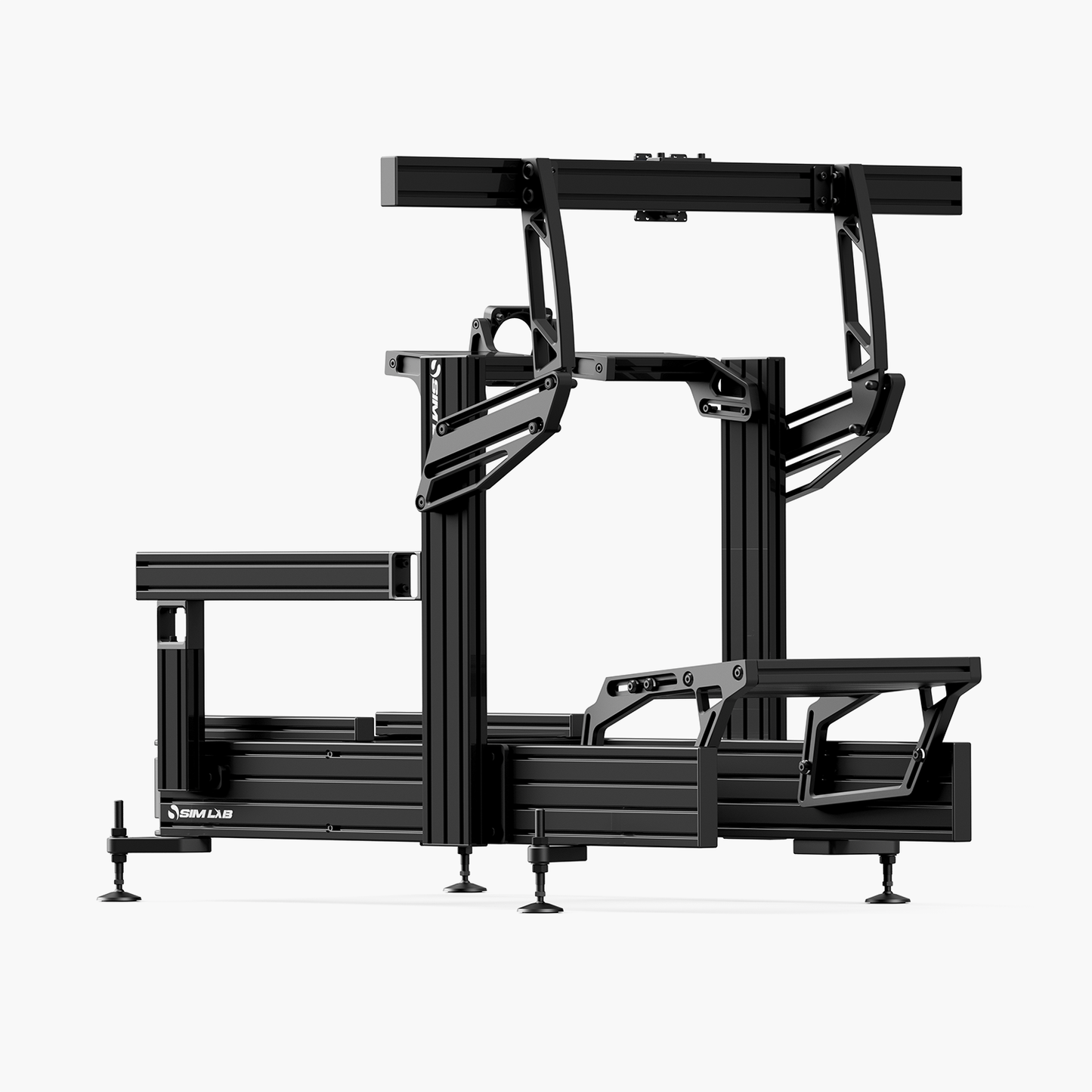
Sim-Lab’s cockpit range covers three main lines: the P1X (flagship), the GT1 (mid-range), and a Mercedes-AMG collaboration. The P1X is the one most people talk about, and for good reason – it’s basically the gold standard for aluminium profile rigs in this price range.
P1X Ultimate
The P1X Ultimate is the latest version of Sim-Lab’s flagship cockpit. Released in July 2025, it brought back the vertical front pillars that the community had been asking for – a design choice that improves compatibility with monitor mounts and makes cable routing much cleaner. Pre-drilled holes and sandwich plates replaced a lot of the fiddly bracket work from earlier versions.
The P1X Ultimate is built around high-end hardware. That ~60kg frame weight keeps it planted under a 25Nm+ wheelbase, and reviewers consistently note there’s no flex to speak of even at sustained load. The trade-off is size – this isn’t a rig you tuck away in a corner.
- Frame: Industrial 6063-T5 aluminium extrusions with vertical uprights
- Weight: ~60kg (frame only)
- Dimensions: 1422mm x 737mm footprint
- Mounting: Universal T-nut system, pre-drilled holes
- Assembly: Sandwich plates, optimised bracket designs
P1X Pro
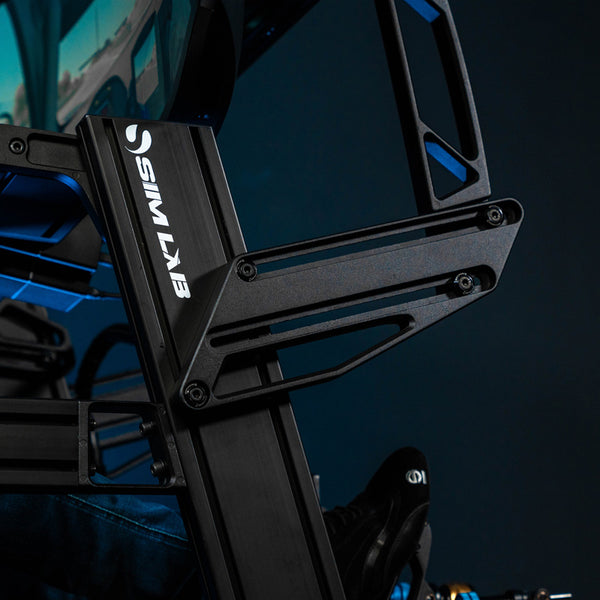
The P1X Pro is the workhorse of the range. Front wheel mount and wheeldeck mount versions are both available – your wheelbase determines which makes more sense. The front mount runs angled uprights at around 20 degrees; some users flag it as a slight compromise for dashboard mounting, though most setups work fine with it.
Community feedback on the P1X Pro is consistently positive. It’s the cockpit that reviewers like Boosted Media have praised for its rigidity-to-price ratio. The aluminium construction means zero flex even with strong direct drive wheelbases, and the T-nut system lets you fine-tune your seating position to the millimetre.
- Frame: Solid aluminium construction, front wheel or wheeldeck mount
- Compatibility: All major wheelbases, pedals, and seats
- Adjustability: Infinite positioning via T-nut system
- Variants: Front mount ($999), Wheeldeck mount ($799), Standard ($599)
- Rating: 4.8/5 from user reviews
GT1 Evo
The GT1 Evo is where most people should probably start. Same aluminium profile construction as the P1X range, more compact form factor, $899. Stepping up from a wheel stand or a budget steel cockpit, this is the level where the difference in rigidity becomes immediately obvious.
The GT1 line also includes the GT1 Pro at $649 if you want a cheaper starting point. The Evo is the better pick for anyone planning to upgrade hardware down the line – it’s more adaptable.
Seats & Mounting
Sim-Lab offers their own S1 Enduro bucket seat alongside a partnership with Sparco for higher-end options. The S1 Enduro is designed for the GT racing posture – upright and supportive for long stints. They also sell Sparco seats (GP, Pro 2000 QRT, Grid Q, R333) which are genuine motorsport seats, not gaming chairs with a racing brand on them. That distinction matters.
Mercedes-AMG cockpit buyers get a matching seat and mounting kit option. For everyone else, the S1 Enduro at $299-$399 is solid value – purpose-built for sim racing, not a gaming chair rebranded. Sparco options are there if you want proper motorsport hardware.
Steering Wheels & Electronics
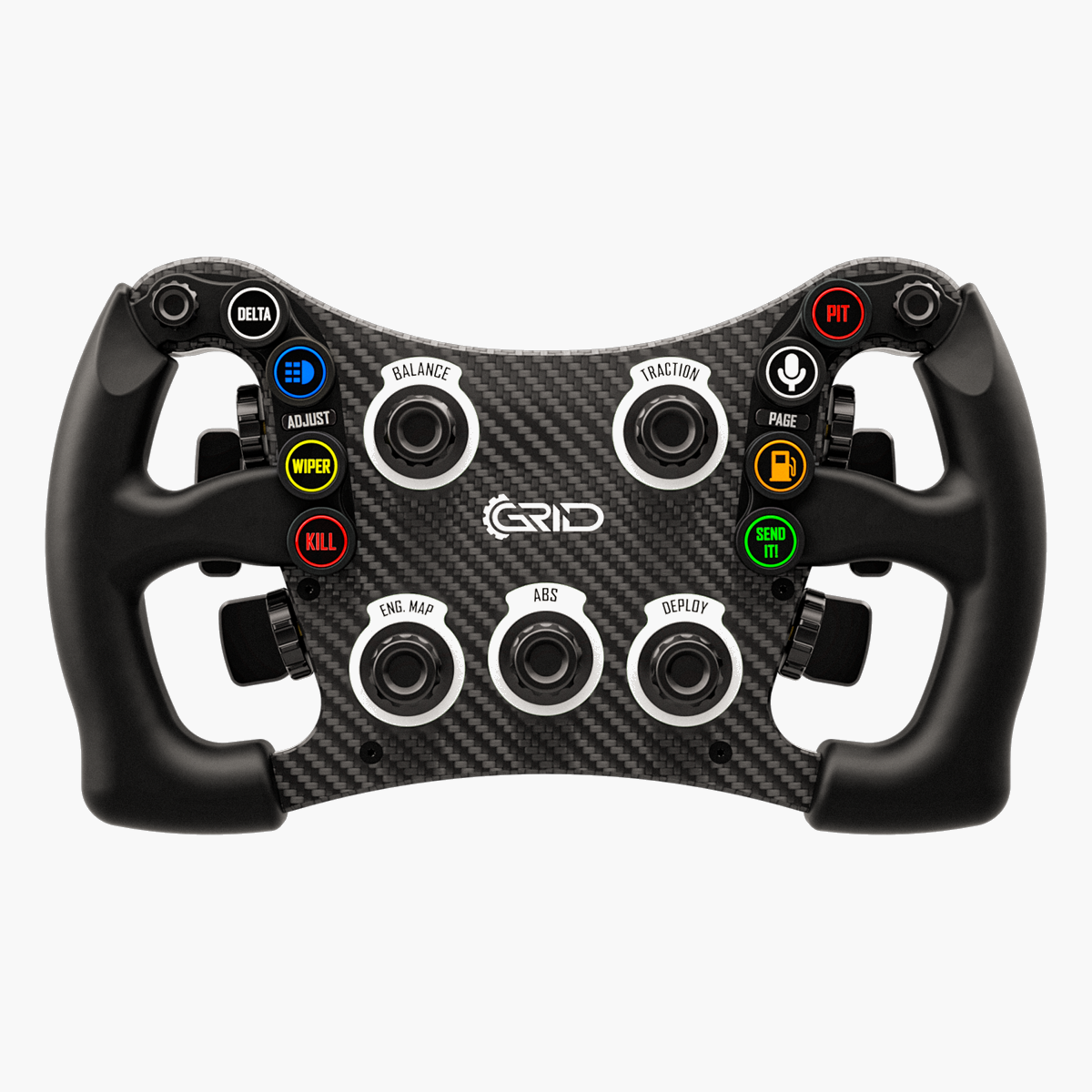
Sim-Lab merged with Grid Engineering in 2021 to form Grid by Sim-Lab, which gave them access to proper steering wheel and dashboard display manufacturing. The GRID MPX V2 is their flagship wheel rim – a 295mm full CNC aluminium construction with 5mm carbon fibre front plate, 87 RGB telemetry LEDs, and adjustable magnetic paddle shifters. USB connection, compatible with any PC wheelbase.
On the electronics side, they have Porsche-licensed dashboard displays (the 911 GT3 Cup dashboard at $599 and button box at $399) and their own GRID DDU5 display unit at $399. These are proper sim racing electronics, not aftermarket gauges bolted on. The Porsche dashboard has a strong community reputation – the build quality and telemetry integration are consistently praised.
- GRID MPX V2: 295mm, CNC aluminium, 5mm carbon fibre, 87 RGB LEDs, $1,199
- Porsche 911 GT3 Cup Dashboard: Licensed display unit, $599
- Porsche 911 GT3 Cup Button Box: Console-style button box, $399
- GRID DDU5: Dashboard display unit, $399
Shifters, Handbrakes & Peripherals
Sim-Lab manufactures their own peripherals now – the XB1 loadcell handbrake ($699), the SQ1 sequential shifter ($499), and a push-pull rally shifter ($499). The XB1 uses a loadcell sensor – force-based rather than travel-based, same principle as loadcell brake pedals.
They also sell XP1 pedal accessories including a conversion kit ($699), foot support, and heel rest. The DD26 TorqueSync (26Nm) and DD39 TorqueSync (39Nm) direct drive wheelbases use a 350VDC internal architecture and open ecosystem compatibility, though availability through the affiliate feed is still pending.
Accessories & Ecosystem
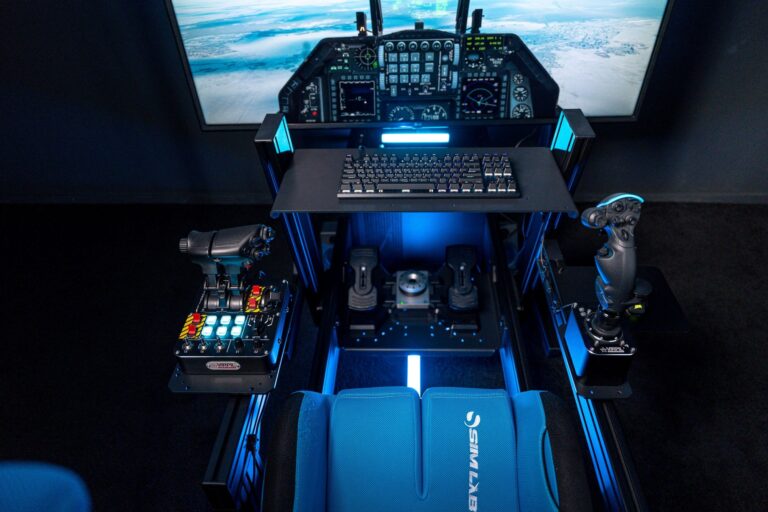
The accessory range fills in the gaps: Vario VESA monitor mount adapters, Xero Play triple pivot adapters, keyboard trays, cup holders, harnesses, and bracket sets. There’s also a dedicated flight sim range with joystick mounts, rudder trays, and a centre post – which shows how versatile the T-slot system is. The T-slot system is flexible enough that sim racing and flight sim setups can share the same base frame.
For motion, Sim-Lab partners with D-BOX for the GEN5 4250i motion kit at $7,950 – that’s the premium end of the ecosystem. They also offer the F33L sim racing gloves if you want the full branded experience, though at $999 they’re firmly in the enthusiast territory.
Compare by Investment Level
Budget breakdown across the range: The entry point is the GT1 Pro cockpit at $649 paired with an S1 Enduro seat at $299 – you’re looking at under $1,000 for a properly solid rig that’ll handle anything up to a mid-range direct drive. The sweet spot is the P1X Pro ($799-$999) with a Sparco seat ($499-$699) – this is where the adjustability really pays off and you’ve got a platform that’ll last years. The no-compromise tier is the P1X Ultimate ($1,198) with the GRID MPX V2 wheel ($1,199) and Porsche dashboard electronics – at that point you’re well into the $3,000+ territory but you’re getting genuinely professional-grade equipment.
Look, the honest take on Sim-Lab is that the cockpits are where the real value lives. The seats, wheels, and electronics are good, but the aluminium profile rigs are what built the brand’s reputation. Choosing between a P1X with a basic seat versus a cheaper rig with all the accessories – spend the money on the cockpit. Seats and peripherals get upgraded; the frame is what you’re stuck with.
Racing Cockpits Buyer’s Guide

Best VR Headsets for Flight Simulation
Fanatec ClubSport Steering Wheel GT3 for Xbox Review
Simagic Sim Racing: The Complete Buyer’s Guide (2026)
Corsair for Sim Racers: Ecosystem Buyers Guide 2026