

I’m a sim racer and amateur racer with a passion for Motorsport, good racecraft and the technical and setup aspect of sim racing.
This Sim-Lab buyer’s guide covers the cockpit brand I’d buy if I were starting from scratch. Sim-Lab is a great Dutch company that are best known for their aluminium profile rigs – and over the past few years, they’ve slowly expanded into a full sim racing ecosystem covering seats, steering wheels, pedals, handbrakes, and (announced but not yet shipping) their own direct drive wheelbases.
Sim-Lab discount code: use SIMRACINGCOCKPIT at checkout for 5% off on sim-lab.eu. On top of the code, Sim-Lab runs the occasional site-wide cut, and a big chunk of the catalogue is sitting on real “was/now” pricing right now – the P1X Ultimate cockpit is down to around €899 from a €1,978 list, and the XP1 loadcell pedal set is €169 against a €649 original. Prices are in euros direct from the Dutch store; the live grids below carry the current figure on each product. Their DDS TorqueSync direct drive wheelbase line has been announced but isn’t shipping to buy yet – I’ve covered the technical detail in the TorqueSync announcement piece. As for Black Friday, we don’t know yet if the code will work on sale prices as well.
Sim-Lab sits in the mid-to-premium bracket for aluminium profile rigs. The GT1 Evo starts around €379 and the P1X Ultimate is down near €899 in its current price-drop window. They’re not the cheapest option, but the build quality and adjustability justify the spend for most sim racers. The sweet spot is probably the P1X Pro if you want long-term flexibility.
Quick Navigation
Jump directly to what you’re looking for:
Why Sim-Lab |
Flagship Cockpits |
DDS Wheelbases |
Seats & Mounting |
Steering Wheels & Electronics |
Shifters & Peripherals |
Accessories & Ecosystem |
Black Friday 2026 |
Compare by Investment Level
This guide covers the full Sim-Lab range – cockpits, the announced DDS TorqueSync wheelbases, seats, steering wheels, electronics, shifters, and accessories. Flagship products, what sets them apart from the competition, and where the value sits across the lineup. If you’re looking at direct drive wheelbases more broadly, the DDS TorqueSync line is shaping up as a credible challenger to the Simucube and Fanatec flagships once it lands.
Why Sim-Lab?
Sim-Lab was founded in 2015 in Tholen, Netherlands. The original product line was aluminium profile cockpits built on industrial-grade 6063-T5 extrusions – the same T-slot system you see in factory production lines and CNC machine enclosures. Rigs use 40x80mm and 40x160mm profiles with a universal T-nut mounting system, which means every component adjusts without drilling a single hole.

What makes them technically different is the construction approach. Where most budget rigs use stamped steel or welded tube frames, Sim-Lab’s extrusions bolt together nicely. The powder coating is well done – durable and consistent.
The P1X Ultimate added a black anodised option for people who want the industrial look. Standard T-slot profiles throughout means you’re not locked to proprietary brackets – generic hardware works fine, and the Sim-Lab Vario range of monitor mounts and adapters bolts into the same slots.
Community Sentiment
What I’ve read from P1X owners is that the rigidity is properly impressive – people describe it as feeling like industrial equipment rather than a gaming accessory. The most common praise is the adjustability and the quality of the powder coating. On the criticism side, assembly takes a few hours (this isn’t a bolt-together-in-twenty-minutes situation), the instructions could be better, and seat slider mounting can be fiddly. Worth factoring in before you order. Sim-Lab’s documentation is still ahead of Trak Racer’s though, which is a fair comparison given they’re going for the same buyer.
Sim-Lab cockpits are for people who want a rig they’ll keep for years and upgrade around. If you’re running a direct drive wheelbase, triples, or motion, the rigidity matters. If you’re on a Logitech G29 and just want something functional, you’re probably overspending – look at the Trak Racer entry-level options or even a solid desk mount instead.
Flagship Cockpits
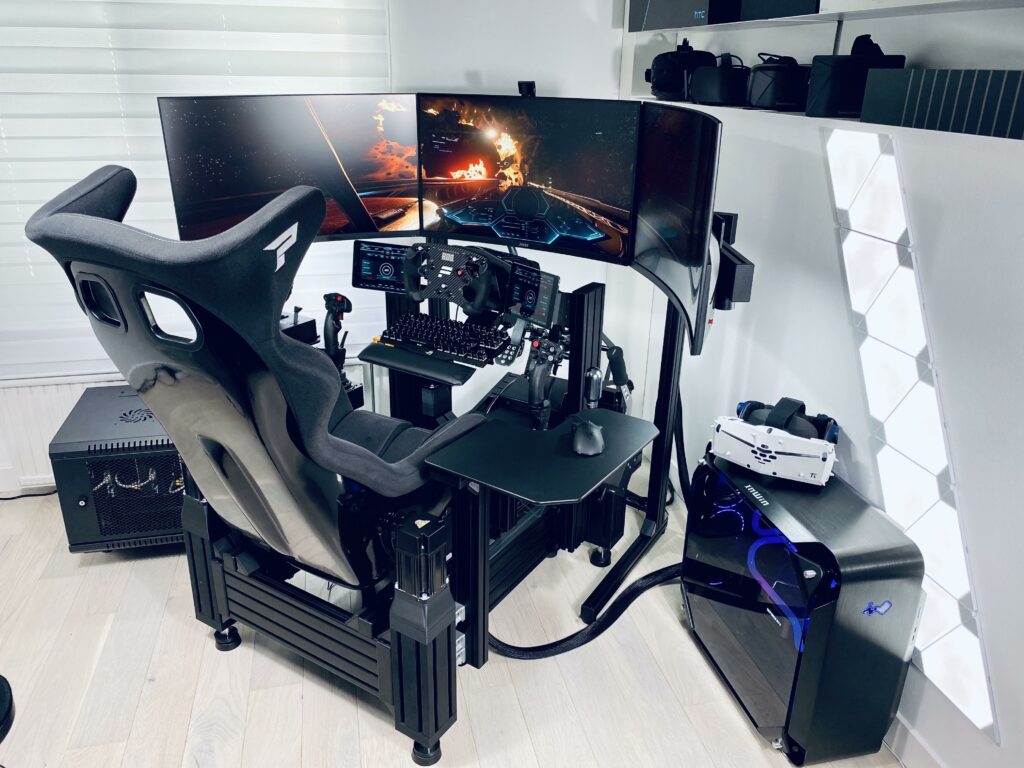
Sim-Lab’s cockpit range covers three main lines: the P1X (flagship), the GT1 (mid-range), and the Mercedes-AMG Petronas F1 collaboration. The P1X is the one most people talk about, and for good reason – it’s the gold standard for aluminium profile rigs in this price bracket.
P1X Ultimate
The P1X Ultimate is the latest version of Sim-Lab’s flagship cockpit, currently around €899 in a deep price-drop window against a €1,978 list. Released in July 2025, it brought back the vertical front pillars that the community had been asking for – a design choice that improves compatibility with monitor mounts and makes cable routing much cleaner. Pre-drilled holes and sandwich plates replaced a lot of the fiddly bracket work from earlier versions.
The P1X Ultimate is built around high-end hardware. That ~60kg frame weight keeps it planted under a 25Nm+ wheelbase, and reviewers consistently note there’s no flex to speak of even at sustained load. The trade-off is size – this isn’t a rig you tuck away in a corner.
- Frame: Industrial 6063-T5 aluminium extrusions with vertical uprights
- Weight: ~60kg (frame only)
- Dimensions: 1422mm x 737mm footprint
- Mounting: Universal T-nut system, pre-drilled holes
- Assembly: Sandwich plates, optimised bracket designs
P1X Pro
The P1X Pro is the workhorse of the range, and it’s the one I built myself – the full build write-up is here. Front wheel mount and wheeldeck mount versions are both available – your wheelbase determines which makes more sense. The front mount runs angled uprights at around 20 degrees; some users flag it as a slight compromise for dashboard mounting, though most setups work fine with it. The live price right now is around €789 for the base, which is a big cut on its own list.

Community feedback on the P1X Pro is consistently positive. Reviewers consistently praise its rigidity-to-price ratio. The aluminium construction means zero flex even with strong direct drive wheelbases, and the T-nut system lets you fine-tune your seating position to the millimetre.
- Frame: Solid aluminium construction, front wheel or wheeldeck mount
- Compatibility: All major wheelbases, pedals, and seats
- Adjustability: Infinite positioning via T-nut system
- Variants: Front mount and Wheeldeck mount, around €789
GT1 Evo
The GT1 Evo is where most people should probably start, around €379. Same aluminium profile construction as the P1X range, more compact form factor. Stepping up from a wheel stand or a budget steel cockpit, this is the level where the difference in rigidity becomes immediately obvious, and it’s the most affordable way into a Sim-Lab aluminium frame.
Step up to the GT1 Pro at around €649 and you get the beefier version with side mounts for shifters and handbrakes built in. Either GT1 takes a direct drive upgrade down the line, so neither is a dead end – the Pro just saves you buying the side-mount hardware separately later.
Mercedes-AMG Petronas F1 Cockpit
The Mercedes-AMG Petronas Formula One Team cockpit is the licensed F1 partnership in the lineup, currently €999 (down from a €1,699 list).
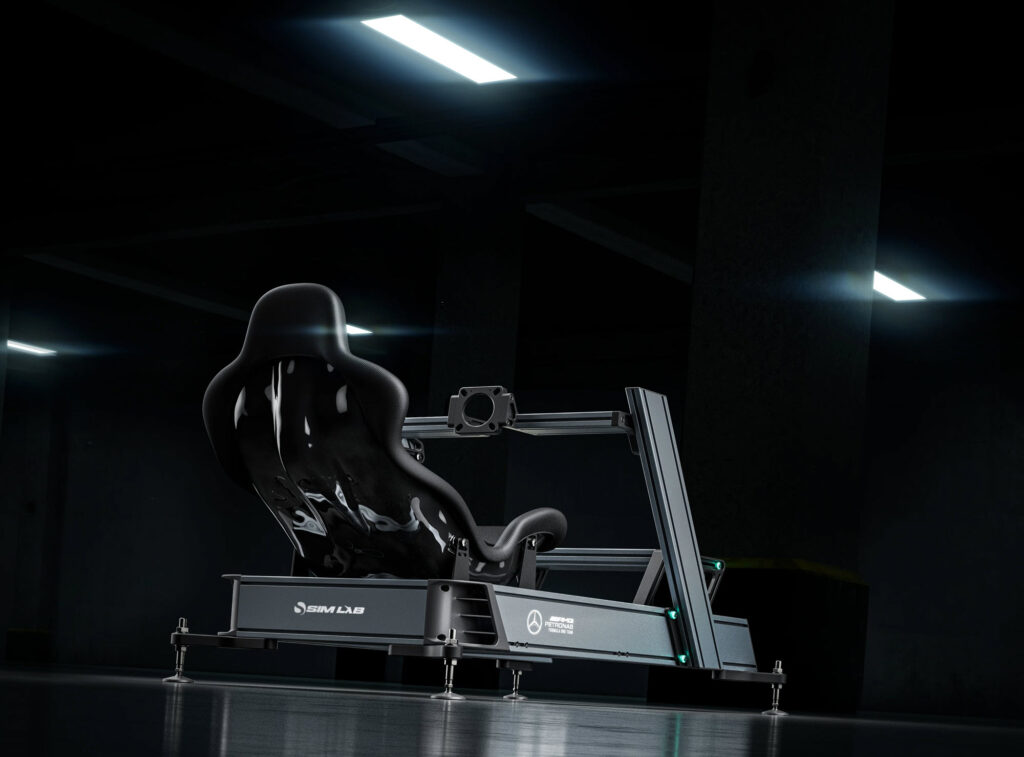
This puts Sim-Lab in similar territory to the Trak Racer Alpine TRX collaboration but with a different aesthetic – matte black finish with the Mercedes silver and turquoise livery rather than Alpine’s blue. Built on the same P1X engineering DNA, with a matching seat and mounting kit available as bundle add-ons. If you’re an F1 fan and want a team-licensed Mercedes aesthetic, this is the Sim-Lab option for you.
DDS TorqueSync Direct Drive Wheelbases (Coming Soon)
This is the big 2026 story for the brand, with one caveat worth being upfront about: the DDS TorqueSync line is announced, not yet on sale. The product page is live as a coming-soon listing, so there’s nothing in our affiliate feed to pull a live price on yet. The technical headline is the 350V internal architecture and 100kHz control loop – I’ve gone into the engineering detail in the TorqueSync deep-dive, but the short version is they’re chasing industrial-servo-grade architecture rather than the lower-voltage consumer setups Moza and Fanatec ship.
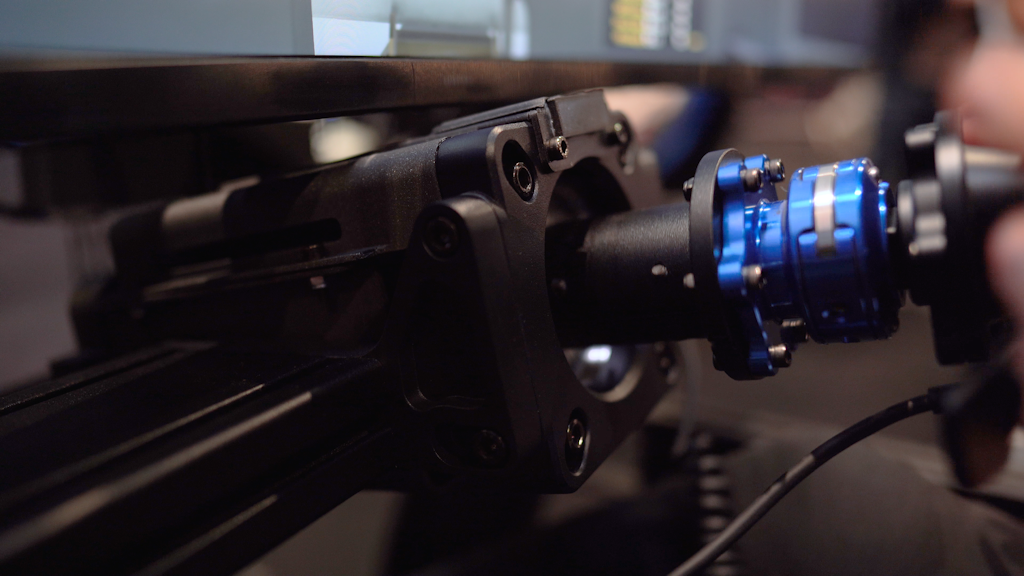
The two announced variants, a 26Nm and a 39Nm, aren’t aimed at the budget end. They’re pitched squarely at the Simucube 2 Pro and Ultimate crowd, with the twist being the open T-slot mounting a Sim-Lab cockpit owner already knows. If you’re on a P1X and can wait, this is the obvious own-brand pairing once it actually ships – everything else in the rig already speaks the same mounting language. Until it does, a Simucube or a Fanatec Podium bolts straight into the same rig, so nobody has to leave a P1X base-less waiting for it.
Seats & Mounting
Sim-Lab offers their own S1 Enduro bucket seat alongside a partnership with Sparco for higher-end options. The S1 Enduro is currently around €449, designed for the GT racing posture – upright and supportive for long stints. They also sell Sparco seats (GP, Pro 2000 QRT, Grid Q, R333) which are genuine motorsport seats, not gaming chairs with a racing brand on them. That distinction matters – a real bucket seat under hard braking is the difference between consistent inputs and your body sliding around.

Mercedes-AMG cockpit buyers get a matching seat and mounting kit option. For everyone else, the S1 Enduro at around €449 is solid value – purpose-built for sim racing, not a gaming chair rebranded. Sparco options are there if you want proper motorsport hardware, and they rate highly in our sim racing seat guide, which covers the cross-brand picture on bucket seats versus GT seats in full.
Steering Wheels & Electronics
Sim-Lab merged with Grid Engineering in 2021 to form Grid by Sim-Lab, which gave them access to proper steering wheel and dashboard display manufacturing. The GRID MPX V2 is their flagship wheel rim – a 295mm full CNC aluminium construction with 5mm carbon fibre front plate, 87 RGB telemetry LEDs, and adjustable magnetic paddle shifters. USB connection, compatible with any PC wheelbase.
On the electronics side, they have Porsche-licensed dashboard displays (the 911 GT3 Cup dashboard around €600 and a matching button box around €400) and their own GRID DDU5 display unit around €400. These are proper sim racing electronics, not aftermarket gauges bolted on. The Porsche dashboard has a strong community reputation – the build quality and telemetry integration are consistently praised.

- GRID MPX V2: 295mm, CNC aluminium, 5mm carbon fibre, 87 RGB LEDs, ~€1,199
- GTSL Pro: GT-style wheel, RPM LEDs, clutch and rocker paddles, ~€549
- Porsche 911 GT3 Cup Dashboard: Licensed display unit, ~€600
- Porsche 911 GT3 Cup Button Box: Console-style button box, ~€400
- GRID DDU5: Dashboard display unit, ~€400
If your budget doesn’t stretch to the MPX V2, the GTSL Pro is the sensible GT-style wheel in the range at around €549 – inverted D-shape, RPM LEDs, clutch and rocker paddles, all customisable in RaceDirector. It’s the one I’d point most people at unless they specifically want the full formula rim.
Shifters, Handbrakes & Peripherals
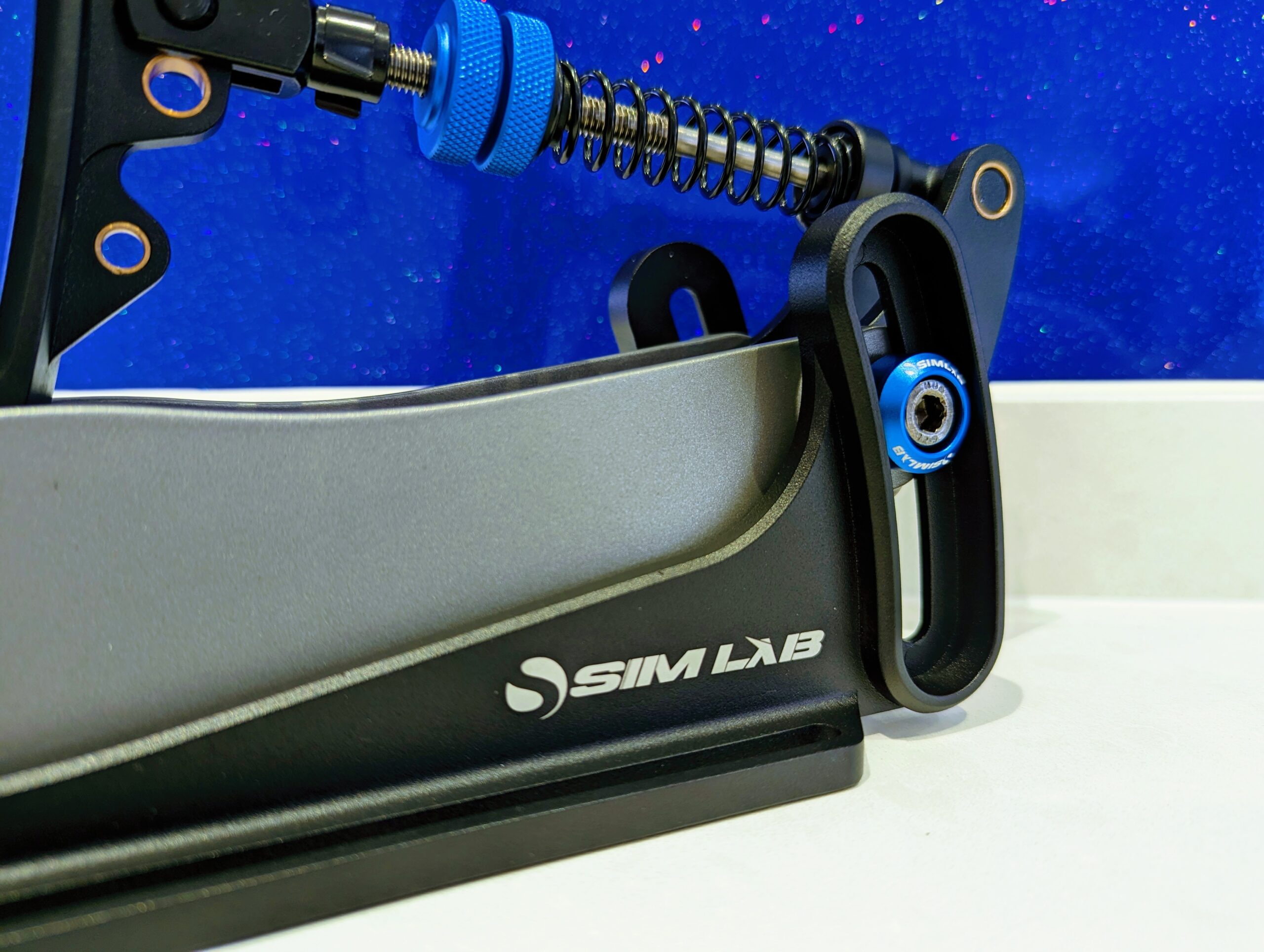
Sim-Lab manufactures their own peripherals now, and I’ve had most of them on the rig. The one to shout about is the XP1 loadcell pedal set: a 200kg loadcell delivering up to 100kg of brake pressure, currently down to around €169 against a €649 original. At that money it’s a genuine bargain, and it held up well when I reviewed the XP1 in full. They also sell XP1 accessories – a conversion kit, foot support, and heel rest.

On the shifter side there’s the SQ1 sequential (around €199) and a push-pull rally shifter for the stage-rally crowd. The push-pull is the more interesting of the two if you run gravel and tarmac events – I put it through its paces in the push-pull rally shifter review, and it’s a proper mechanical unit rather than a token add-on.
The XB1 handbrake rounds it out. It uses a loadcell sensor – force-based rather than travel-based, the same principle as a loadcell brake pedal – so you pull against pressure, not distance, which is what you want for consistent handbrake turns. I gave it a proper going-over in the XB-1 handbrake test drive.

Once the DDS TorqueSync line ships, the Sim-Lab “everything from one brand” pitch is complete – cockpit, seat, wheel rim, dash, pedals, shifter, handbrake, and direct drive wheelbase, all bolted together via the same T-slot extrusion system. For now it’s everything bar the base.
Accessories & Ecosystem
The accessory range fills in the gaps: Vario VESA monitor mount adapters (the freestanding Triple Monitor Mount is currently around €149), Xero Play triple pivot adapters, keyboard trays, cup holders, harnesses, and bracket sets. The Vario Vesa system is one of the better monitor-mounting solutions out there, though it’s worth reading the setup first – I wrote a how-to on setting up the Vario Vesa mounts because the pivot adapters aren’t obvious on the first go. There’s also a dedicated flight sim range with joystick mounts, rudder trays, and a centre post, which shows how versatile the T-slot system is – the same base frame happily takes a sim racing cockpit one weekend and a flight sim setup the next.

For motion, Sim-Lab partners with D-BOX for the GEN5 4250i motion kit at around €8,000 – that’s the premium end of the ecosystem. They also offer the F33L sim racing gloves if you want the full branded experience, though at around €999 they’re firmly in enthusiast territory.
Sim-Lab Black Friday 2026
We rate the chance of Sim-Lab repeating last year’s site-wide Black Friday discount as medium to high. By 13 November 2025, the Sim-Lab home page already carried a banner reading “Black Friday 11% OFF site-wide! Automatically applied at checkout!” And in Sim-Lab’s own 2025 year-end post, they called Black Friday “an incredible period for us”, which is part of why we expect them to run it again.
We can’t say yet when the sale will start or how long it’ll run. Last year’s start and end dates weren’t on any Sim-Lab page we could find, and there’s no 2026 Black Friday page from them so far. In the meantime, have a look at Sim-Lab’s standing deals page.
No Sim-Lab Black Friday deals listed yet – check back. We check daily from 10 November.
The full Sim-Lab Black Friday forecast is on our Black Friday page, along with last year’s deals. Once the sale is over, we’ll mark every forecast there as a hit or a miss. We haven’t found anything from Sim-Lab yet on whether our code will stack with a Black Friday price.
Compare by Investment Level
My take on Sim-Lab is that the cockpits are still where a huge amount of value lives, and the wider ecosystem is now nearly all there. The seats, wheels, electronics and peripherals are strong products in their own right, and I’m certain the DDS TorqueSync wheelbase will complete the set once it ships.
If you’re choosing between a P1X with a basic seat versus a cheaper rig with all the accessories, spend the money on the cockpit. Seats and peripherals get upgraded; the frame is what you’re stuck with for a decade.
One thing to plan for if you’re in the UK: Sim-Lab ships from the Netherlands, so a direct order lands you with import VAT and a courier handling fee. This 5% SIMRACINGCOCKPIT code applies on sim-lab.eu which should help to take the sting out of importa duty for UK residents.
Related Posts
Should Sim Racers Wait for the Pimax Crystal Pro, or Buy Today?
Sim Racing Wheel Stands and Folding Cockpits: Why I’d Skip One, and What to Buy Instead
The Best Direct Drive Sim Racing Bundles (2026)
Best Thrustmaster Wheel and Pedal Mods (2026)
ButtKicker and Tactile Feedback for Sim Racing: The Highest-ROI Upgrade You Shouldn’t Skip (2026 Beginner’s Guide)
Sim Racing Motion Platforms: A Beginner’s Guide to Adding Motion to Your Rig (2026)
Topic: Sim Racing Cockpits