
I’m a sim racer and amateur racer with a passion for Motorsport, good racecraft and the technical and setup aspect of sim racing.
I think most of us sim racers know that Simucube occupies a very specific position in the market. They’re not trying to compete with Moza or Simagic on price, and they’re not chasing the entry-level crowd Fanatec dominates. Simucube is the high end choice, and they own that position unapologetically. The company’s roots are actually quite interesting – Granite Devices spent eight years building industrial motor controllers before the sim racing community’s interest in direct drive pulled them into this market in 2015. By 2019-2020, with the success of Simucube 2, they’d shifted their primary focus to sim racing under the Simucube brand, dedicating over 60 professionals to sim racing equipment whilst Granite Devices remained the parent company. That industrial background shows. My experience with the Simucube 2 Pro is that it’s properly solid and in the near 5 years I’ve owned it, it has never let me down.
The target market: serious sim racers, esports professionals, and real-world racing drivers who use simulation for training. The pricing reflects this positioning: Simucube wheelbases range from roughly £1,200 to over £3,000, and their ActivePedal force feedback pedals range from £1,470 (Pro) to over £2,000 (Ultimate) for a single pedal, so a simucube setup is kind of a high net worth flex thesedays.
Quick Navigation
Jump directly to what you’re looking for:
Why Simucube |
Headline Products |
Direct Drive Wheelbases |
Steering Wheels |
Pedal Sets |
Accessories & Ecosystem |
Compare by Investment Level
Today’s post is a guide to the complete Simucube ecosystem: direct drive wheelbases across multiple torque ranges, the ActivePedal family of force feedback sim racing pedals, steering wheels including the new Savu range, and accessories including the Simucube Link connectivity system. I’ll explain what makes Simucube technically different, when eye wateringly high pricing makes sense, and what you get for the investment beyond just higher torque figures that marketing departments love to shout about.
Why Simucube?
There’s a genuine reason Simucube costs what it does. Granite Devices the parent company – spent years in industrial automation before sim racing pulled them in. The Simucube 2 range uses 22-bit encoders (Sport/Pro) and 24-bit encoders (Ultimate), whilst competitors typically sit at 20-21 bit. What that means in practice is you pick up on finer textures through the wheel – kerb rumble strips feel more defined, and the transition from grip to slip is more gradual rather than binary.
The new Simucube 3 Ultimate takes this further with a “spoke-type IPM” motor that delivers 35 Nm peak torque and uses a 23-bit absolute encoder. That’s absolutely massive, 25Nm is much too much for me. The higher torque is probably more relevant for realism training with professional drivers than for competitive advantage in online racing, not to mention, the “headroom” of a higher torque direct drive system should allow far more details to come through the wheel. According to our friends on YouTube, that is.
Meanwhile, the ActivePedal is well known to be the world’s first force feedback pedal, and the tactile feedback for ABS activation, traction control intervention, and G-force simulation fundamentally changes how you interact with braking according to user reports. Until the activepedal, we were happy with rumble motors on the pedals which, even just a few years ago, were quite an innovation.
Community Sentiment
The community sentiment is that Simucube hardware quality is exceptional. Users consistently describe it as “industrial grade” and “built to last.” Professional drivers like Tony Kanaan and James Baldwin have endorsed Simucube for training and competition, which obviously carries massive weight. But the community doesn’t hide the pricing reality either. The consensus: “You get what you pay for, but you need to actually need what you’re paying for.” Personally, I don’t. The Simucube Tuner software is brilliant if you like fiddling with FFB profiles – proper granular control over everything – though newcomers tend to find the sheer number of sliders a bit daunting at first.
Simucube clearly targets experienced sim racers who want granular control of everything. Pro Esports competitors where advantage and the latest gear (likely sponsorship) matters, real-world racing drivers using sim racing for training, serious enthusiasts who demand maximum immersion and precision, and users with a long-term investment mindset.
Where it doesn’t: entry-level sim racers, casual gamers, budget-conscious buyers (lately, that’s me) who’d get better value from Fanatec, Moza or Simagic, and users who prioritize plug-and-play simplicity.
Simucube’s Flagship Products
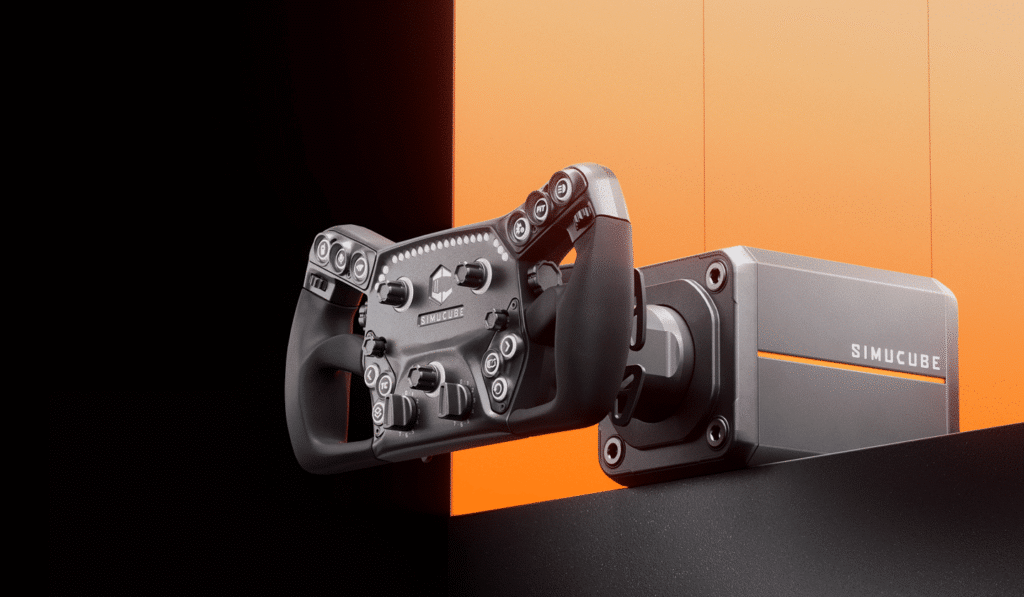
Simucube 3 Pro Direct Drive Wheelbase
Honestly, every Simucube product is a flagship product – that’s kind of the point of the brand. But the SC3 Pro is where most people land – 25 Nm is enough to be genuinely immersive without your arms giving up after an hour of GT3.
With the Simucube 3 range, Simucube have completely redesigned the package: the Control Box integrates the power supply and emergency stop directly into the wheelbase unit, which dramatically simplifies cable management compared to the Simucube 2.
From what I’ve read, the SC3 Pro’s FFB is cleaner and more detailed than the SC2 – which was already very good. The 23-bit encoder is probably the reason; 8 million steps vs the SC2’s 4 million means finer texture in what you feel.
Again, I don’t mind some roughness in my FFB – I had a really good setup with the DD2 where some of the noise / cogging was quite helpful and revealed qualities about the DD2 that I think a lot of sim racers miss. Anyway…
- 25 Nm peak torque (ample headroom for all racing disciplines)
- 23-bit absolute encoder (8 million steps)
- Custom-designed low-cogging servo motor for smooth operation
- Integrated Control Box (power supply + e-stop in wheelbase unit)
- Simucube Link ecosystem reduces USB cable clutter
- Compact form factor compared to Simucube 2
- USB-C connectivity to PC
Simucube 3 pricing at time of writing: the Sport does 15 Nm for €1,405, the Pro bumps to 25 Nm at €1,656, and the Ultimate hits 35 Nm for a rather eye-watering €3,463.
Simucube 2 Pro Direct Drive Wheelbase
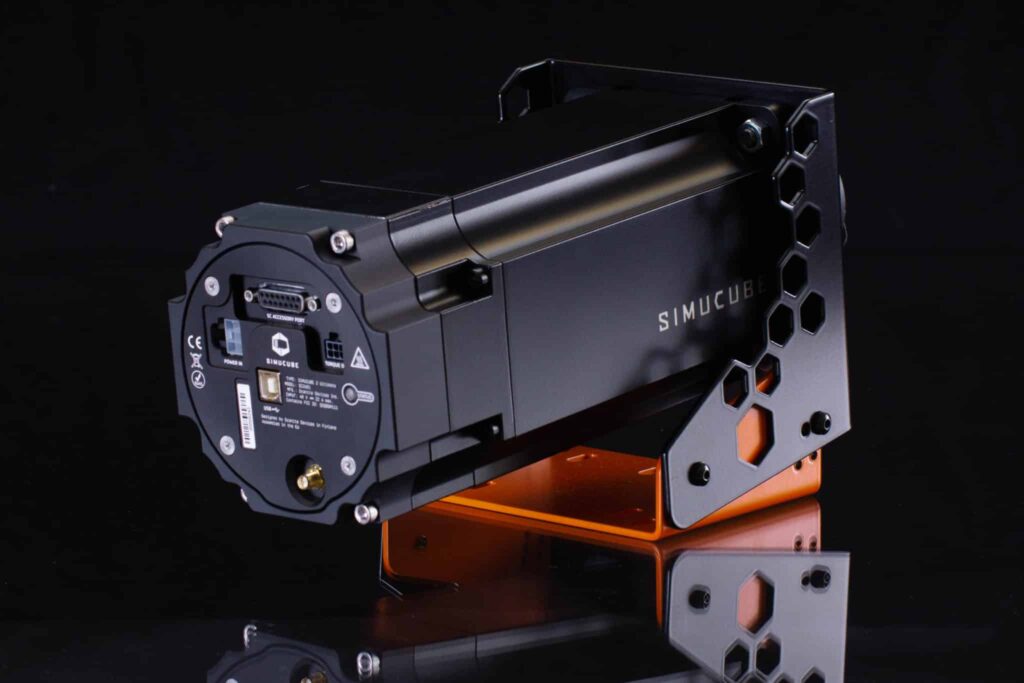
The most popular model in the Simucube 2 lineup for good reason. The 25 Nm torque output hits slightly above the practical sweet spot, with enough torque for realism without the arm fatigue that 30+ Nm can induce during longer races.
Professional drivers reference the SC2 Pro when discussing real-world force feedback comparison, and what I’ve found reading community feedback is that the Pro hits the right balance for most drivers. I hold on to mine as my main wheelbase despite the new higher end wheelbases. Does everything I need it to, and I’ve never once thought “I wish I’d spent more.” You’re getting “industrial-grade” direct drive servo motor technology with 22-bit encoder resolution that translates to granular force feedback detail.
Key Features:
- 25 Nm peak torque (continuous rating also high)
- 22-bit encoder resolution for granular force feedback
- Industrial-grade direct drive servo motor
- Simucube True Drive software for extensive customization
- Compatible with wide range of third-party steering wheels
Simucube ActivePedal Ultimate Primary Set
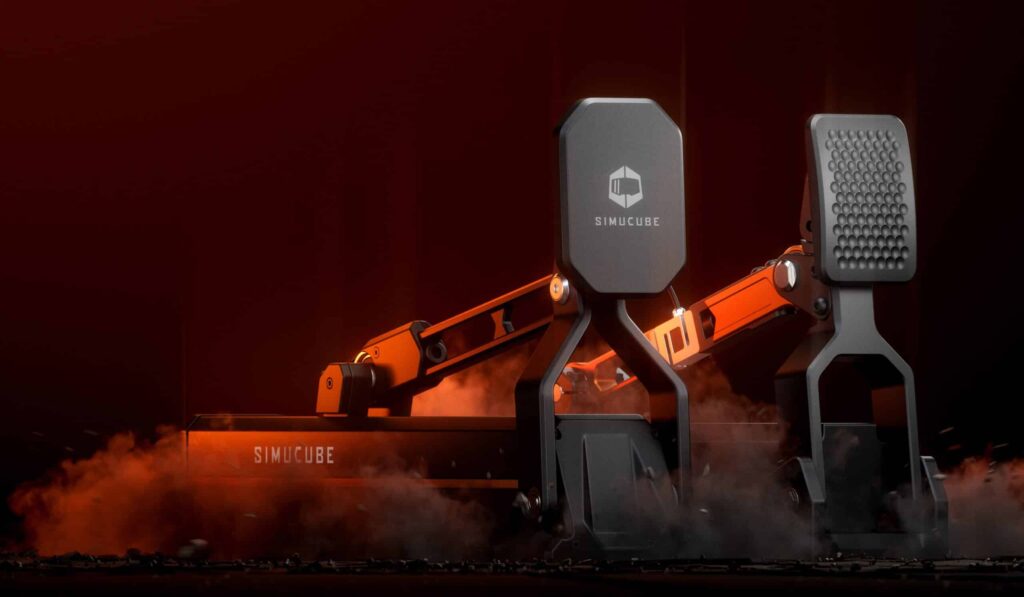
The world’s first force feedback pedal and Simucube’s most innovative product. This represents that occasional shot of innovation in sim racing hardware that certainly took me by surprise when it was announced.
The ActivePedal tactile feedback fundamentally changes braking technique and consistency according to users who’ve made the investment. You can feel ABS activation, traction control intervention, and G-force simulation through the pedal itself. You’ll need a Link Hub to run it, which is sold separately.
Key Features:
- Unlimited adjustability via software (no mechanical adjustments needed)
- Telemetry-based force feedback effects (ABS, traction control, G-force)
- Zero wearing materials – completely maintenance-free
- Automatic profile switching between cars and simulators
- Can function as brake, throttle, or clutch with click of button
- 170 kg brake force, 6 kg unit weight
Direct Drive Wheelbases
The Simucube wheelbase range covers three torque levels across two generations. The SC2 range (Sport 17 Nm, Pro 25 Nm, Ultimate 32 Nm) uses the established True Drive software and is widely available on the second-hand market at attractive prices. The SC3 range (Sport 15 Nm, Pro 25 Nm, Ultimate 35 Nm) uses the newer 23-bit absolute encoder, redesigned motor architecture, and requires the Link Hub for ecosystem connectivity. Every wheelbase in the range uses proper industrial servo motors with CNC-machined aluminium housings – the kind of build quality you can feel the moment you pick one up.
The SC3 Sport is the cheapest way into the new generation at €1,405. Honestly though, if budget’s tight, the second-hand SC2 Pro market is worth a look first. The SC3 Pro at €1,656 is what I’d buy new.
Steering Wheels
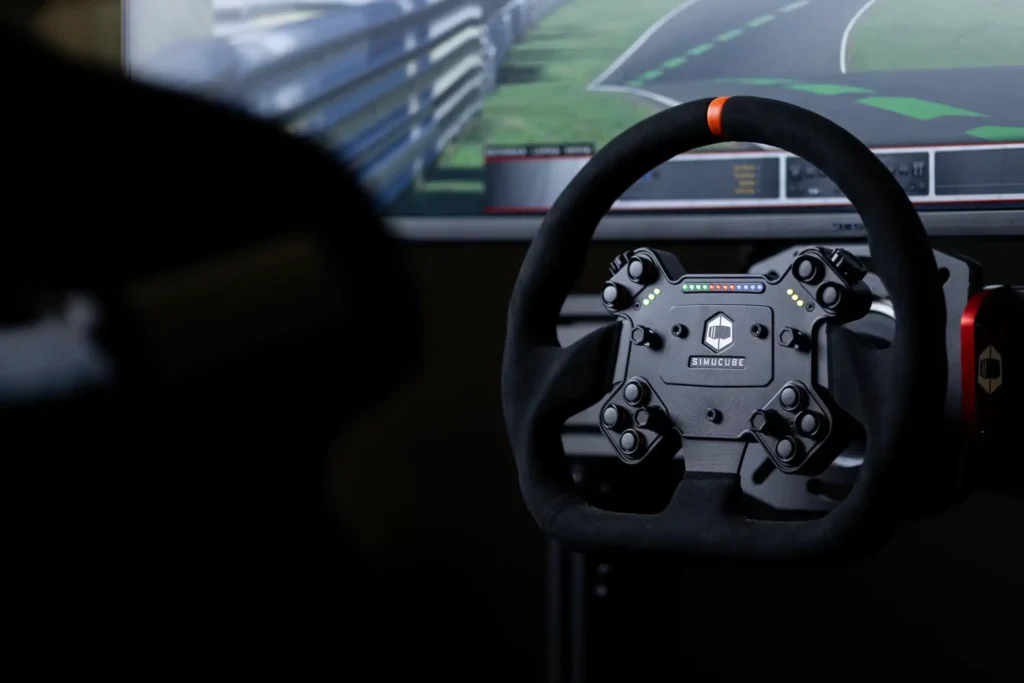
Simucube’s wheel lineup has grown considerably with the SC3 generation. Beyond the Valo GT-23 and the Tahko Round that I’d been familiar with, there’s now a full Savu family and the new Valo Evo open-wheel design. Their wheelbases are also compatible with many third-party wheels via quick-release adapters – you’re not locked in if you prefer Cube Controls or Precision Sim Engineering.
Savu Sport & Savu Pro
The Savu family is Simucube’s new GT-style screenless wheel range designed in Finland and manufactured in the EU. The Savu Sport is the entry point – full-metal frame produced via high-pressure die casting, 12 RGB backlit buttons with interchangeable caps, quiet paddles, and plug-and-play optimised for the Link ecosystem. Step up to the Savu Pro and you get extra encoders, switchers, and a telemetry LED strip across the top – handy if you’d rather keep your eyes on track than glance at a screen. You can grab either one bundled with an SC3 wheelbase, which saves a bit versus buying separately.
What I like about this direction from Simucube is that they’re building wheels that actually look like sim racing wheels rather than trying to replicate something you’d find in a GT car showroom. The die-cast construction is genuinely impressive for the price point – there’s no flex in these wheels, full stop.
Valo GT-23 & Valo Evo
The Valo GT-23 remains the premium round GT wheel – black anodised CNC milled aluminium rim with Alcantara, zero flex, hall effect sensors on the shifters with adjustable bite point position. The wireless Simucube Link connection is standard. It’s an excellent all-rounder and the one I’d point most GT-focused racers toward.
The Valo Evo is new and interesting: the first open-top bullhorn wheel in the Simucube ecosystem. Leather and aluminium frame, two 7-way switches, ten industrial-grade buttons with aluminium guards, plus two rotary and two thumb encoders. Eighteen programmable RGB LEDs. It’s an open-wheel / IndyCar-style shape rather than round, which makes sense given Tony Kanaan’s involvement with Simucube generally. If you’re running open-wheel stuff in iRacing or rFactor 2, the Valo Evo is probably the first Simucube wheel I’d shortlist.
Pedal Sets
ActivePedal Ultimate
The top-tier option. 170 kg of brake force, fully adjustable in software across pressure, travel, curves, damping, and friction – no mechanical fiddling required. Profiles created by professional motorsport drivers are available out of the box. The telemetry-based effects (ABS pulsing, traction control cutoff, G-force simulation) are what make this genuinely different from a load cell pedal rather than just more expensive. Requires a Link Hub to operate.
ActivePedal Pro
Same ActivePedal tech, lower price. You’re at 1,100 N of brake force vs the Ultimate’s ~1,700 N – full software control, telemetry effects, automatic profile switching, all of it. Real talk: most people racing online won’t come close to either limit. The gap between them matters a lot less than the gap between either and a load cell.
Was out of stock last time I checked, which says a lot about demand. Worth checking back regularly if you’re after one.
Co-Pedal & Simucube Throttle
If you’ve bought an ActivePedal as your brake and need passive pedals to complete the set, Simucube now offer two options. The Co-Pedal (€360) is the newer 2-in-1 design – configurable as throttle or clutch, uses a patented mechanical Arc profile for realistic feel without dead zones. Adjustable travel (30–70 mm), rest angle (4–14°), and preload. The redesigned shell frame reduces flex versus the older Simucube Throttle.
The Simucube Throttle (€352) is the original passive companion – load-cell based, 48–84 mm travel range, 80 x 245 x 230 mm. Fair warning though: the Throttle won’t work on its own – you need it paired with an ActivePedal. And if you’re running both an Ultimate and a Pro together, you’ll want an Ethernet switch. Not deal-breakers by any stretch, but the sort of gotchas you want to know about before handing over the card details.
Accessories & Ecosystem
The Simucube Link ecosystem includes the Link Hub for connectivity, Quick Release wheel side kits, and mounting solutions. The SC3 generation uses real-time Ethernet communication with “LightBridge technology” for contactless power and data transfer – meaning no slip rings to wear out and no wiring down the steering column. The SC3 requires the Link Hub as a mandatory purchase (around €101), which isn’t included in the wheelbase price. Factor that in when comparing headline prices.
Compare by Investment Level
Simucube’s high-end positioning means understanding what justifies the investment at each tier. The entry point starts around £1,200–£1,500 for SC3 Sport or second-hand SC2 Sport configurations, the sweet spot sits at £1,400–£2,200 covering SC3 Pro territory (in my opinion), and no-compromise setups begin at £3,000+ including the SC3 Ultimate, ActivePedal, and the full Link ecosystem.
My take – if you’re desperate for Simucube gear but you’re priced out of the brand new market, the Simucube 2 Pro is a fantastic investment on the second hand market. I bought my SC2 Pro back in 2021 and it’s done thousands of hours without a single hiccup – genuinely can’t fault it.
Racing Cockpits Buyer’s Guide

Best VR Headsets for Flight Simulation
Fanatec ClubSport Steering Wheel GT3 for Xbox Review
Simagic Sim Racing: The Complete Buyer’s Guide (2026)
Corsair for Sim Racers: Ecosystem Buyers Guide 2026