


I’m a sim racer and amateur racer with a passion for Motorsport, good racecraft and the technical and setup aspect of sim racing.
Featured image: My cockpit (right) and my son’s Overpower kids’ rig (left)
A sim racing rig (or “sim racing cockpit” – the chassis you mount all your gear onto) is the one part of your setup you feel every single lap. Get it wrong and the whole rig flexes under braking and direct drive load; get it right and you forget it’s there. This guide ranks the cockpits I’ve built, owned and tested in my home sim room, from a $629 first proper rig up to $20k full-motion builds, so you can match the frame to your budget and the gear you’re planning to bolt to it.
After years of swapping rigs in and out of my office, the one I’d put most people on is the Trak Racer TR8 Pro V2 – it’s stiff enough for a 25Nm direct drive wheel, assembles in under an hour, and at $629 on sale it undercuts almost everything that’s as rigid. The rest of this guide is for the buyers that pick doesn’t fit: tighter budgets, the Fanatec ecosystem, formula-style driving, or a full turnkey build you just want delivered and bolted together.
Quick Navigation
Jump directly to what you’re looking for:
What makes a good rig |
Spec comparison |
TR8 Pro V2 |
RCP Cockpit |
Fanatec ClubSport GT |
Alpine Racing TRX |
F1 tubular cockpits |
Sim-Lab premium rigs |
Prebuilt & motion rigs |
The buying process |
Other 2026 cockpits
What Makes a Good Sim Racing Rig
In the list below I’ve stuck to rigs I’ve tested, built or owned. When I pick a frame, three things matter more than anything else: budget, compatibility with the gear you’ve got (and the gear you’ll upgrade to), and rigidity. Aesthetics come a distant fourth. You need a cockpit that’s affordable, stiff, and able to support your equipment as you upgrade over the years.
When I’m testing, I usually mount the Simucube, and occasionally my Fanatec CSL DD – though I’ve also got a Moza R3, R5 and R12 to choose from. If you’re still picking the wheelbase that goes on the rig, my direct drive wheels buyer’s guide covers that side of the decision, and if you’re completely new, start with the beginner’s guide to sim racing first.
Above everything else, rigidity is the one to get right. Higher-end wheelbases and pedals generate far bigger forces – up to 30Nm of torque at the steering wheel and anywhere from 25kg to 120kg at the pedals. That load creates flex: the unintended movement of a rig that’s meant to stay put.
What flex is (and why it ruins the feel)
Flex takes away the mechanical feeling of the equipment and the feedback you get back. At worst you can see it happening – most obviously on the pedal base, where a part that should be firmly fixed visibly bends or twists under load. Some materials give under pressure; that’s flex, and it’s the thing a good rig is built to eliminate.
If you’re not sure what it looks like, here’s a video I shot while recording a heel-and-toe article. Watch the pedal base move as I get on the brakes:
That pedal base (an old RSEAT RS1 cockpit) flexes around 4 degrees at 25kg of brake force. The fix was simple: I upgraded the rig shortly after upgrading the pedals. The reason is that Sprint sim pedals can handle more load than that pedal base was designed for. If I’d been running Thrustmaster or Logitech pedals there’d have been no flex at all, because the brake force would be perhaps a fifth of what the Sprints demand.

The practical takeaway: if you’re going to upgrade your pedals or wheelbase later, decide now whether you’ll upgrade the rig at the same time, or just buy the stiffer rig today and save the hassle. Stripping down a fully built sim rig to swap the chassis is a miserable afternoon, and it’s one I’d rather you avoid. The same flex logic applies to the wheelbase mount, not just the pedals.
Frame material: aluminium profile, steel tube, or plywood

The cheapest material that genuinely kills flex – and the easiest to extend later – is extruded “8020” profile aluminium, the square, boxy-looking stuff. It might not look as pretty to the untrained eye, but experienced sim racers go straight for a profile rig like the Sim-Labs and RCPs below. If sim racing is something you want to stick with and grow into over years, an 8020 aluminium rig is the way to go. It isn’t the only option though – steel tube rigs look cleaner and often cost less, and there are now plywood rigs that flex less than profile. Here’s the short version:
8020 Aluminium Profile
✓ Outstanding strength-to-weight ratio
✓ Near-infinite adjustability and accessory mounting
✓ Easy to modify and upgrade
✗ Can look industrial
Steel Tube
✓ Clean, professional look
✓ Often cheaper than profile
✓ Plenty stiff for most setups
✗ Fewer adjustment and mounting options
Premium Plywood
✓ Surprisingly rigid
✓ Unique, premium look
✓ Environmentally friendly
✗ Fewer mounting options
Sim Racing Cockpit Spec Comparison
Here’s how the rigs I recommend stack up on the specs that decide the purchase – frame material, how much brake force the pedal deck swallows before it flexes, footprint, seat style and price. Prices are bare chassis (no wheel, pedals or PC) unless noted.
| Rig | Frame | Brake / DD | Seat | Price |
|---|---|---|---|---|
| TR8 Pro V2 | 40×40 base / 80×40 uprights ali | 180kg plate, 25Nm+ | Add your own | $629 → |
| RCP Cockpit | 8020 aluminium | Load-cell ready, DD2-class | Bucket or reclining | $875 → |
| Fanatec ClubSport GT | 50mm steel + 8020 ali hybrid | Up to ~30Nm | GT shell, 290mm | $900 → |
| Alpine Racing TRX V2 | 80×40 aluminium profile | 180kg plate, 0-16Nm | Formula/GT switch | $899 → |
| Playseat Formula Instinct | Tubular F1 | All DD | Fixed F1, X-Adapt | $749 → |
| Sim-Lab P1X Pro | 160×40 base / 120×40 uprights ali | 30Nm+, 150kg+ | Configurable | from ~€789 → |
Bare-chassis specs and prices verified June 2026. Trak Racer and Alpine show current direct sale prices.
1. Trak Racer TR8 Pro V2 – Best Overall ($629)
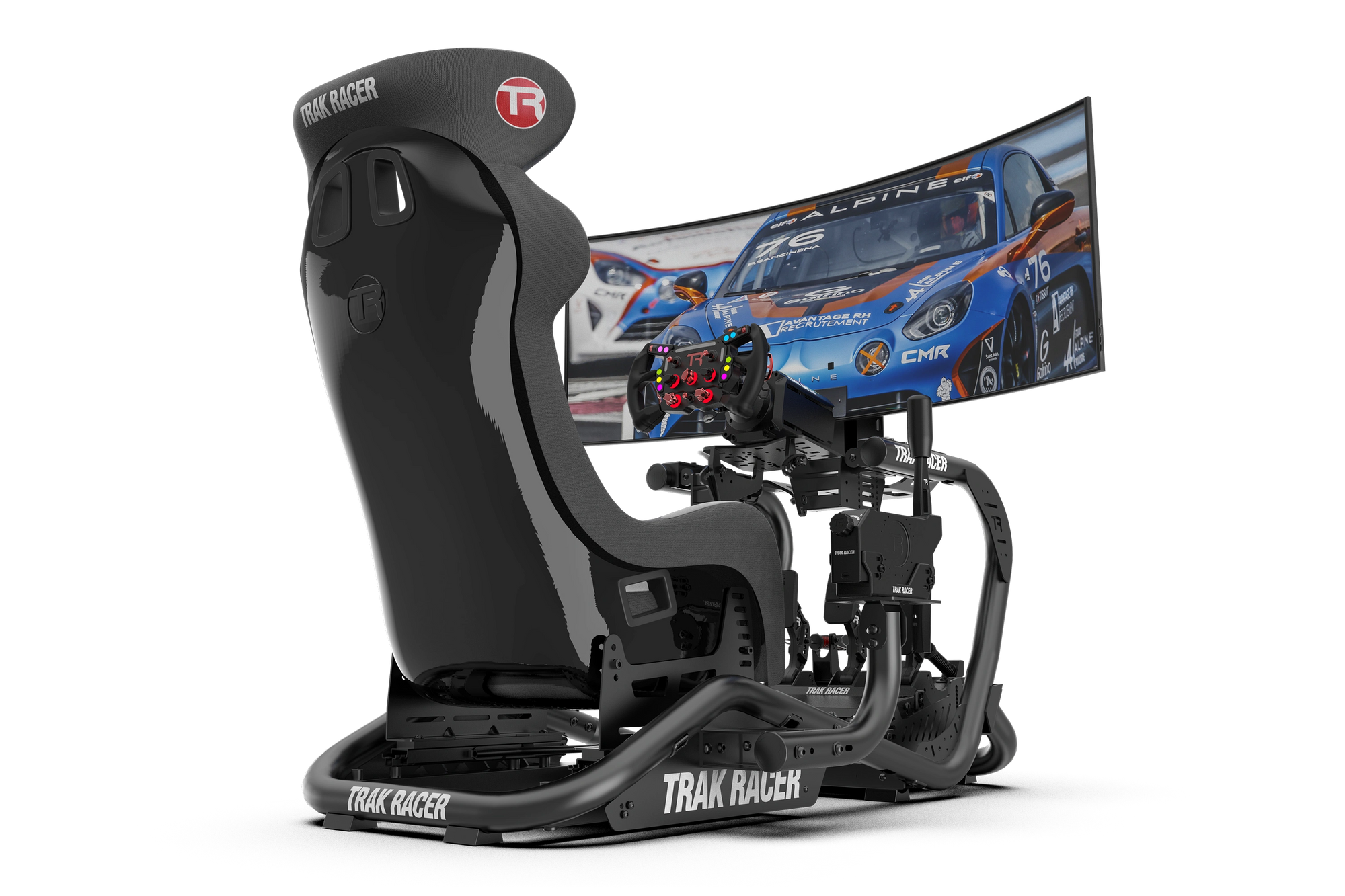
The TR8 Pro V2 sits in an awkwardly useful place in the Trak Racer line – more rig than the entry-level TR40S, but without the Alpine F1 partnership pricing of the TRX. It’s the second-generation update of the 2018-2021 TR8, with feedback from over 10,000 original-TR8 owners baked in. It’s the rig I’d suggest if you’ve been racing on a desk-mounted Logitech setup and you’re ready for your first proper cockpit, but you’re not yet certain you’ll still be at it in five years.
What earns it the top spot is the combination of assembly speed and the wheel mount. The TR8 Pro assembles in 30-60 minutes – the simplest build of any rig here. I’ve not yet had hands on the V2 specifically, but the V1 was famously quick to put together and Trak Racer say the V2 is faster still. The wheel mount is three-point adjustable and dual-supported, so the shaft through it doesn’t twist when a 25Nm direct drive wheel tries to wrench it sideways. The frame is aluminium extruded profile – a 40×40mm base with 80×40mm uprights – and the pedal plate is rated to 180kg of brake force, so a future Heusinkveld Ultimate or Asetek Invicta upgrade won’t outgrow the chassis. It’s racked up over 250 reviews on Trak Racer’s own site at 4.8 stars, which is the community signal that this is a credible pick rather than marketing copy.
You also get an optional integrated single or triple monitor stand (good for diagonals up to about 70 inches), and a universal wheel deck that takes side- and front-mount bases. The honest caveat: it’s a single-purpose cockpit, not a modular extrusion platform. If you’re planning motion, button boxes on extrusion brackets and integrated triple-monitor mounting from day one, the bigger 8020 rigs make more sense. But for a strong, fast-to-build cockpit at $629 on sale (RRP $699), nothing in the bracket does the core job better.
2. RCP Cockpit – Best Value ($875)

If you want the stiffness you’ve read about on the smallest budget, with proper scope for upgrades, the RCP Cockpit from Racing Cockpits is the one I point people at. It’s a sturdy 8020 extruded aluminium rig with a Fanatec-compatible pedal base, wheelbase mount and shifter rails, and a 28″ × 55″ footprint that doesn’t dominate a room. It takes a side-mounted bucket seat or a bottom-mounted reclining seat, supports a vibration plate, and handles the full Fanatec CSL DD / GT DD Pro / DD1 / DD2 range plus Simucube 2 and the Logitech G-series.
RCP also sells a stack of upgrades for it – a stiffer Fanatec DD2 side mount, a Simucube front-mount bracket, and single or triple-monitor mounts – so it grows with you rather than capping you out.
Update June 2026: the older RCP Cockpit Sport is still out of stock as I write this (the affiliate feed confirms it), so the active Racing Cockpits pick is the RCP Cockpit PRO at $875 frame-only (or $1,095 with an NRG seat).
3. Fanatec ClubSport GT – Best for the Fanatec Ecosystem ($900)
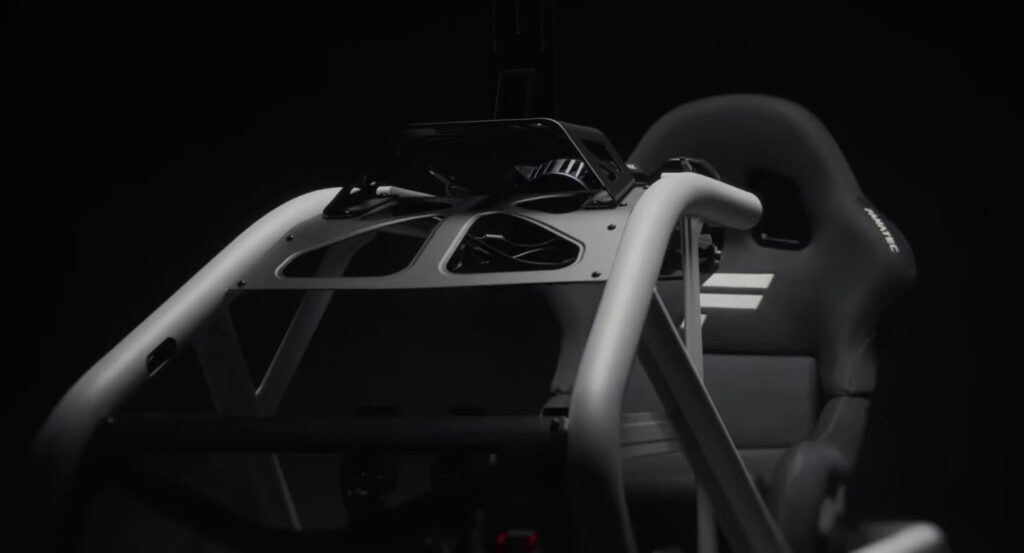
The Fanatec ClubSport GT is a hybrid build – 50mm round steel tube triangulated with 8020 aluminium profile – which gets you the clean tubular look with the rigidity to take a direct drive wheel up to around 30Nm without complaint. It’s pre-drilled for the entire Fanatec ecosystem and pretty much every third-party base too, with both side and front wheelbase mounting, a pedal plate that swaps between GT and Formula positions, and a 290mm seat bolt pattern. Build time is about two hours even with the sparse instructions, and the whole thing is tool-free to adjust once it’s together.
Fanatec have gone to town on the accessory ecosystem: an adjustable-width PC tower mount, a keyboard/mouse tray that fits either side, upper accessory rails for screens and streaming gear, and genuinely clever cable management on the front PC tray. There’s onboard 100×100 VESA mounting that handles a 27-inch 16:9 up to a 49-inch ultrawide. Worth knowing: Corsair acquired Fanatec’s parent company in September 2024, so the stock problems that plagued Fanatec for years have largely stabilised under Corsair’s logistics – this is a cockpit you can buy and have arrive.
It’s leagues ahead of the old Rennsport and original ClubSport cockpits, and for anyone already running Fanatec wheels and pedals it’s the obvious 2026 pick. One quiet money-saver if you’re buying direct: the code SIMRACINGCOCKPIT5 takes 5% off most of the Fanatec catalogue at checkout.
4. Alpine Racing TRX V2 – Best for Formula/GT Switchers ($899)

The Alpine Racing TRX is a commercial-grade simulator co-developed by the Alpine F1 Team and Trak Racer, engineered and designed in Australia with input from F1 engineers. The headline feature is the seating: it switches between a Formula and a GT driving position tool-free, so if you split your time between open-wheel and GT3 it’s the one rig that does both properly. The V2 runs an 80×40mm aluminium extruded profile frame at around 32kg, takes a direct drive wheelbase up to 16Nm, and the pedal plate tilts and handles serious brake load. Trak Racer now offer D-BOX Gen 5 motion integration with bespoke brackets for the TRX range too, so it’s a genuine upgrade path into motion later.
At $899 on sale (RRP $999) it’s a step up in money from the TR8 Pro V2, and you’re partly paying for the Alpine F1 pedigree and the switchable seating. If you only ever drive GT3, the TR8 Pro V2 or RCP will save you money. If you live in formula cars but want GT on tap, this is the rig. It carries a 5-year warranty.
5. Tubular F1 cockpits – Playseat Formula Instinct & the Fanatec bundle (from $749)
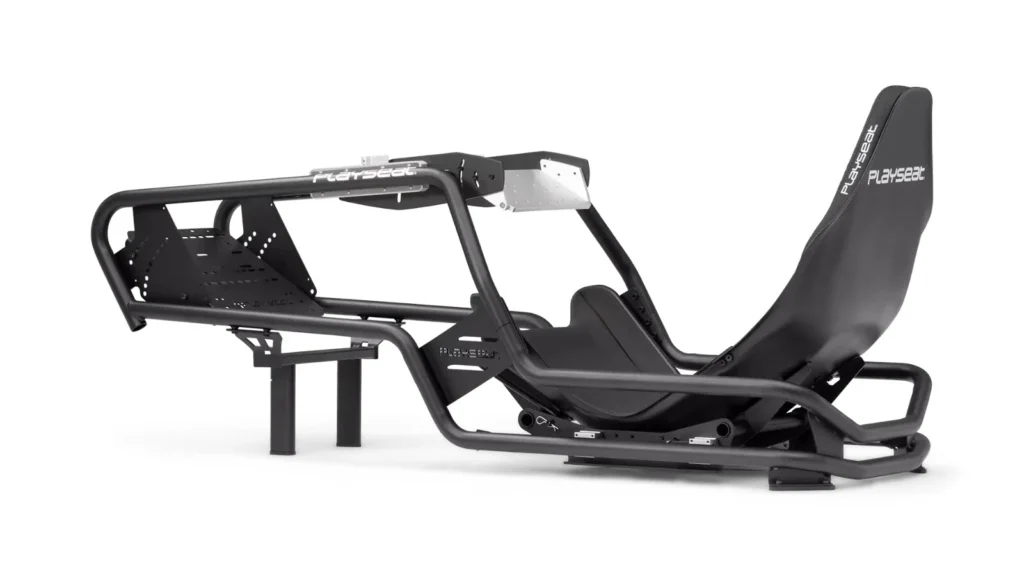
Tubular cockpits are having a moment, and for open-wheel racing I get why. A round-tube F1 frame drops you into a proper reclined single-seater position that a boxy 8020 rig has to be coaxed into, it goes together in a fraction of the time, and fitting your base and pedals is far less fiddly. For anyone who mostly drives F1, Formula or LMP, this is the shape to look at.
The one I’d point most people at is the Playseat Formula Instinct – F1 Edition at around $749. It’s the lightweight, officially F1-licensed tube cockpit built with the teams, with Playseat’s aluminium X-Adapt quick-release for the wheel plate and a fully adjustable pedal plate. Assembly is close to tool-free until you start bolting hardware on, the fixed formula stance holds firm under a direct drive load, and it stows away when you need the room back. If you want the full-fat version, the Instinct’s bigger sibling – the $2,000 Formula Intelligence with the heavier ForceLock frame – is the one Verstappen’s photographed in, but for most sim racers the Instinct does the same job for a third less.
If you’re buying into the Fanatec ecosystem there’s a neater answer still, and it’s the one we keep coming back to: the Fanatec CSL Cockpit Formula V2.5 Bundle at $1,459. It’s the all-in-one on this page I’d recommend – a CSL DD with the Boost Kit 180 (8Nm), the ClubSport Formula V2.5 wheel, CSL Pedals and the CSL Cockpit, matched and warrantied as a single box. You get a formula-position rig, wheel, base and pedals for one price and one order, and the SIMRACINGCOCKPIT5 code still knocks 5% off at checkout. For a first proper F1 setup where you don’t fancy sourcing parts separately, it’s hard to beat.
Sim-Lab P1X Pro and GT1 Evo – the premium 8020 rigs
Sim-Lab is the brand I built my own test bench around, and it’s where a lot of experienced sim racers end up: premium 8020 extruded aluminium, zero measurable flex, and the widest accessory range of anything here. Two are worth knowing – the flagship P1X Pro and its cheaper GT-position sibling, the GT1 Evo. Both are configurable, so the price shown in the cards below is the starting point, live with stock – I’d still sanity-check the exact config before you pay.
Sim-Lab P1X Pro – my test rig (from ~€789)

The P1X Pro is the rig I assembled as SimRacingCockpit’s own test bench – the frame I bolt every wheelbase and pedal set onto when I’m reviewing them, and it earns that job. The 8020 profile is stiff enough that I’ve measured zero flex under a 25Nm-plus direct drive wheel and load-cell pedals, the pedal plate adjusts through a proper raised-leg F1 position, and assembly was genuinely painless: every bag of bolts is labelled and the build took me about 1.5-2 hours. It’s a buy-once, keep-for-years cockpit, and the accessory ecosystem – monitor mounts, keyboard trays, button-box brackets, shifter mounts – means it grows with whatever you throw at it.
It’s configurable rather than a single price – you choose the wheelmount (front mount, wheeldeck or a Fanatec DD mount), an optional integrated monitor mount, and an optional seat – so the cost climbs from around €789 as you add to it. You can configure and buy the P1X Pro at Sim-Lab, and check the options and stock before you pay. I’ve written the full build up in my P1X Pro build and first impressions, and the Sim-Lab buyer’s guide covers the rest of the range.
Sim-Lab GT1 Evo – the GT-position sibling (from ~€379)

The GT1 Evo is the one I point people at when they want a genuinely high-end 8020 rig without P1X money. It drops you into a GT driving position rather than the P1X’s F1-style stance, uses the same stiff 40×80 profile that shrugs off 25Nm at the wheelbase and load-cell pedals up to around 80kg, and it comes pre-drilled so the initial setup is quicker – figure 2-3 hours. It’s the less expensive sibling of the P1X, and for a lot of people it’s the smarter buy. Configure the GT1 Evo at Sim-Lab – again, check the config and stock before you commit.
Prebuilt & Full-Motion Rigs (If You’d Rather It Arrived Built)
Everything above is a chassis you build up with your own wheel, pedals and seat. If you’d rather skip the parts-picking and have a complete rig delivered – or you want full-motion – these are the turnkey options I’d point you at. You pay a premium for the convenience and the matched components, but there’s no sourcing, no compatibility guesswork, and on the motion rigs no way you’d assemble it better yourself.
Trak Racer TR160 MK4 – Full Motion (~$21,999)
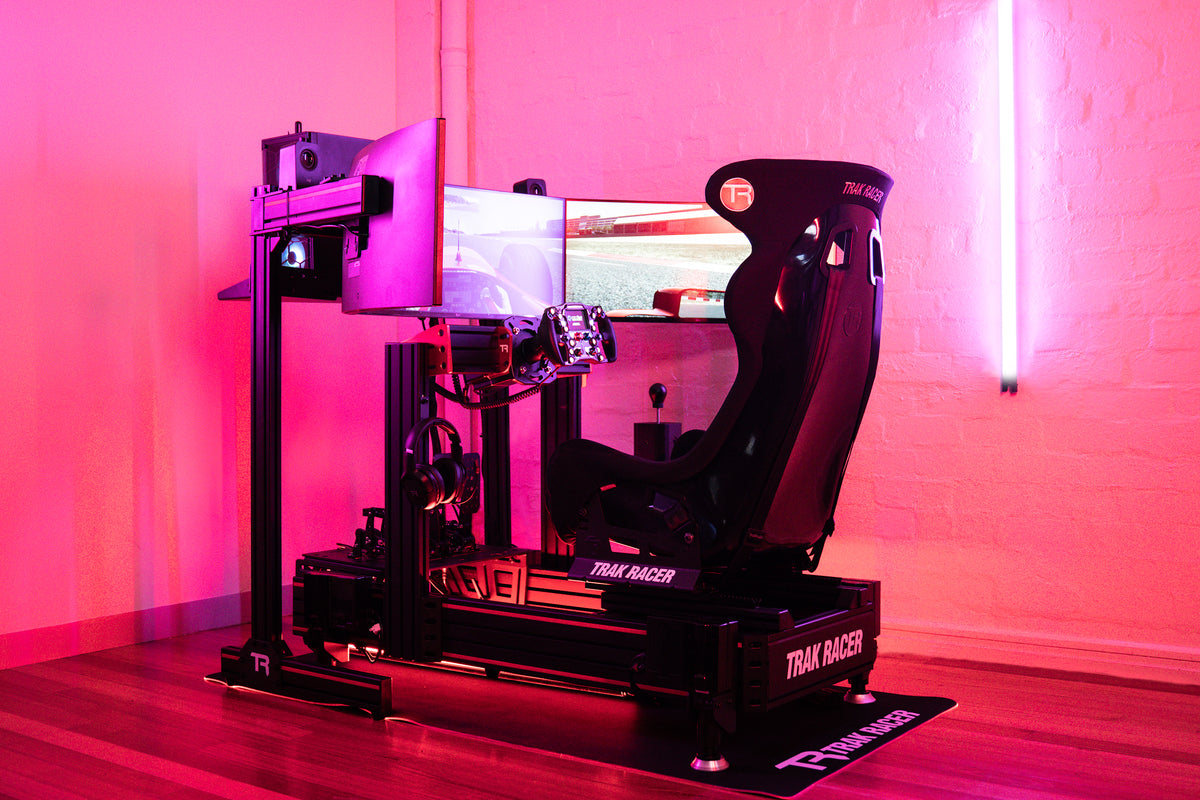
The showpiece. An 8020 TR160 chassis on a D-BOX Gen 5 four-actuator motion platform, with a Simucube 2 Pro 25Nm base, Cube Controls wheel and VNM load-cell pedals. Rated to a 120-150kg driver and it ships fully assembled. This is the “money no object, build me a rig” answer. Check it at Trak Racer →
Trak Racer Spec 1 – TR8 Pro Plug-and-Play (~$9,388)
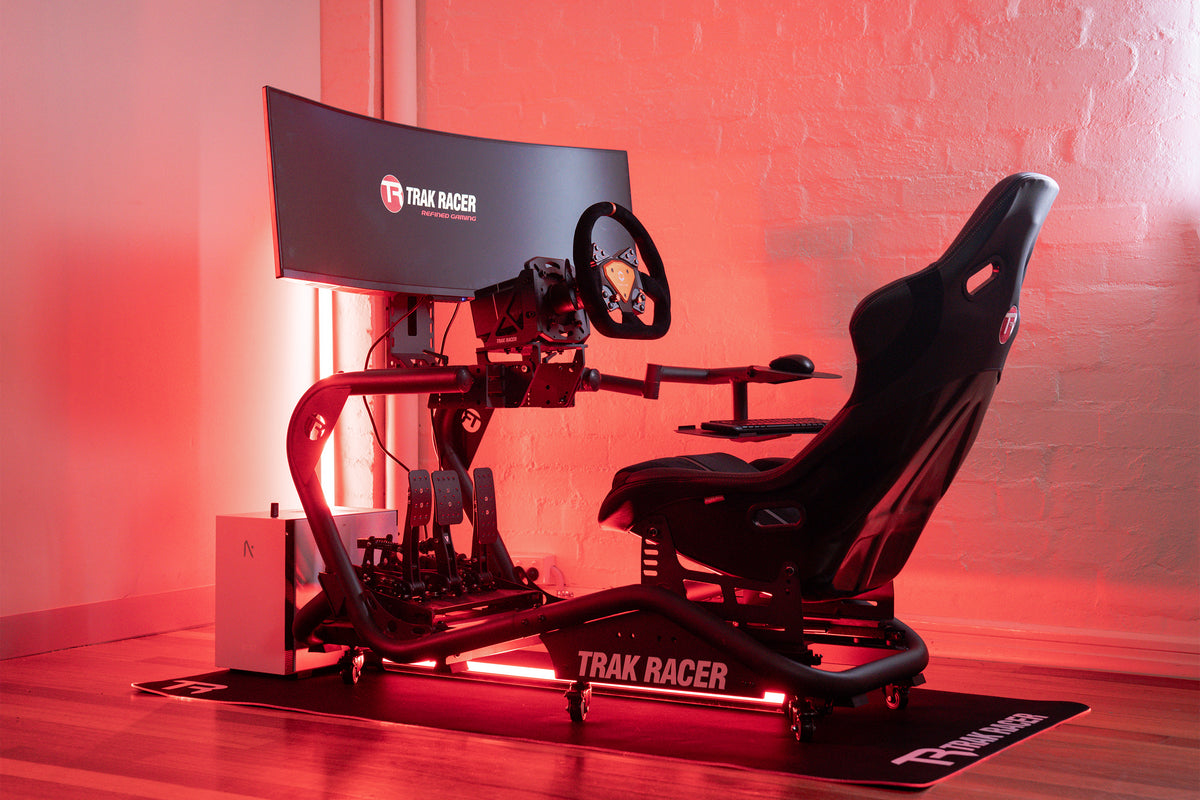
The mid-tier turnkey. A TR8 Pro cockpit pre-built with a Simucube 2 Sport direct drive base, pedals and a PC – one order, plugged in and racing. The same rigid chassis as my top pick, just delivered complete. Check it at Trak Racer →
Fanatec ClubSport GT Cockpit GT3 Endurance Bundle (~$3,064)
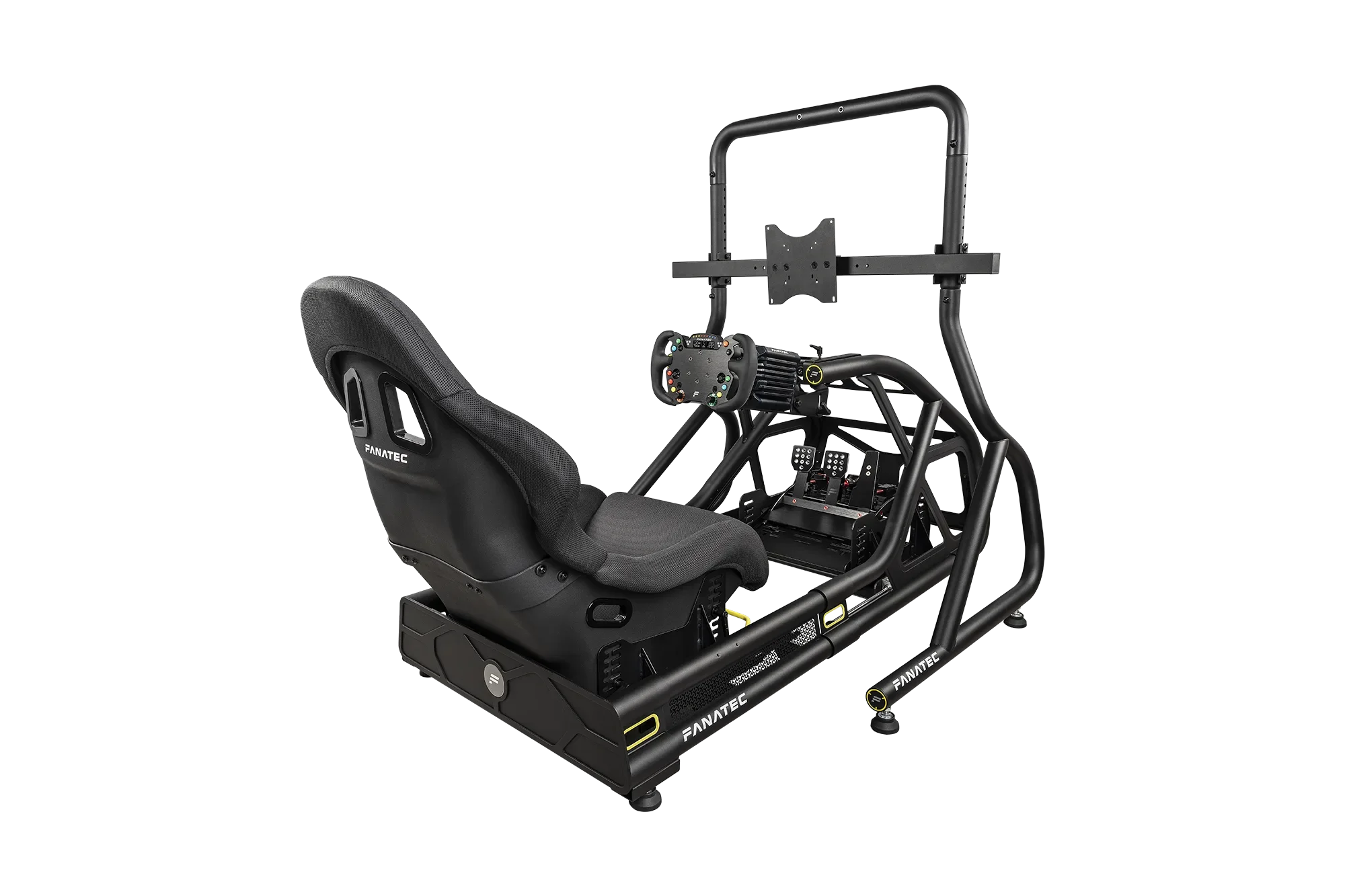
Fanatec’s complete all-in-one. The full ClubSport GT cockpit and seat with a DD+ 18Nm base, ClubSport V3 pedals and a GT3 wheel, matched and warrantied as one package. This is the genuine cockpit bundle (not the desk-mount hardware-only Ready2Race) – the ecosystem answer to “just sell me a finished rig”, and the SIMRACINGCOCKPIT5 code still applies. Check it at Fanatec →
The Buying Process: Seat, Wheel Deck and Mounts
A couple of things catch people out at checkout. Some rigs are sold as a seat-and-frame combo; others list the frame only, with the seat as a separate line item, so a “cheaper” rig can end up costing the same once you’ve added a seat. The other variable is the wheel deck and any monitor stand you want included.
Wheel deck choice comes down to how your wheelbase mounts. The CSL DD, for example, is side-mounting, whereas MiGE-based bases like the Simucube are front-mounting – so check the rig offers the mount your base needs before you buy. If you’re starting from nothing, you can build a complete setup for around $1,200 with a gaming PC you already own: a value frame like the RCP, a starter direct drive wheel, and a set of pedals. For most people, though, the TR8 Pro V2 at $629 is the frame I’d build the rest of the setup around.
And the rule that’s saved me money every time: if you can possibly stretch to it, buy the stiffer rig now. An 8020 extruded aluminium chassis (or the hybrid Fanatec) will outlast every wheelbase and pedal upgrade you throw at it, and you’ll never have to strip a built rig down to replace the one part you can’t upgrade in place.
One More 2026 Cockpit Worth a Look
The rigs above are the ones I’ve spent the most time with, but there’s one more 2026 cockpit I reckon is worth knowing about before you commit.
Trak Racer TR5 Hybrid (~£499)
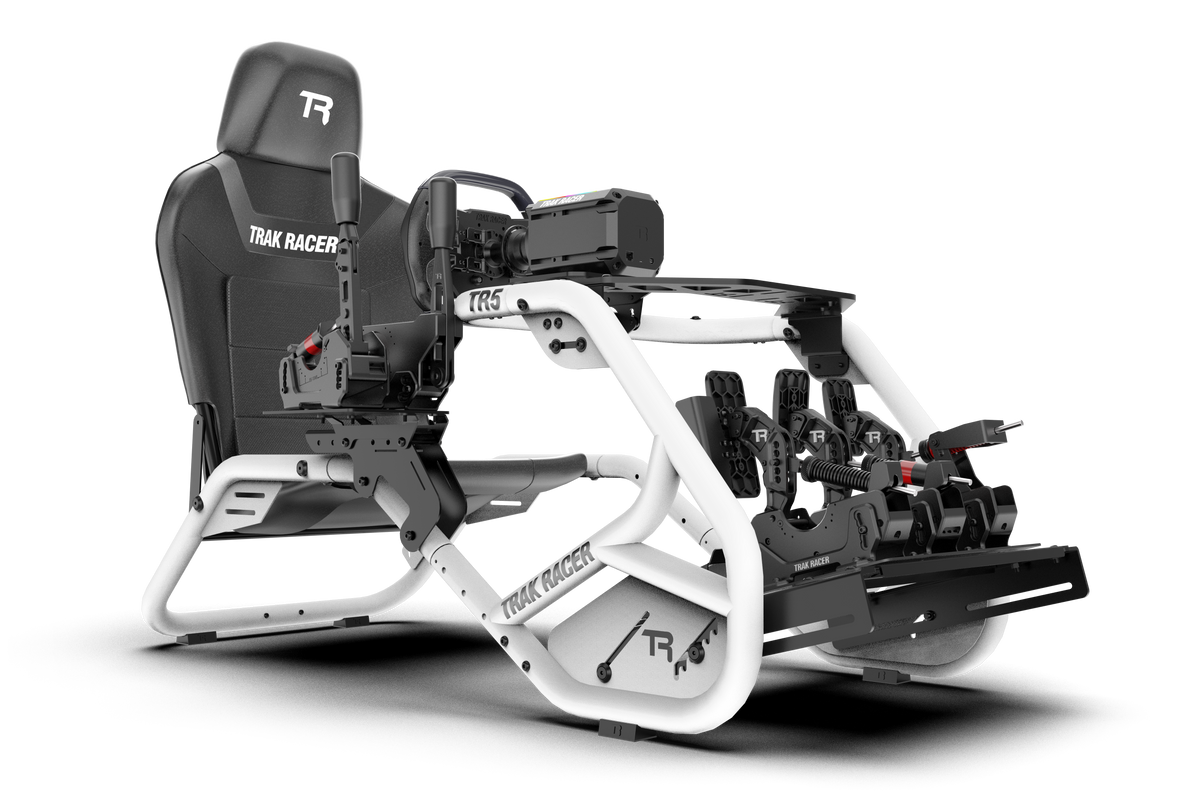
I like the look of this, and for the money it seems like a good deal. Tubular gear is back in fashion because, built well, it’s rigid enough – and it’s much easier to assemble than a classic 8020 rig, and so much easier to fit your base equipment to. This one’s for the sim racers who just want a cockpit, rather than the “I’m going to turn my bedroom into the inside of a GT3 racing car” crowd.
It’s a hybrid steel-and-aluminium build that takes most direct drive wheelbases up to around 12Nm without flex (a Simucube 2 Pro is TR8 territory), and it folds away when you need the room back. Check the TR5 Hybrid at Trak Racer →
For the full direct drive context that informs which rig makes sense, my direct drive wheels buyer’s guide covers the wheelbase side of the same decision, and the seat guide covers what to bolt into the frame.
Related posts:
Pimax Dream Air SE (SLAM) Review: My Verdict
Conspit 310 APEX Review: Getting Back to a 310mm Wheel
What’s Going On With Pimax?
Should You Upgrade From a Quest 3 to the Pimax Dream Air?
Ascher Racing 8-inch Dashboard Review: Recommended DDU
MOZA FCS Farming Control System Review
Topic: Sim Racing Cockpits