
I’m a sim racer and amateur racer with a passion for Motorsport, good racecraft and the technical and setup aspect of sim racing.
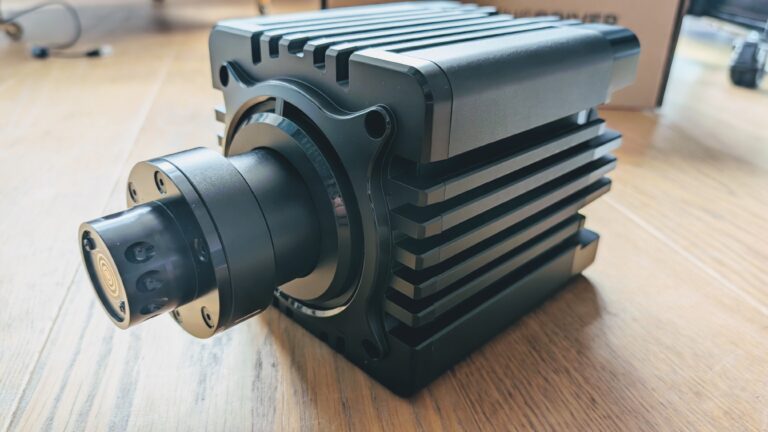
Featured image: Moza R12 V2 wheelbase
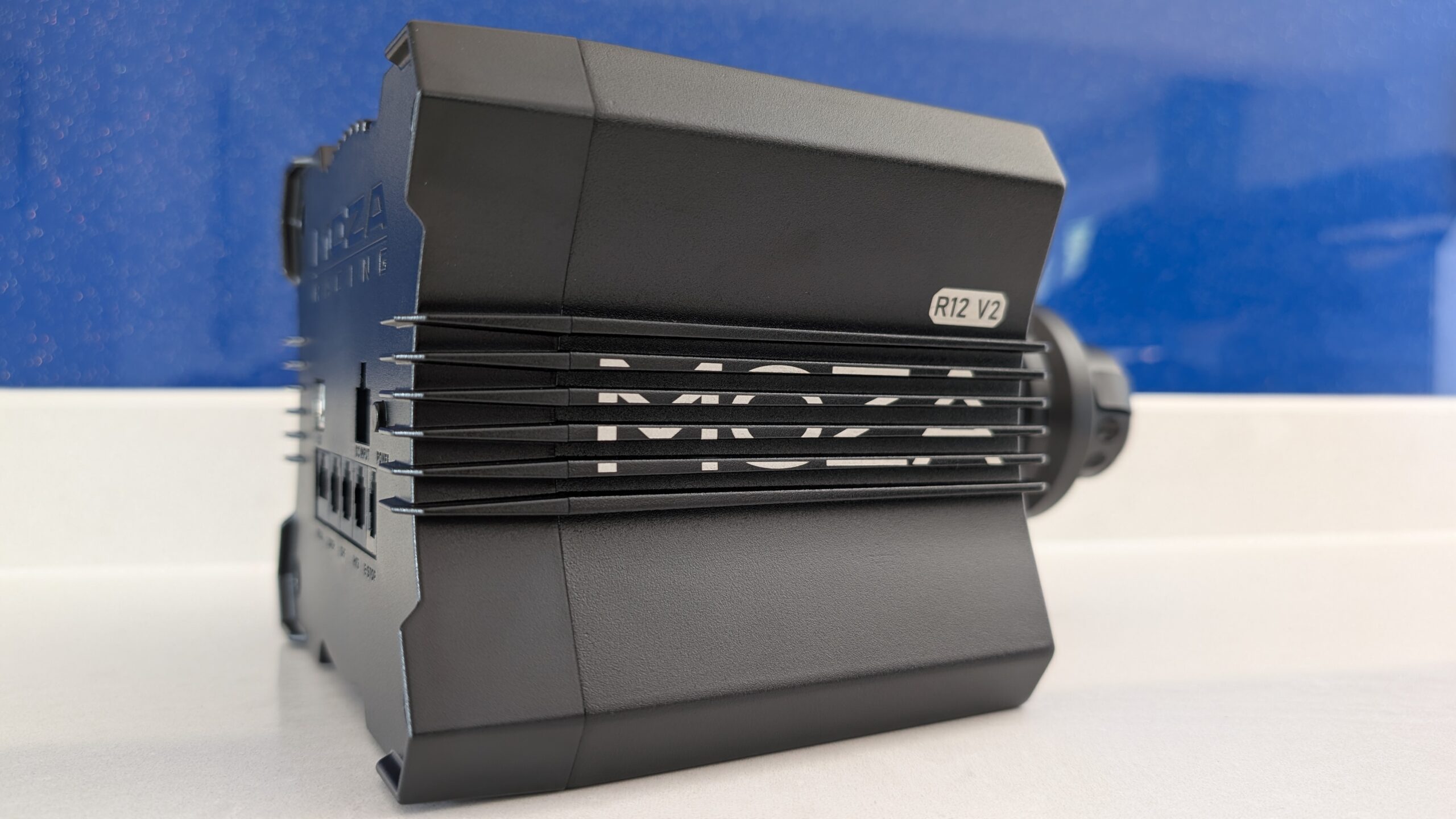
I’ve had two generations of Moza’s R12 on my rig now, and to me the R12 is just a bargain. It has a good amount of torque for a beginner to intermediate driver, the force feedback is detailed, and you’re not going to get bored of it in a hurry. Five years ago there were only one or two direct drive wheelbases really worth going for, and it was probably a Fanatec. Now we’ve got all this choice, and the R12 is right there, really claiming the middle ground as the all-round, mid-range direct drive base that doesn’t cost a fortune.
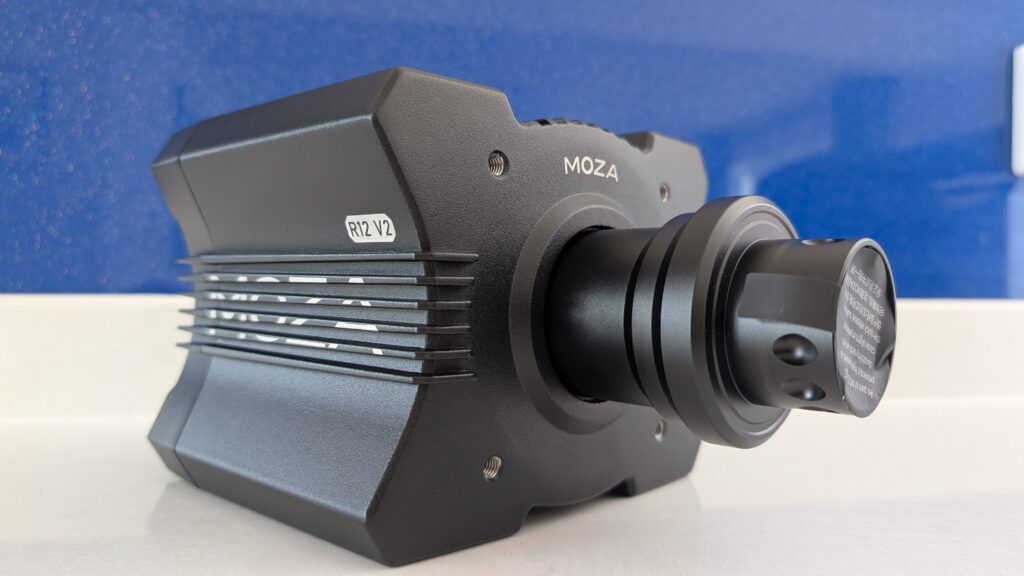
I reviewed the original R12 in October 2024, not long after Moza installed their NexGen 3.0 firmware on it, and the following year Moza sent over the R12 V2, which I ran for about a month alongside my Simucube 2 Pro. In today’s post I’m taking a closer look at what Moza changed for the V2, how the original felt on my rig, what I measured on my own unit, and why I’d still pick it over the Simagic and Fanatec bases around it.
Quick Navigation
Jump directly to what you’re looking for:
R12 vs R12 V2 |
The original R12 |
A month with the V2 |
The numbers |
Pit House |
Build |
Competition |
Who should buy it?
What changed from the R12 to the R12 V2
From the outside you’d struggle to tell the original R12 and the R12 V2 apart – same 12 Nm, same motor, same ports – and most of what Moza changed is in the encoder and the firmware. The encoder goes from 15-bit (32,768 steps per revolution) to a 21-bit magnetic encoder with 2,097,152. The firmware moves from NexGen 3.0 to NexGen 4.0, which adds an iRacing 360 Hz mode and cogging torque compensation, and Pit House now gives you 19 force feedback settings to play with where the original had up to 15. Moza have also added front mounting holes to the four underneath, and the V2 has the carbon-fibre-wrapped rotor that Moza lead with in their marketing.
| Spec | R12 (V1) | R12 V2 |
|---|---|---|
| Peak torque | 12 Nm | 12 Nm |
| Encoder | 15-bit (32,768 steps) | 21-bit (2,097,152 steps) |
| FFB algorithm | NexGen 3.0 | NexGen 4.0, iRacing 360 Hz mode, cogging compensation |
| Rotation | Limitless | 90-2,700° |
| Mounting | Bottom | Bottom and front |
| Power supply | 216 W peak | 216 W peak |
| Weight | 7.5 kg | 7.5 kg |
| USB refresh | 1000 Hz | 1000 Hz |
| Slip ring | Conductive, rated for 5 million revolutions | Conductive, rated for 5 million revolutions |
The rotation changed as well: the original was listed as limitless, and the V2 is set anywhere between 90° and 2,700° in Pit House, which for most driving is no loss at all.
Moza discount code: use SIMRACINGCOCKPIT at checkout for 3% off at mozaracing.com.
My time with the original R12
Once set up, the original R12 felt natural to use. On the default settings it gave me detailed feedback across iRacing, Assetto Corsa and rFactor 2, and the main steering shaft is secure and confidence-inspiring. 12 Nm felt like more than enough to cover almost every sim racing discipline, with enough headroom to keep clear of clipping and plenty of power left over for clean force feedback. At the top end of its range it never clattered or felt like it was going to shake itself to bits, and I never had a single scary oscillation with Moza’s Hands-off Protection switched on. That left me with the impression of a wheelbase that’s well built and well sorted in its firmware.

Kerb strikes, bumps and oversteer came through without any interference – the R12 gives you a clean signal straight from the wheelbase to your hands. Understeer wasn’t always as clear in my testing in AC, which leaves you leaning more on the visual and audio cues. Setting AC’s slip value to 50 or above seemed to help with that.

12 Nm is a great step up from entry-level wheelbases, and it could even be enough power to never want for anything else. And with Moza’s range of rims, pedals and add-ons, once you’re in their ecosystem there’s probably little reason to leave, unless you’re aiming for some really high-end kit.
A month with the R12 V2
I’d been running a Simucube 2 Pro for a couple of years by the time the V2 arrived, and before that I’d spent time with a Fanatec CSL DD and the original Simagic Alpha Mini. So I was coming at the R12 V2 from what a lot of people would call the benchmark, and I was curious whether a base in this part of the market could hold its own against units costing a lot more.
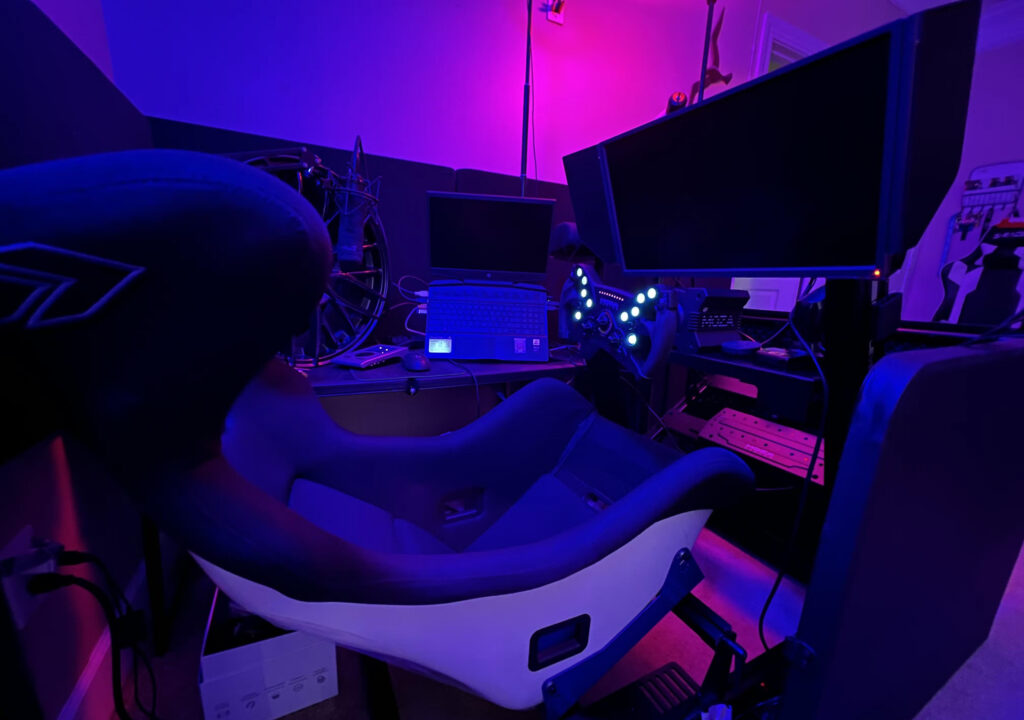
My first proper session was in ACC at Spa, and something felt odd through Eau Rouge. On the Simucube, the weight transfer through there arrives as a progressive build of resistance. The R12 felt different – not worse, just different – and it took me a few laps to work out why. It wasn’t trying to give me the weight you’d expect from hydraulic power steering, the way a lot of wheelbases do. What I was getting was more direct, mechanical feedback.
Over the month, the R12 V2 was remarkably consistent. Some wheelbases I’ve owned feel different depending on temperature or how long they’ve been running. The R12 V2 felt the same on a cold morning as it did after a three-hour endurance stint, and that’s an improvement over Moza’s earlier bases.
The motor, the encoder and my measurements
Moza’s headline for the motor is the slanted-pole design, which they describe as an asymmetric segmented skew. The point of it is to cut cogging torque, the notchy feeling you get in cheaper wheels as the magnets pass the poles. The carbon wrap around the rotor gets a lot of attention too; Moza say it’s there to protect the rotor, suppress eddy current losses and help with heat. Carbon fibre is also stiffer than structural steel, at around 230-390 GPa against 200 GPa. By my own rough reckoning the rotor’s inertia comes down from about 0.012 to 0.008 kg·m², a third lower; Moza don’t publish a figure for it.
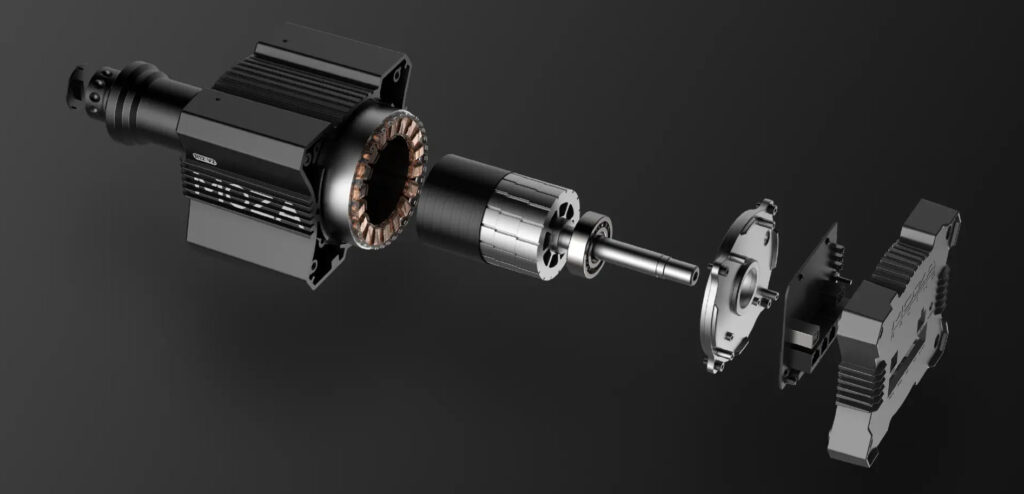
The encoder numbers are easier to pin down. 2,097,152 steps per revolution at 900° of rotation works out at about 2,330 steps per degree, far finer than any movement you could make with your hands. Is it overkill? Absolutely, although it does mean you’ll never notice any stepping or resolution issues on this base.
On my own unit, cogging came out at roughly 0.15 Nm, which is impressively low for this kind of money – my old CSL DD measured around 0.4 Nm. After a 45-minute ACC race the motor sat at 42°C; it went from rest to 12 Nm in 0.018 seconds and drew about 145 W on average while I was racing. Moza’s temperature management keeps it quiet, and I do wonder if there’s performance left on the table there; Pit House has a Radical temperature option too, which is what I ran on the original R12.
Pit House and NexGen 4.0
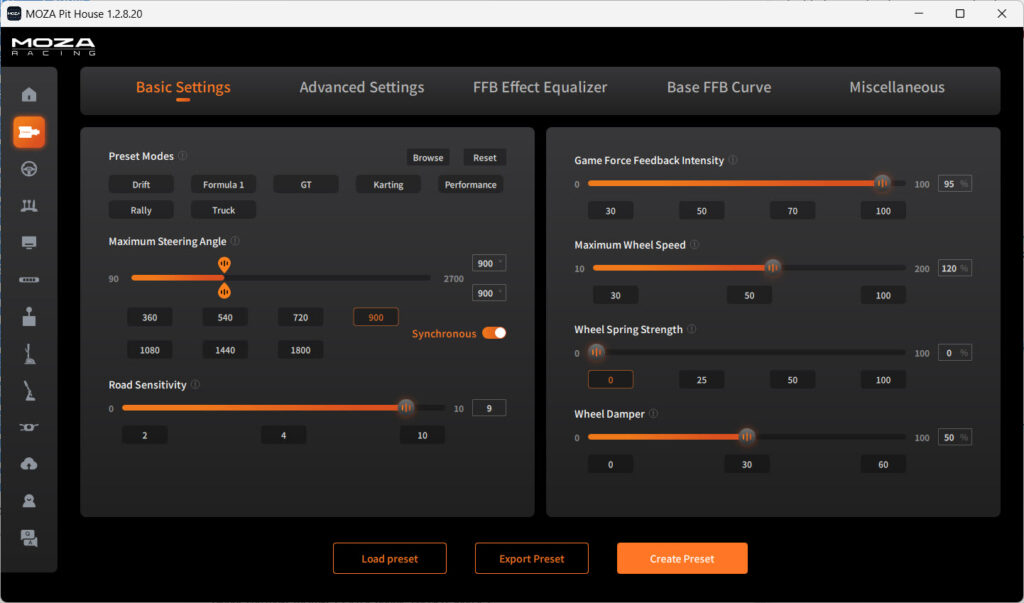
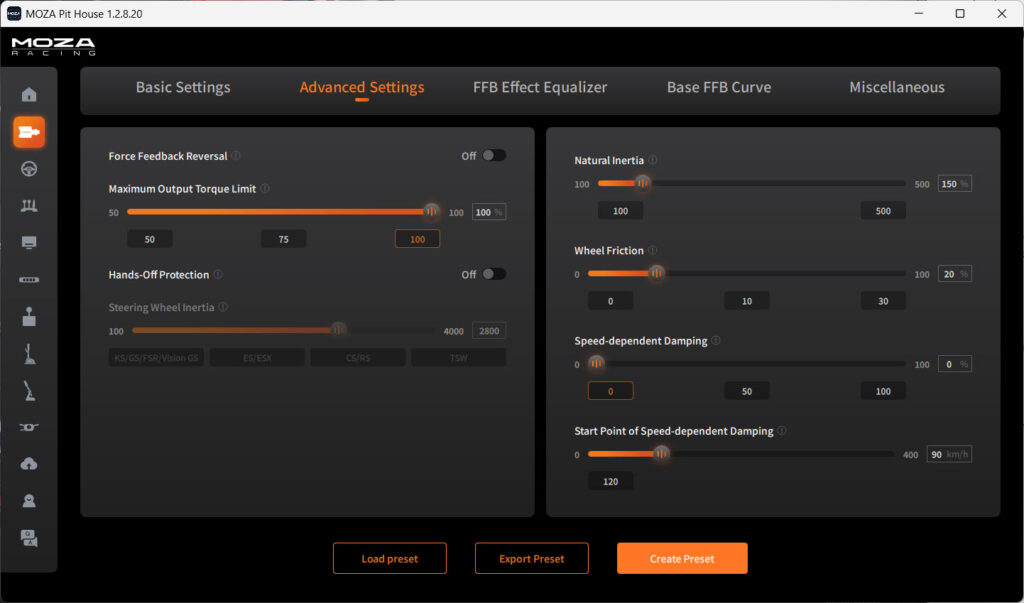
Everything is set up in Moza’s Pit House, and it has come a long way since I last tried Moza products. You can build a profile per sim (AC needs a little less gain than iRacing to stop the wheel oscillating) and set the rev lights on your rim from the same place. The NexGen 4.0 algorithm does make a difference, although it isn’t better everywhere, so give yourself a few sessions before you decide whether you like it. There’s also tons of support online, with settings for each of the main sims, and I’ve put mine together in my Moza FFB settings for iRacing.
The FFB Effect Equaliser is the setting I spent the most time with. It’s a seven-point EQ from 0 to 100 Hz, set in percentages, with weight transfer down at 0-15 Hz and road texture up at 40-100 Hz. I boosted the 15 Hz point, which made understeer much easier to read in ACC, and pulled back the top end to stop the kerbs at the Monza chicane from trying to rip my arms off. The mobile app is useful as well: you can change the force feedback mid-race without alt-tabbing, which helps when you’re learning a new car or track. I do wonder about the security side of having a wheelbase connected to the cloud, though.
Build and connections
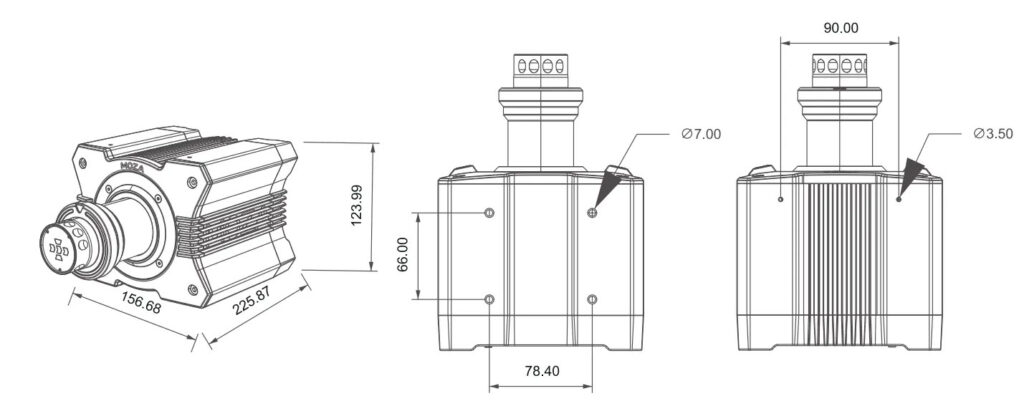
The R12 V2’s housing is aviation-grade aluminium with a black painted, laser-etched finish, and it feels properly solid. The PC connection is a USB Type-B rather than the more fragile Type-C some manufacturers are moving to. Moza pedals, shifters and their handbrake plug straight into the back. The packaging was excellent when my original R12 arrived, with the right mounting bolts and a small tool kit in the box, so fixing it to my rig was a breeze – although at 7.5 kg it’s not a lightweight.
The quick release is Moza’s own design. If you want to use a rim from another manufacturer, Moza sell a 70 mm Quick Release Adapter, but only the steering works through it, not the buttons. My Vision GS review goes into how the Moza QR hub works, as I ran that wheel on my Simucube. The wheel connects through a conductive slip ring rated for over 5 million revolutions; at an average of 1,000 revolutions per hour of racing, that’s 5,000 hours. Not infinite, but reasonable. What concerns me more is the proprietary quick release and wheel interface – if Moza ever stopped supporting it, you’d be stuck with whatever wheels exist at the time.
The R12 V2 against the Alpha EVO and the CSL DD
The R12 V2’s obvious rival is the Simagic Alpha EVO, which offers the same 12 Nm with Simagic’s Ultra-Low Inertia motor. Fanatec’s CSL DD is a 5 Nm base, or 8 Nm with the Boost Kit 180, and it comes with the QR2 Lite base side, which takes any of Fanatec’s QR2 wheels. The ClubSport DD is a step further up; since a firmware update in May 2026 it makes 15 Nm. The R12 V2 sits between the two Fanatec bases, with 50% more torque than a boosted CSL DD and, on my measurements, well under half the cogging my CSL DD had.
For me it’s a straightforward call: I’d choose the R12 over any lower-torque wheelbase, including the CSL DD with the 8 Nm boost kit. If you want to see how it compares with everything else, it’s in my direct drive wheels guide, and the rest of Moza’s range is in my Moza Racing buyers guide.
Who should buy the R12 V2?
If you’re coming from a Logitech or a Thrustmaster, the R12 will blow your mind; the step up to direct drive at this level is huge. If you’re already running a DD1, a Simucube 2 Pro or something similar at the high end, it’s more of a sidegrade than an upgrade.
For everyone in between, this is the base I’d point you at. Put it on a decent rig with a Vision GS and a set of CRP2 pedals and you’ve got a setup that’ll last.
Enjoy!
Related Articles
The Best Direct Drive Sim Racing Bundles (2026)
Simucube 3 Review: Sport, Pro and Ultimate
The Best Direct Drive Wheels for Sim Racing
Fanatec Podium DD Review
Le Mans Ultimate – Sorting Out the FFB Settings with Revosim
REVOSIM RS Pure 9Nm Bundle Review
Topic: Direct Drive Wheels