

I’m a sim racer and amateur racer with a passion for Motorsport, good racecraft and the technical and setup aspect of sim racing.
It’s been ages since I last ran with a round, leather-type steering wheel – but combined with the test sample CHS shifter, (which we’ll be releasing the review for soon), I had an absolute blast with it in the FF1600 at everyone’s favourite: Lime Rock Park.
And why not; a round steering wheel these days feels a bit of a rare thing to have – everyone’s in the GT3s with the paddle shifts – I’m glad I got the chance to “go analogue” and try out a more classic setup.
Quick Navigation
Jump directly to what you’re looking for:
Verdict |
Where to buy |
Unboxing |
What it is |
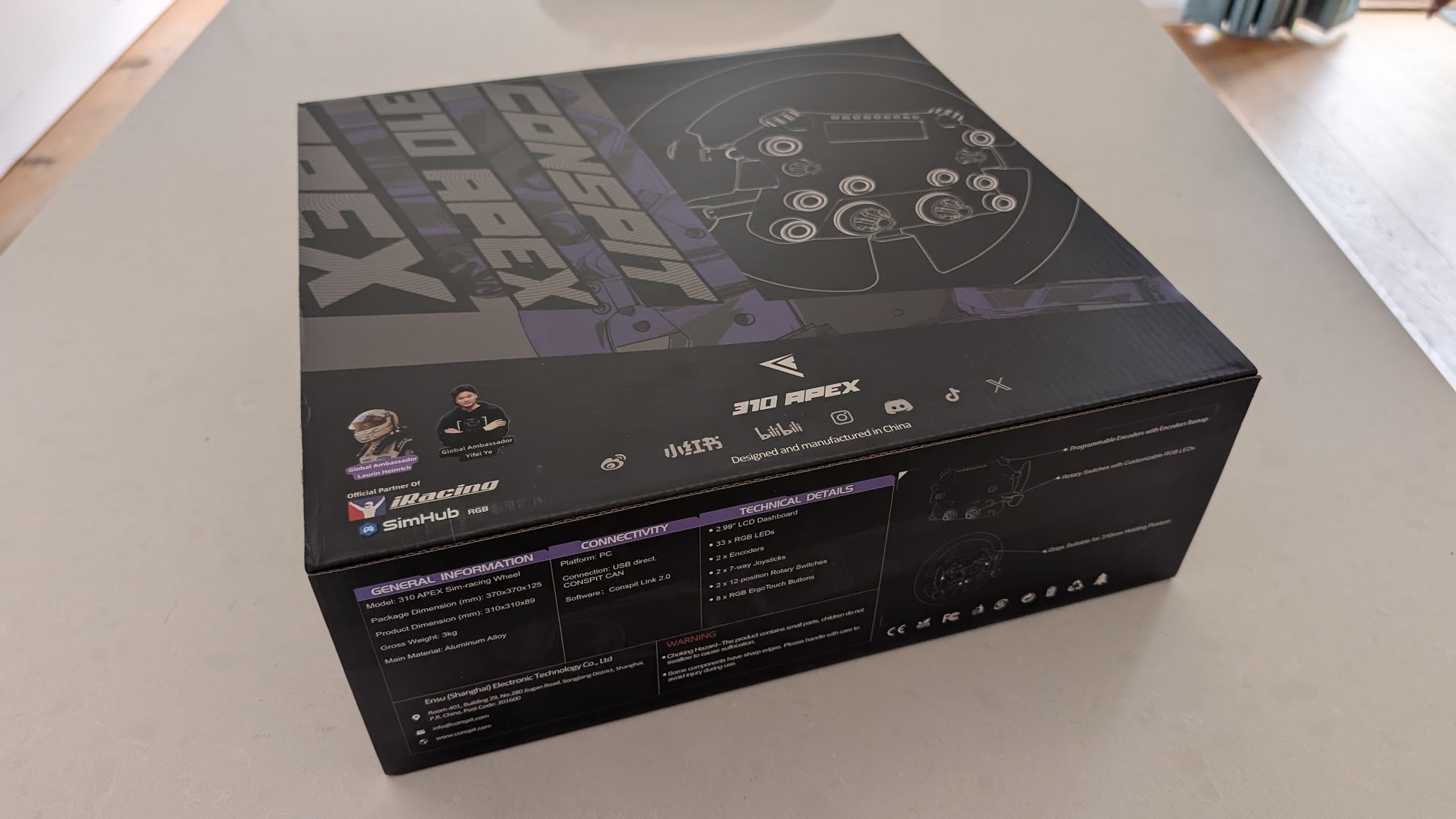
Specs |
The rim |
Paddles and buttons |
Fitting |
Software |
On track |
Who it’s for |
Pros and cons |
Should you buy one?
First, the verdict
The 310 APEX is priced somewhere between a budget wheel and a much higher-end bit of kit – for just a little over £300 (£311 was the cheapest I saw in the UK, September 2026), this is quite a steal. Compared to what three hundred pounds would buy you six years ago, this is actually a very, very high-end wheel priced at a very reasonable budget.
Where to buy the 310 APEX
The 310 APEX is stocked by Trak Racer, and our daily price monitor below carries the live price – check what it says at the checkout rather than trusting a figure in an article, including mine!
Unboxing
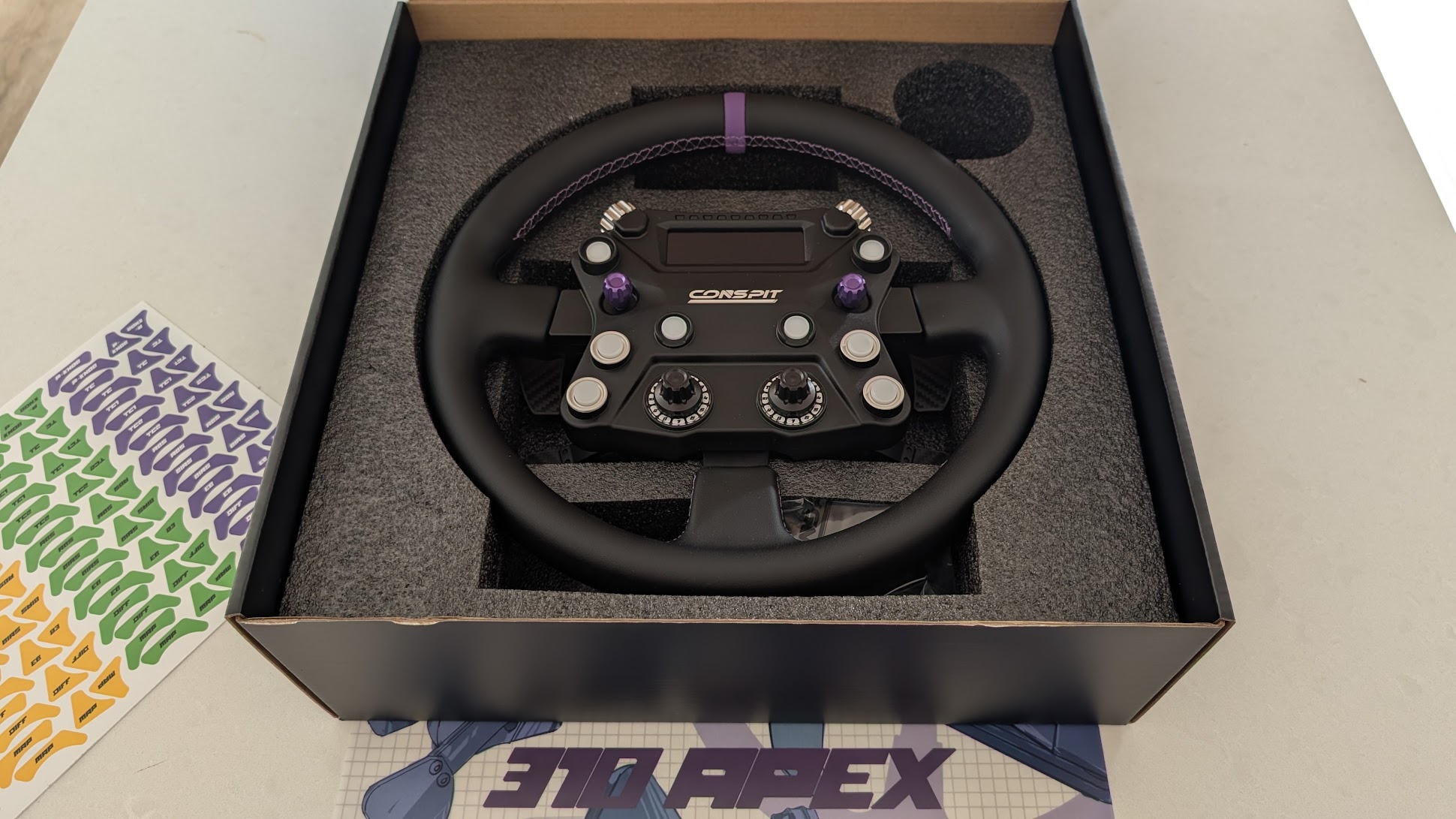
As usual Conspit excels at the packaging. They supply the tools and fittings you need with some stickers and the usual hand-drawn reproduction of the product itself on a plastic sheet. I don’t know why they do this, but I like that they do.
What the 310 APEX is
A 310 mm diameter wheel with a fully die-cast aluminium alloy front and rear housing makes it a feelsome experience indeed – I’m running this on my Simucube 2 Pro (because I’ll be testing Conspit’s direct drive proposition very soon, so this gives me a nice baseline to compare).
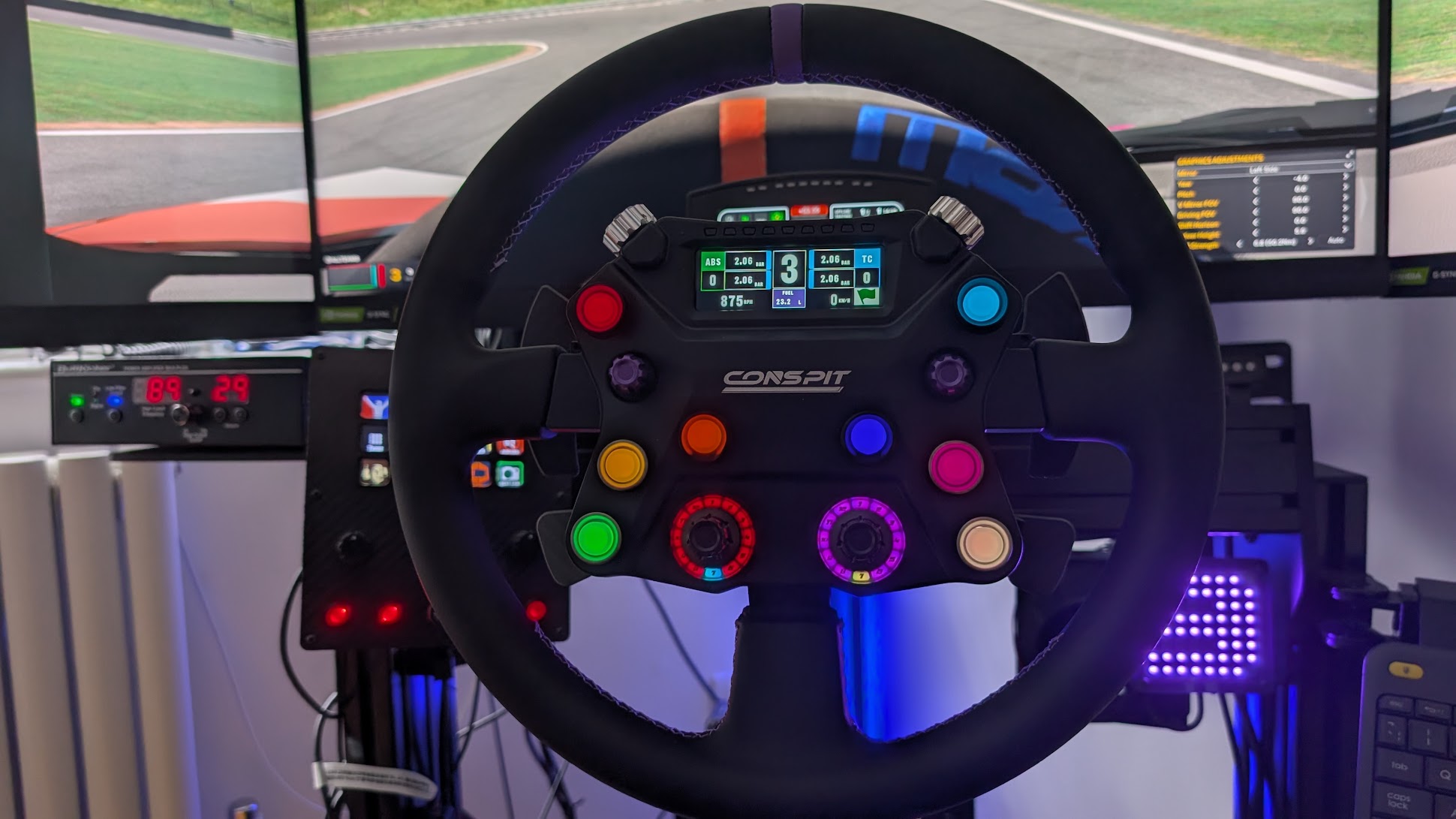
Quality wise – it’s a nice bit of kit. The core of this wheel, the 310 button box, is SimHub compatible, and once you’ve downloaded and installed Conspit’s Link 2.0 software (and remembered to recentre your wheelbase) you’re ready to go racing. I’ve always enjoyed a wheel review – mostly because wheel testing tends to give you maximum reward (“wow I can really feel my wheelbase through this thing!”) for minimum effort; yes – it’s easy to fit.
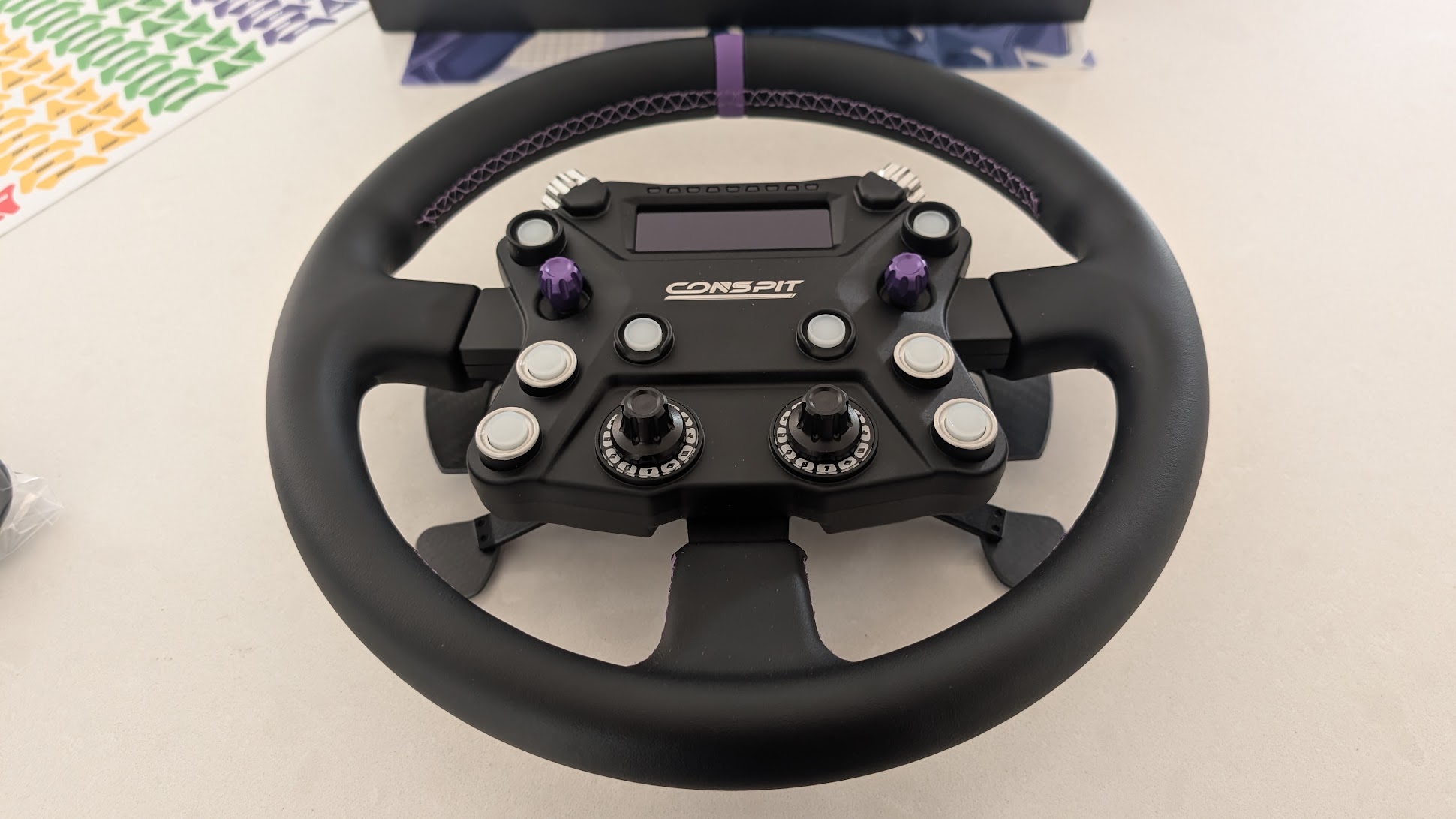
The 310 APEX hasn’t really replaced anything on my rig; it’s more of a useful addition to the steering wheel stable. I’m using a round wheel for the first time in what must be at least two or three years, because I’ve had the McLaren Artura Pro, and before that I ran my Cube Controls, both formula-style wheels. I must admit I just haven’t owned a 310 mm round steering wheel since… let me think. My Fanatec days, I want to say. No – I had a Cube Controls round one.
The specifications, from Conspit’s own spec sheet
| Rim | 310 mm, synthetic leather with purple stitching and a centre marker; 310 x 310 x 89 mm overall |
|---|---|
| Body | Die-cast aluminium alloy front and rear housing; 1,520 g |
| Dashboard | 2.99-inch colour LCD, 800 x 268 px |
| LEDs | 33 RGB: 9 rev lights and 24 around the rotary switches |
| Controls | 8 RGB “ErgoTouch” buttons (500 g actuation), 2 encoders, 2 seven-way joysticks, 2 twelve-position rotary switches |
| Paddles | 2 magnetic Hall-sensor shift paddles (aluminium levers, carbon paddles); 2 modular Hall-sensor clutch paddles |
| Connection | USB direct (coiled cable to USB-A supplied) or CONSPIT CAN; 4-pin connector at the hub |
| Mount | 6 x 70 mm PCD adapter plate supplied |
| Software | Conspit Link 2.0; SimHub (LEDs and buttons) |
The rim, and the feel through it
The rim is a “wear resistant” microfibre-type faux leather experience with nice stitching and a centre mark. It’s on the quite heavy side at 1500g – and I’ve added a BG Racing 100mm extension atop my (now classic) Simucube SQR hub. But “quite heavy” is no problem for this grade of steering wheel. It has great rotational inertia and works really nicely for the type of car it’s designed for – I used it heavily in the FF1600 and found myself having to remember I have a job to do rather than pumping in more laps. If that isn’t sim racing immersion I don’t know what is.
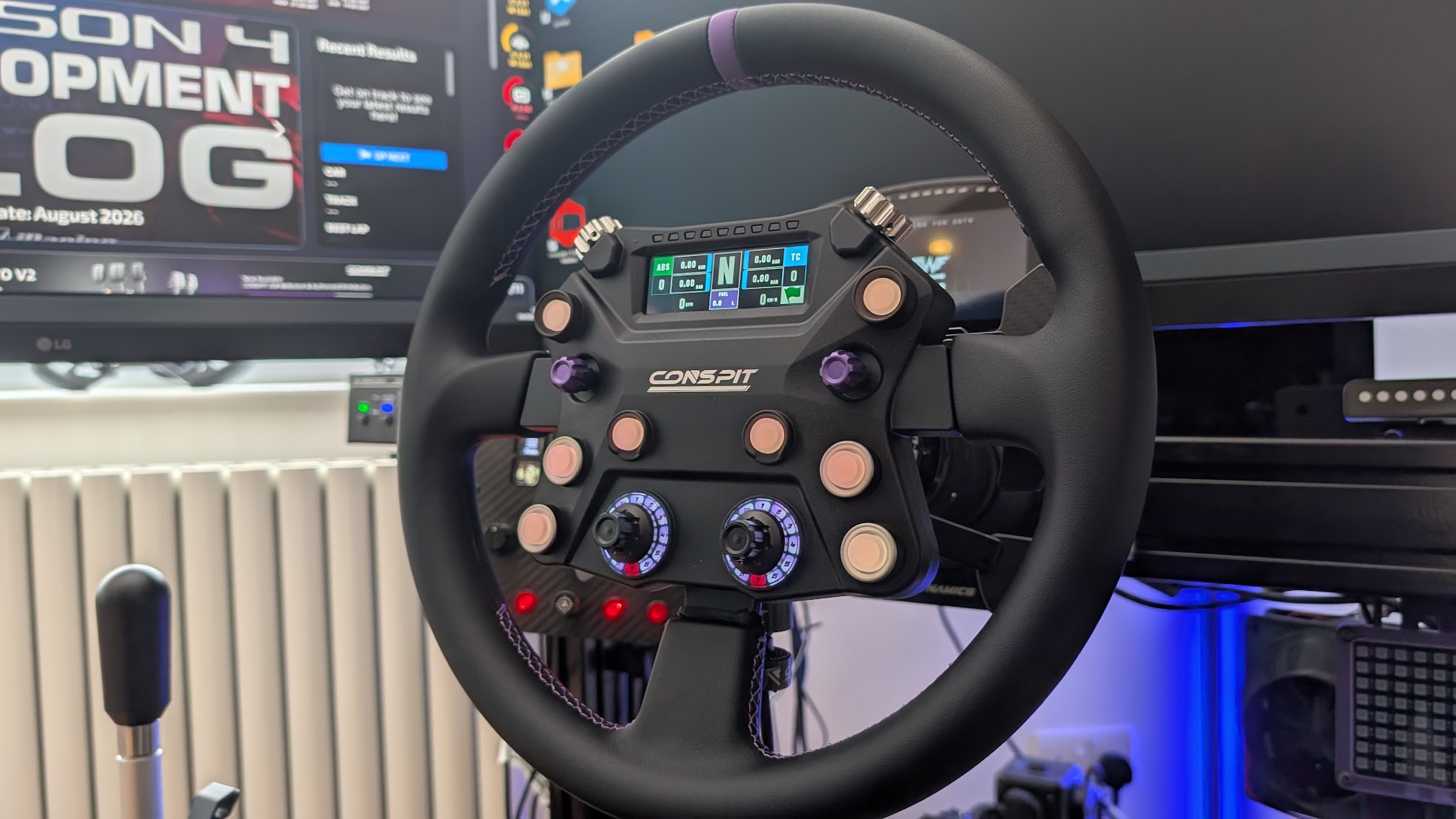
The die-cast body and what I believe to be a steel mount carries the vibration and feedback from the direct drive very nicely. Again – that transmission of “feel” from the direct drive through the rim has always been something I’ve been quite sensitive to. Over the years, I think manufacturers have really got the message: we don’t want you to add damping via your design! The 310 APEX does a fabulous, communicative job of just that – reminding me that the Ares Apex direct drive unit has its work cut out to compete against my SC2 Pro.
The paddles and the buttons
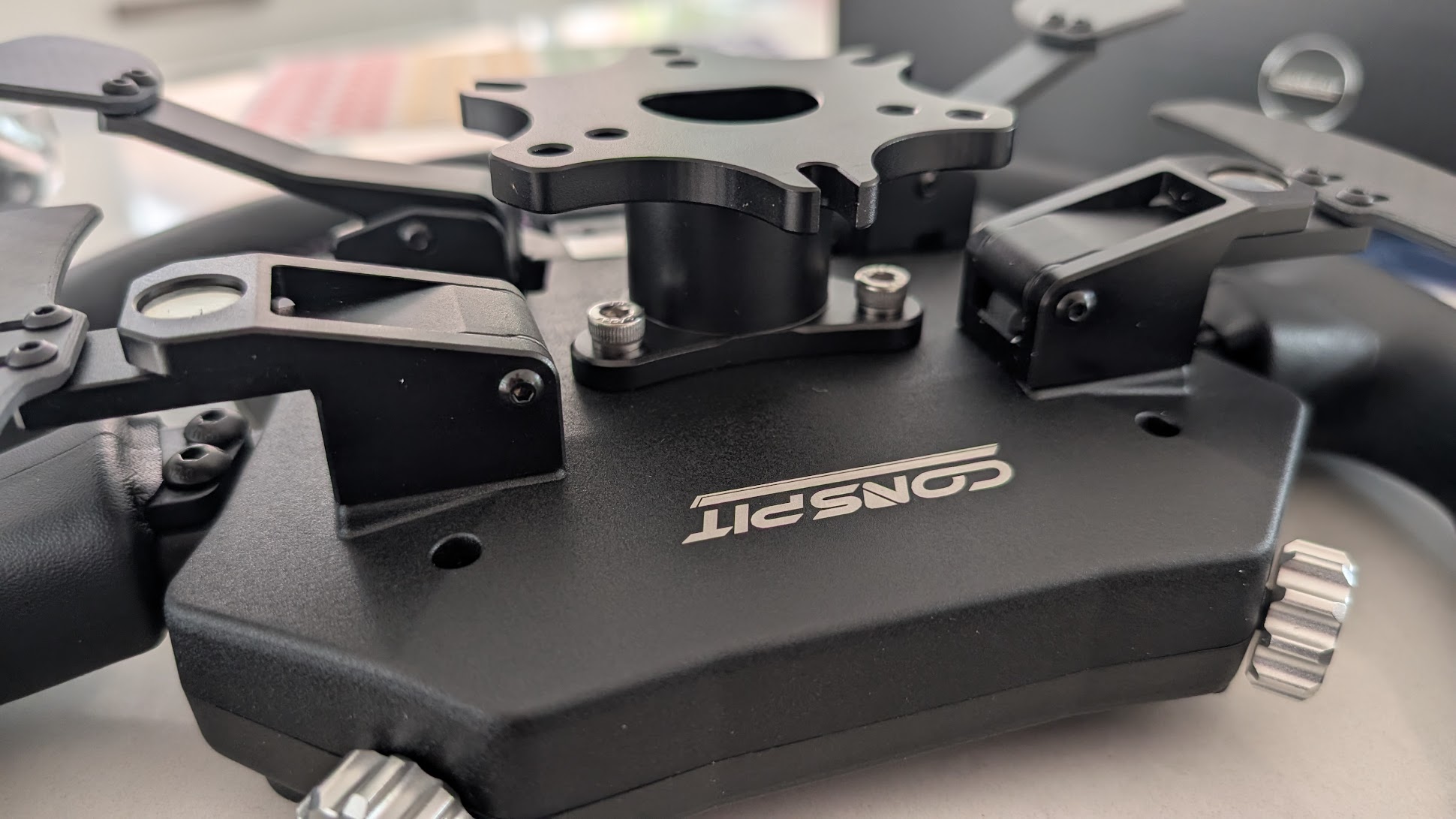
On the back of the wheel you have two Hall effect clutch paddles and of course a pair of CNC-machined aluminium levers with carbon paddles.
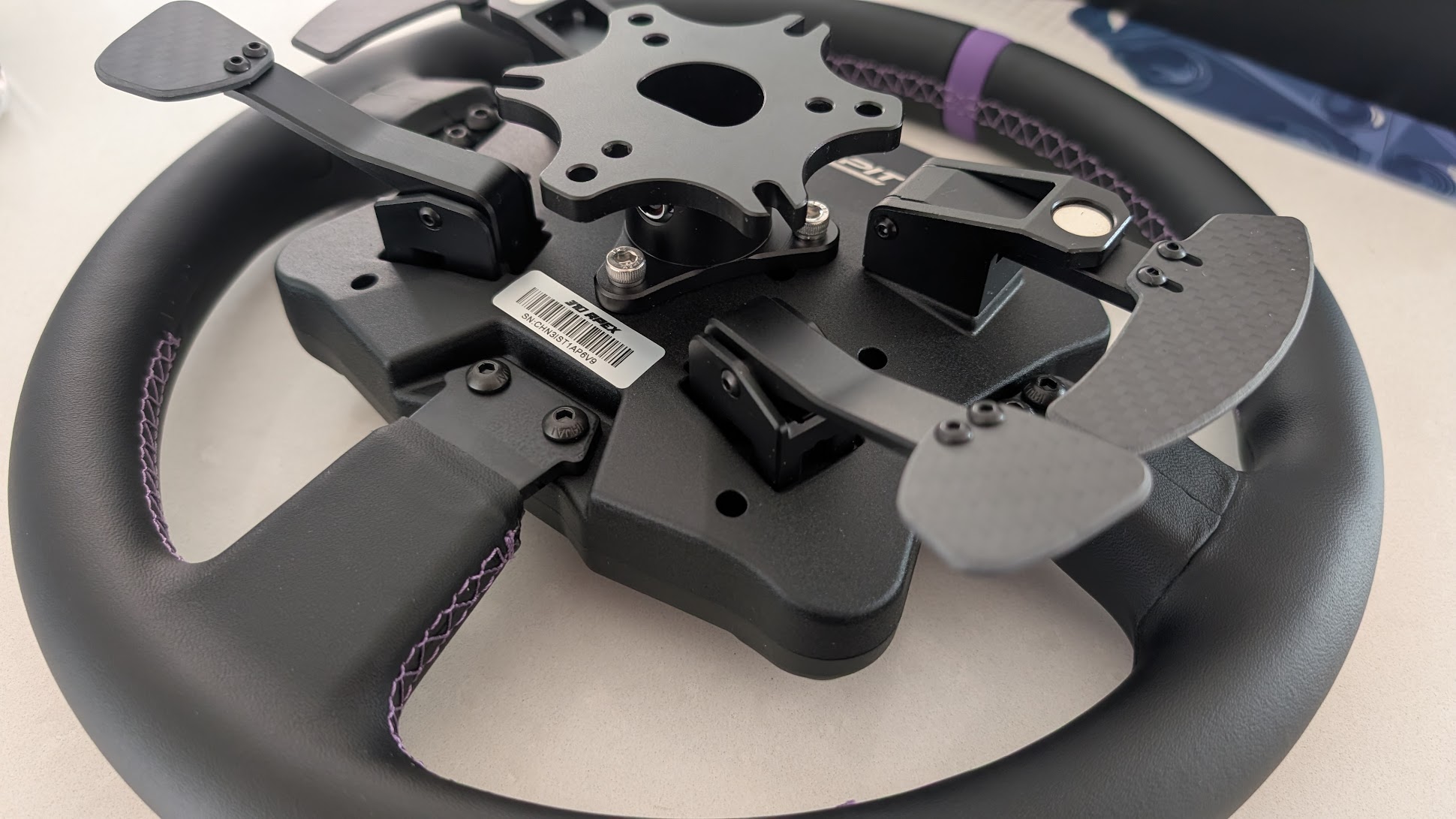
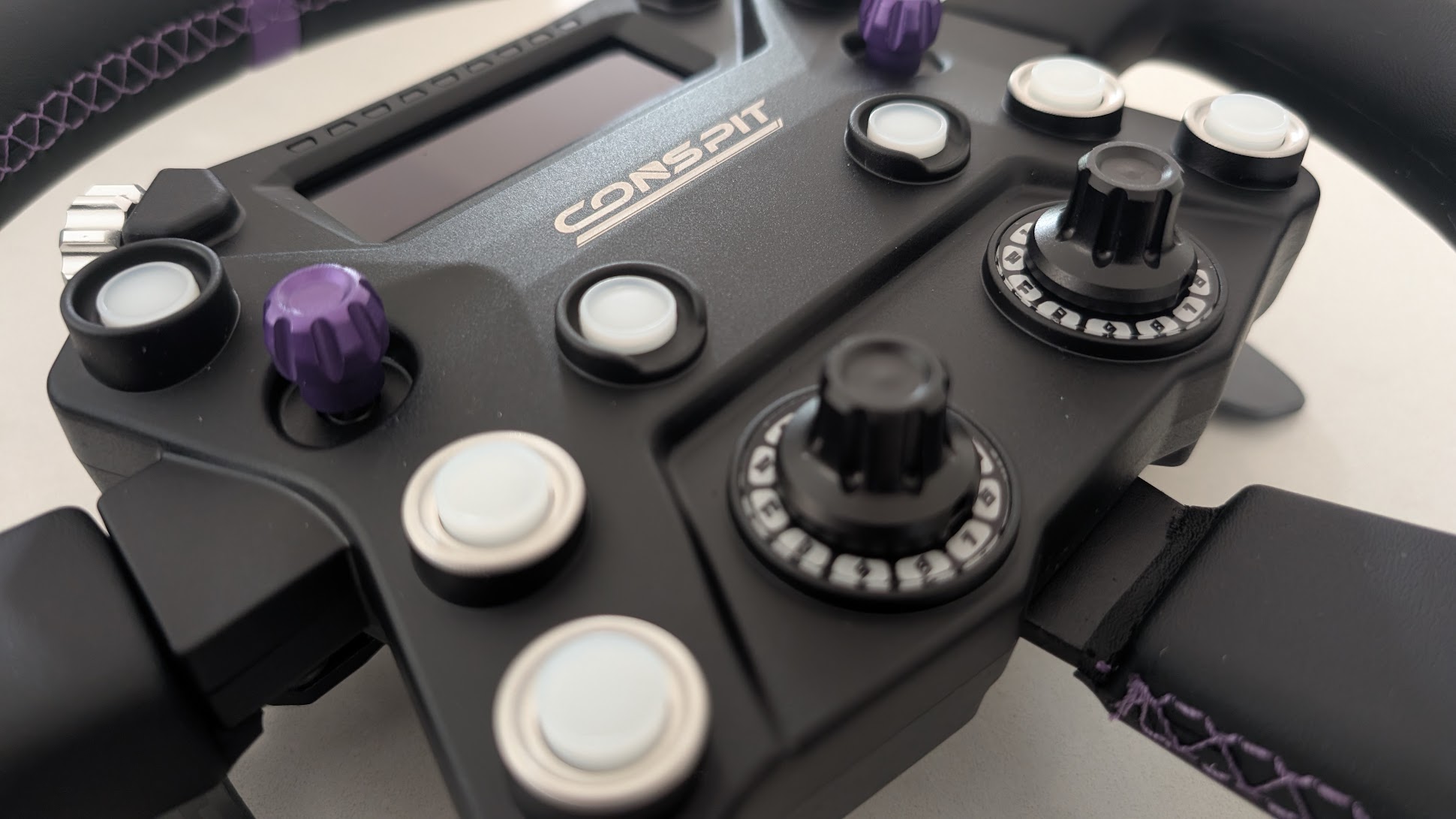
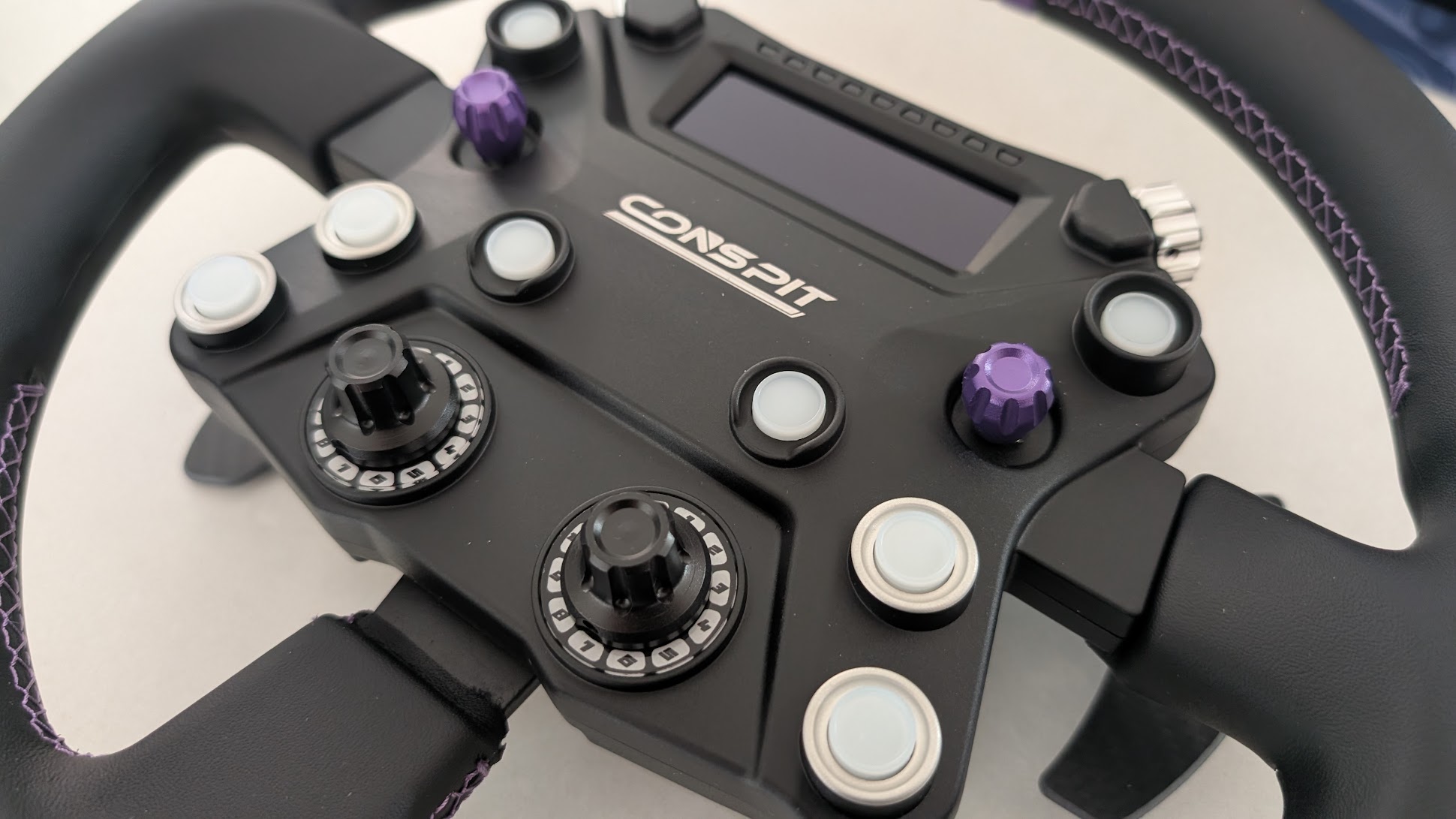
The clutch paddles and the encoders, for a wheel that is basically three hundred pounds, are all exceptionally high quality and perfectly acceptable, particularly as a first wheel.
Fitting it to the Simucube
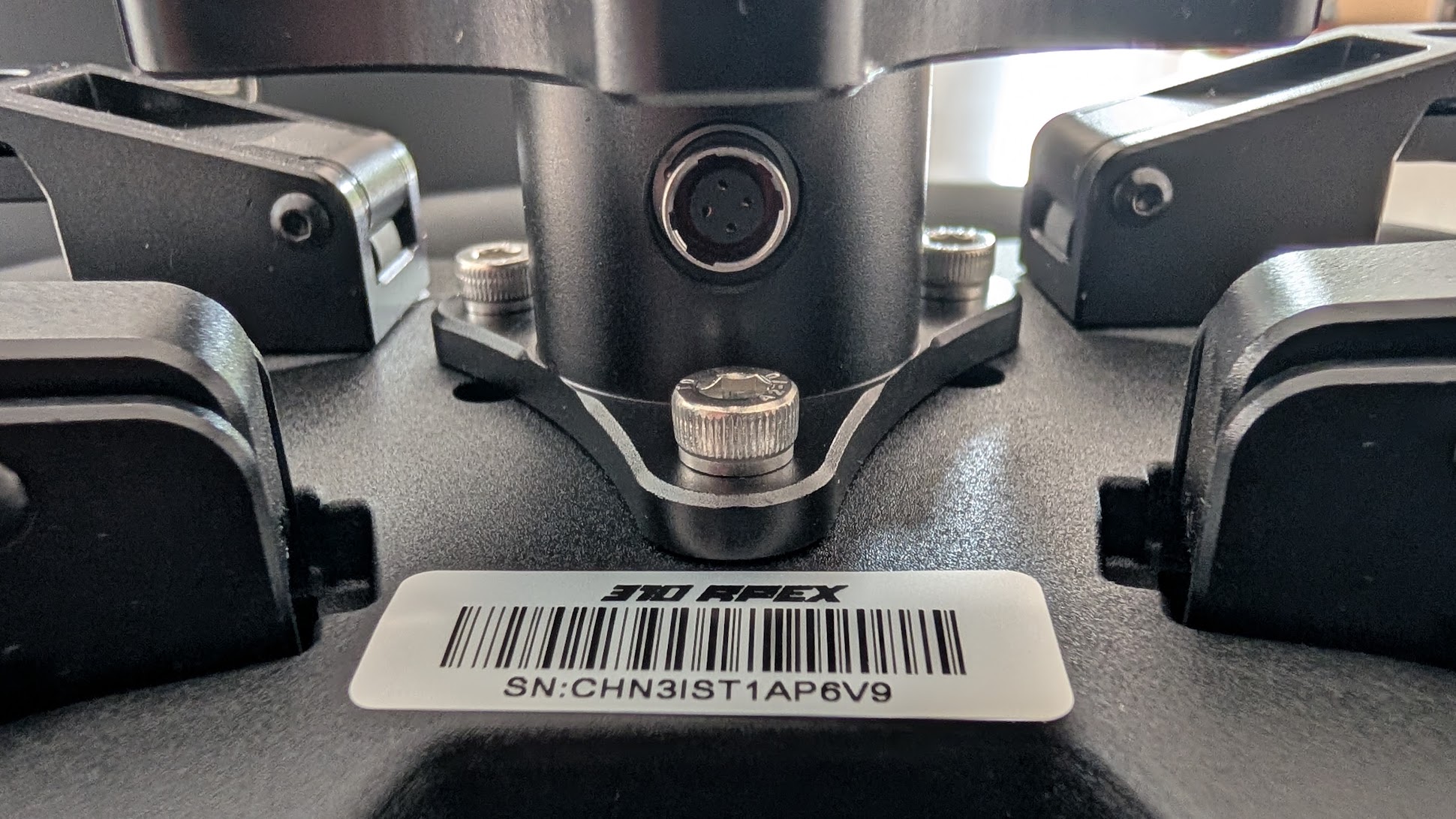
Conspit provide the nuts and bolts for mounting, but, because I was mounting mine in a slightly more custom way, I opted to go off to my spares box to find longer bolts to accommodate the extra length required for my wheel extension. Conspit ships the wheel with a standard 6 x 70 mm PCD adapter plate and a coiled CAN-bus-style cable to USB-A. It has been years since I’ve seen a 4-pin CAN bus connector: in my old Radical SR3 RSX! So I felt a little nostalgia as I lined up the bolts and finalised the assembly.
Conspit Link, SimHub and the screen
Once Conspit Link is installed and, optionally, the wheel is added to SimHub, you’ve got everything you need to get going. The setup itself – easy – aside from the keymapping for the buttons there’s little to do.
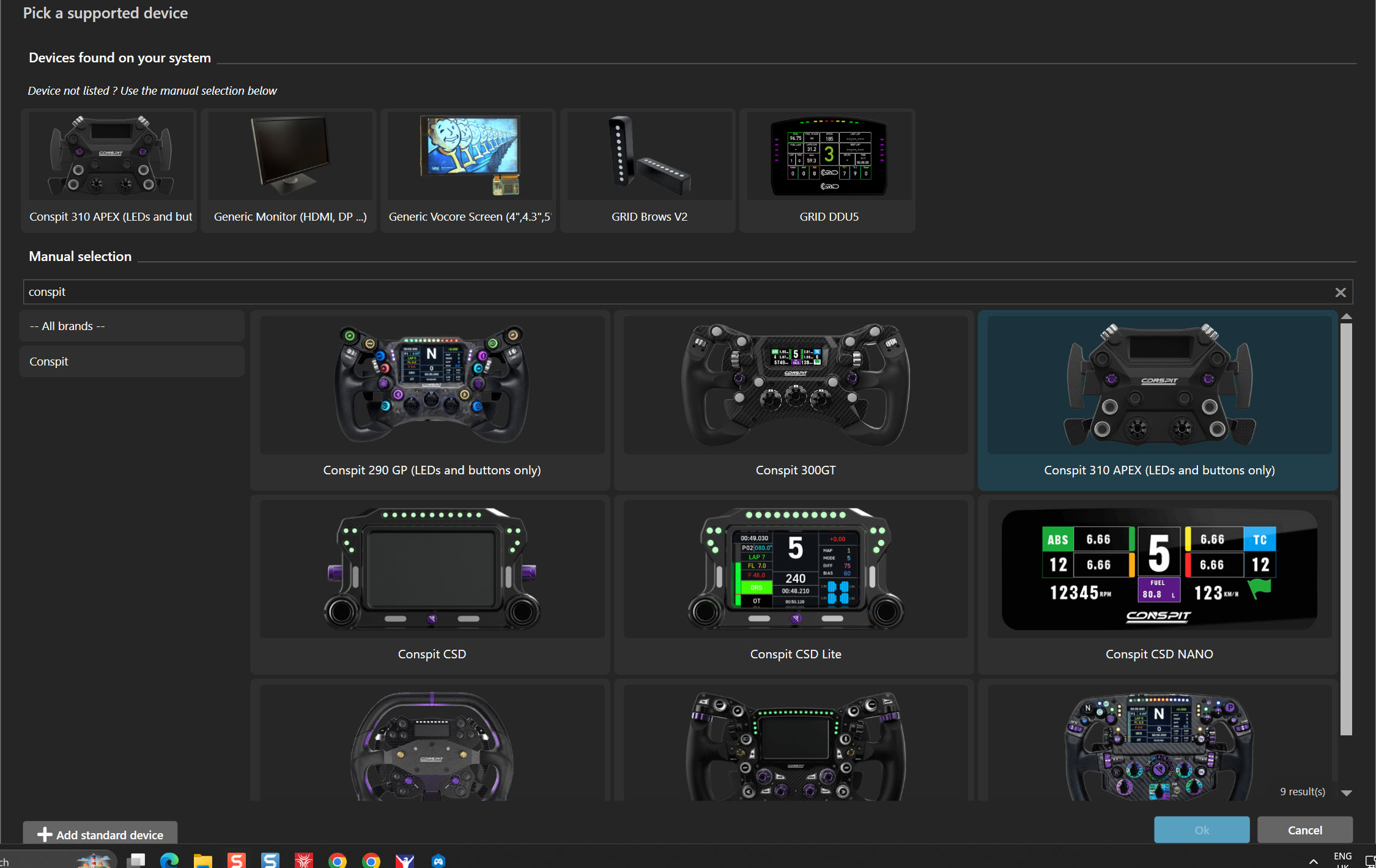
Despite configuring the LEDs to pink in SimHub, I think Conspit Link took over and gave me a default, colourful arrangement which I was perfectly happy with. I think a bit more time spent with Conspit Link would probably be the better way to manage this; given I’ve now got a fair bit of Conspit equipment, SimHub can just get on with running my Grid DDU, Grid Eyebrows and my Raceflag.
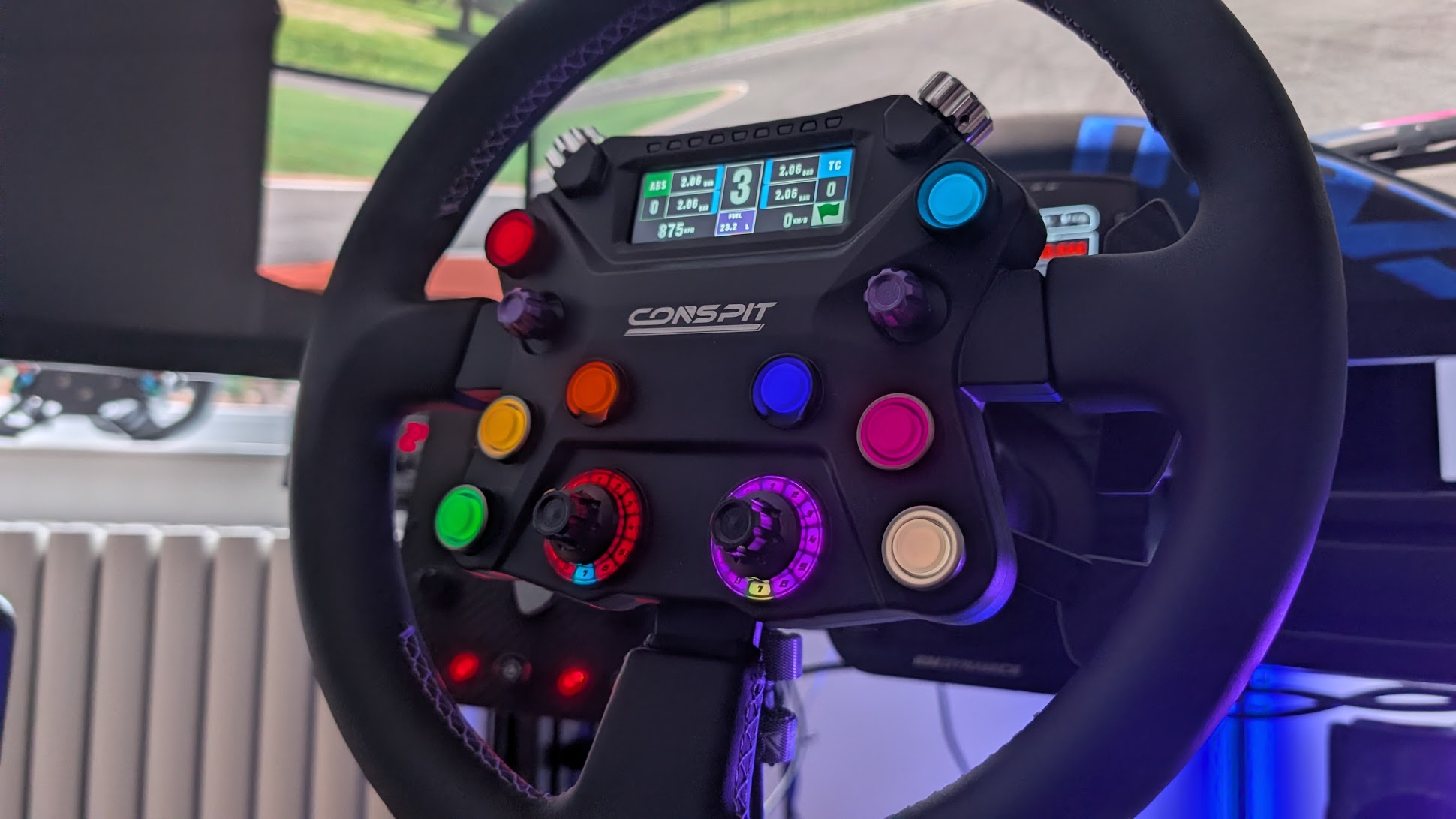
The screen is small but mighty – it’s a basic display but configurable through the Link software – there are 7 dashboard styles to choose from, but you can only configure via Link. This makes SimHub a bit of a non-thing as the level of support between Link vs SimHub is huge.
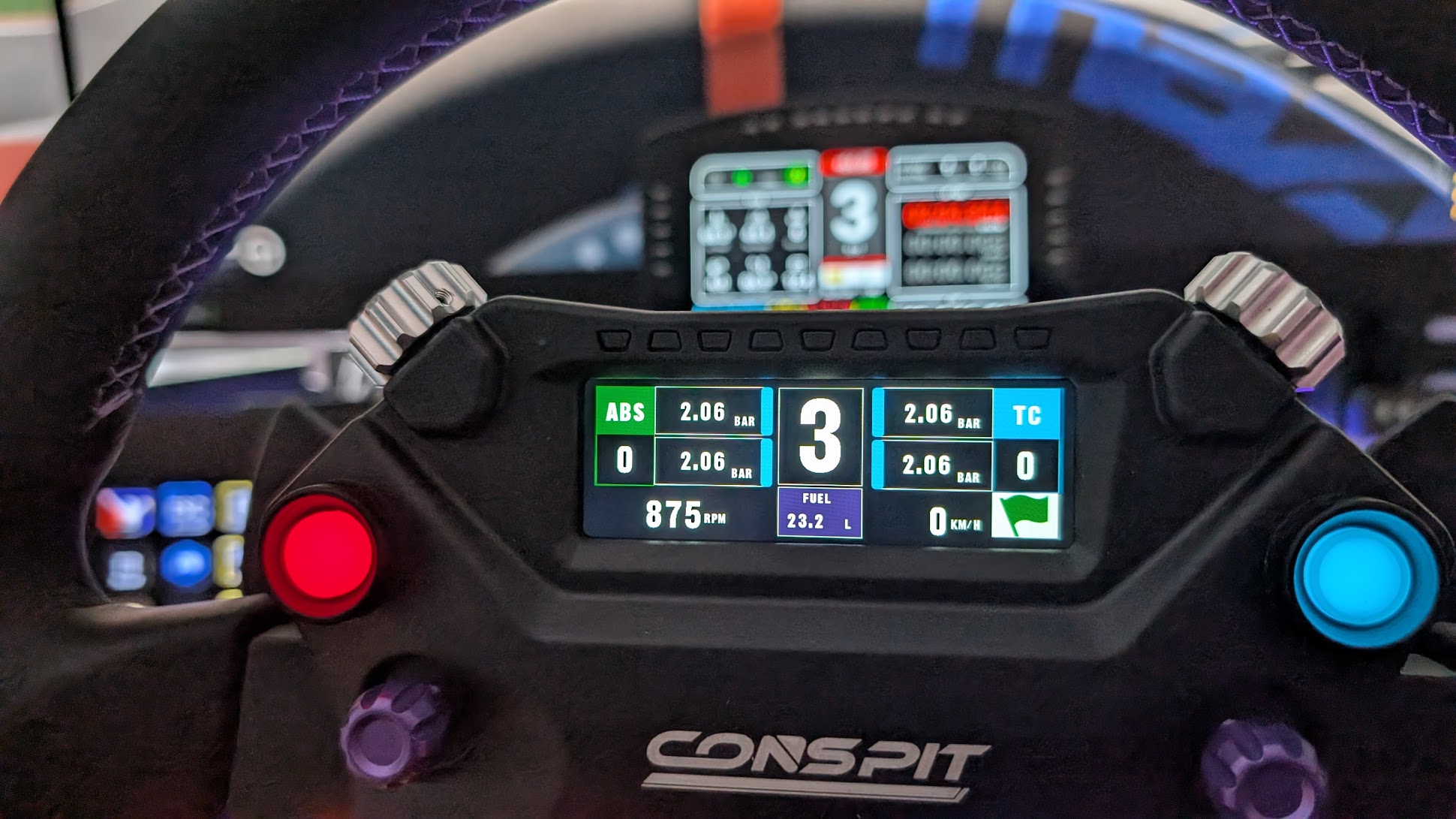
On track in the FF1600
The test, as I mentioned, was a long blast around Lime Rock in the FF1600 with the (soon to be released) CHS shifter in H-pattern mode. A side note: my heel-and-toe shifts have got rusty – I need to get some time in to smooth all of that out.
I think the 310 APEX is going to join the collection and be very welcome, because, as I said, I could really do with a bit of practice smoothing everything out – I’ve missed a racing season.
Who it’s for
Very few people these days, I suspect, would be hurtling around Le Mans in a GT3 car with a 310 mm round steering wheel. This is a very, very nice wheel rim for rookies, for beginners, for drivers who like to do a track day or might even be racing themselves in something that isn’t a Porsche 911 GT3 or an F3 car. Every steering wheel has a purpose.
If you’re looking for a wheel that’s 70 mm PCD compatible, or you’re thinking about investing in Conspit’s new direct drive wheelbase, the Ares, this is a great match and a really good way to get started. The coolest thing about the wheel is that, for the money, the feel is absolutely solid, so it’s brilliant for your Formula 4, your Formula Vee, your Mazda MX-5 Cup – all of the stuff that most of us got started with, and many of us are still doing on the daily.
Pros and cons
Pros
- The die-cast body carries the direct drive’s feedback through the rim very nicely.
- A very high-end wheel for a little over £300.
- Easy to fit and easy to set up; Conspit supply the tools and fittings.
- SimHub compatible, with Conspit Link 2.0 for the rest.
- Great rotational inertia for the cars it’s designed for.
Cons
- On the quite heavy side at 1500g, though that’s no problem for this grade of wheel.
- Conspit Link took over my SimHub LED colours – a bit more time in Link is the answer.
- A wheel extension means a trip to the spares box for longer bolts.
- Not the wheel for hurtling around Le Mans in an LMP2 car.
Should you buy one?
So, do I recommend this wheel? Yes – if you’ve got that three hundred (pounds or dollars) spare and you’re not sure which to pick, this is a great contender. I’m so impressed with Conspit. So, thanks for the opportunity to try the wheel out.
Related Posts
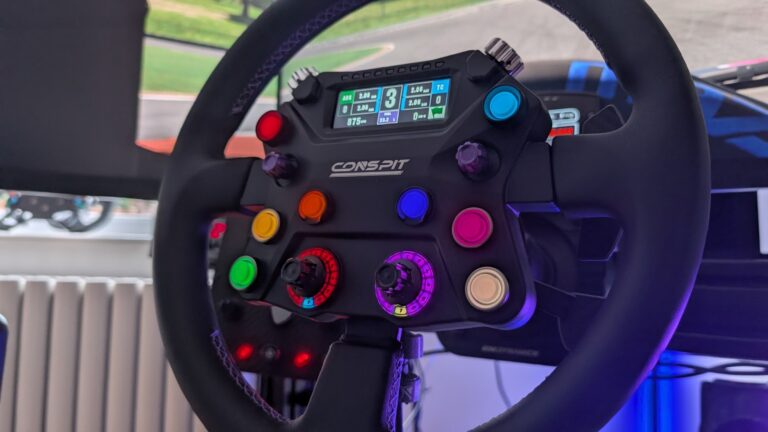
Conspit 310 APEX Review: Getting Back to a 310mm Wheel
MOZA FCS Farming Control System Review
Fanatec CSL Steering Wheel GT3 Review: The McLaren V2 Replacement That Delivers
Moza R21 and R25 Ultra Review: High-End Direct Drive Wheelbases Tested
Fanatec Podium DD Review
Pimax Crystal Super Review
Topic: Sim Racing Wheels