

I’m a sim racer and amateur racer with a passion for Motorsport, good racecraft and the technical and setup aspect of sim racing.
The PXN GT One is a €209 GT-style sim racing wheel that’s got no business being this good at the price – and it’s the clearest sign yet that proprietary ecosystem lock-in is starting to crack. I mounted it on my 80/20 aluminium profile rig last week, mostly out of curiosity, because I’ve been looking for a secondary GT3 rim that doesn’t cost me half as much as the Simucube 2 Pro it’s bolted to.
What I found was a wheel that, for the price of a decent dinner out with drinks, gives you carbon fibre paddles, Hall sensor dual-clutch analogue paddles, native SimHub telemetry integration, and 15 RPM LEDs plus 12 RGB-backlit buttons.
At €209 on the early-bird pricing, this thing holds its own against steering wheels costing a lot more.
Quick Navigation
Jump directly to what you’re looking for:
Sim Racing’s Gatekeeper Problem |
Who’s the GT One For? |
Carbon Fibre and TPE: How it Feels |
SimHub Integration |
Head-to-Head Comparison |
Beginner Pitfalls |
Final Verdict
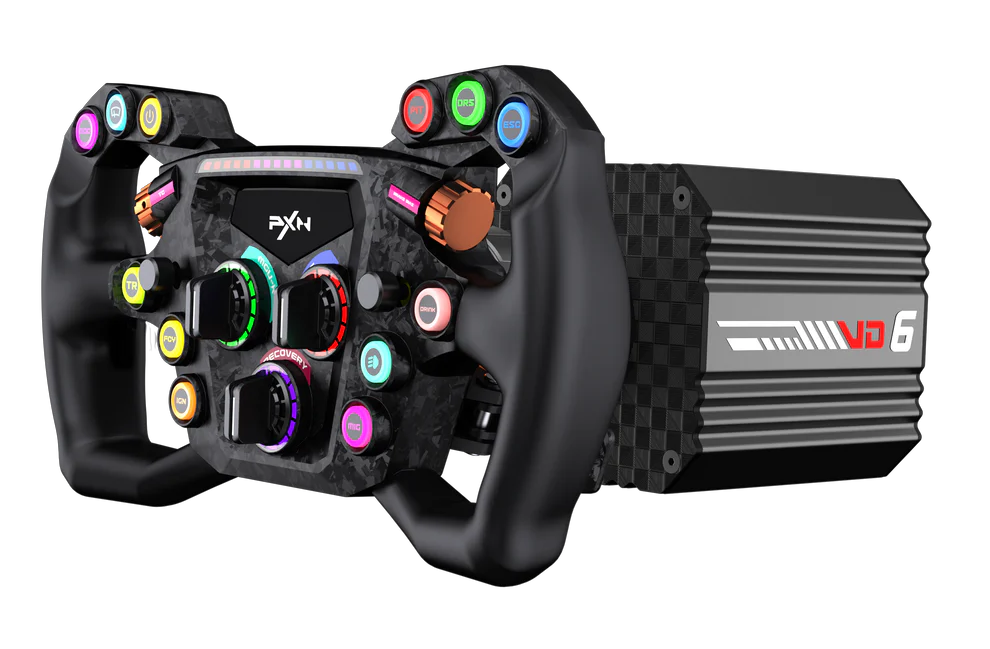
Quick disclaimer: it’s not a direct drive wheelbase. It’s not going to replace a £900 Grid Engineering rim on your main rig. But if you’ve ever felt that budget sim racing gear forces you into a walled garden of proprietary bases and matching peripherals, this wheel is the first real shot across the bow.
A few years ago, budget wheels felt like toys – small diameters, spongy rubber, microswitches that clicked like a biro. The GT One? Different generation of thinking entirely. Open standards, USB connectivity, and it couldn’t care less what base you’re running.
Sim Racing’s Gatekeeper Problem: Breaking the Ecosystem Cycle
The wheel sitting on your desk isn’t just a wheel – it locks you into an entire brand’s product line whether you want it to or not. Fanatec’s a good example: they put the Xbox security chip inside the steering wheel rather than the wheelbase, which is clever engineering but also means you’re buying compatibility alongside the hardware, not just the hardware itself. Pick a brand and you’re choosing their base, their pedals, their quick-release standard, their software, and very often their pricing on every upgrade that follows.
I’ve started calling it the Entry-Level Ecosystem Tax. Bought a Logitech G29 because the price was right? Great – now you want better pedals, and it’s Logitech pedals or nothing. Nicer rim? Can’t swap one in. The rim and base are one sealed unit on the G29, so you’re stuck with what you bought. Before long you’re dropping £400 on a completely new system from a different brand. Different proprietary quick-release, different software stack, and the whole cycle kicks off again.
The question I keep seeing in forums is “what’s the best sim racing wheel?” and honestly, my answer’s shifted. Used to be: pick a brand, stick with it. Now? Pick hardware that doesn’t lock you in. The PXN GT One uses a 50.8mm bolt pattern (with a 70mm adapter available for about $20) and includes a USB coiled cable that lets it work as an independent input device on any PC – your choice of wheelbase is completely separate from your choice of rim. That’s genuinely new at this price point.
The mistake I see beginners making over and over is buying on brand recognition rather than protocol compatibility. They’ll spend €300 on a mid-range branded wheel, then discover two years later that upgrading to a direct drive base means replacing everything: the rim, the quick-release, sometimes the pedals too. Moza has pushed against this as well, but the GT One is the most aggressive example at this price point of a wheel that simply refuses to care what base you’re running. Not cheap. But honest about what you’re actually getting.
The TL;DR: who’s the GT One For?
The GT One is a sub-€250 GT-style rim with full SimHub support and no lock-in to PXN’s wheelbase ecosystem. It works natively with PXN’s VD-series and V12-series bases, but the included USB coiled cable means it runs as a standalone USB device on any PC. Running a Simucube, Fanatec, or any 70mm-pattern base? You’ll need the Z QS Quick Release Adapter ($19.99 from PXN) to bridge the 50.8mm to 70mm mounting difference.
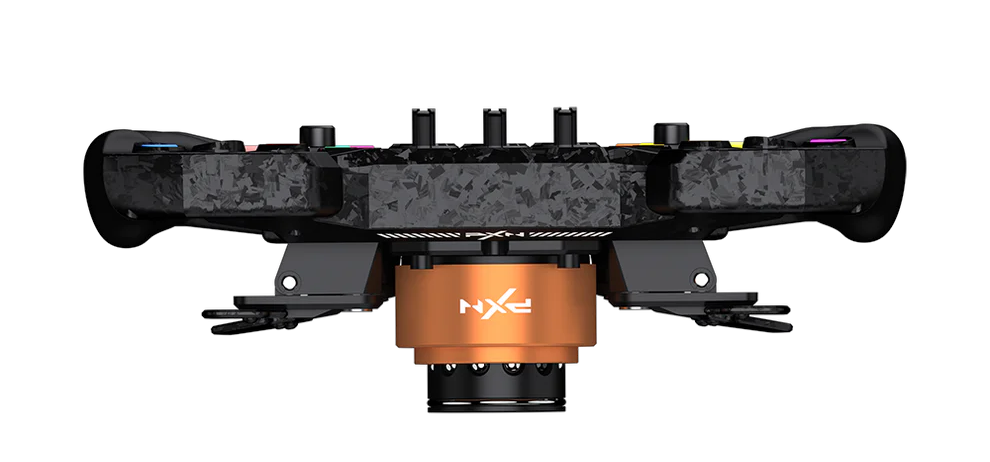
Early-bird pricing is $199/€209/£199, going up to $219/€229/£219 after 26 April 2026. PXN also sells bundles: GT One + VD6 for $469 or GT One + VD10 for $509 if you need a wheelbase too. At 300mm diameter, 1,500g total weight, and a fiberglass composite frame with carbon fibre surface, this is a properly sized GT wheel. Not a scaled-down afterthought.
Visit Our Sponsors
Tactile Mastery: The Carbon Fibre and TPE Experience
Pick up the GT One and the weight distribution is the first thing you notice. At 1500g it’s not featherlight, but it’s balanced well enough that it doesn’t create a dead zone of inertia on lighter direct drive bases. The 300mm diameter is standard GT sizing, which matters more than it sounds, because a lot of budget rims come in at 270mm or smaller and they feel like toy steering wheels the moment you load up ACC and sit in a Porsche 992 GT3 R cockpit.
The fiberglass composite frame gives the whole thing a rigidity that’s genuinely hard to appreciate from product photos – you notice it the moment you load FFB and it doesn’t flex. No flex when you’re cranking lock-to-lock through a chicane, no creaking, no sense that the chassis is absorbing the force feedback signal before it reaches your hands. Carbon fibre on the face? Cosmetic, not structural. Looks right though, and it doesn’t feel plasticky when you’re gripping it.
The TPE grips are where this wheel earns its price. Budget rubber grips tend to be either too hard, slippery under sweaty palms, or too soft, deforming and developing permanent squeeze marks within a month. TPE sits in a useful middle ground, firm enough to feel precise but with enough give that your hands don’t cramp during a two-hour endurance stint. I ran a 90-minute iRacing session at Spa – hands felt better at the end than they do on some wheels I’ve paid three times as much for.
The magnetic shifters feel good – crisp click, no slop. Definite click, enough resistance that you won’t accidentally upshift mid-corner, but not so heavy that rapid sequential shifts during a rolling start become a workout. Carbon fibre paddles at this price – you don’t usually get that.
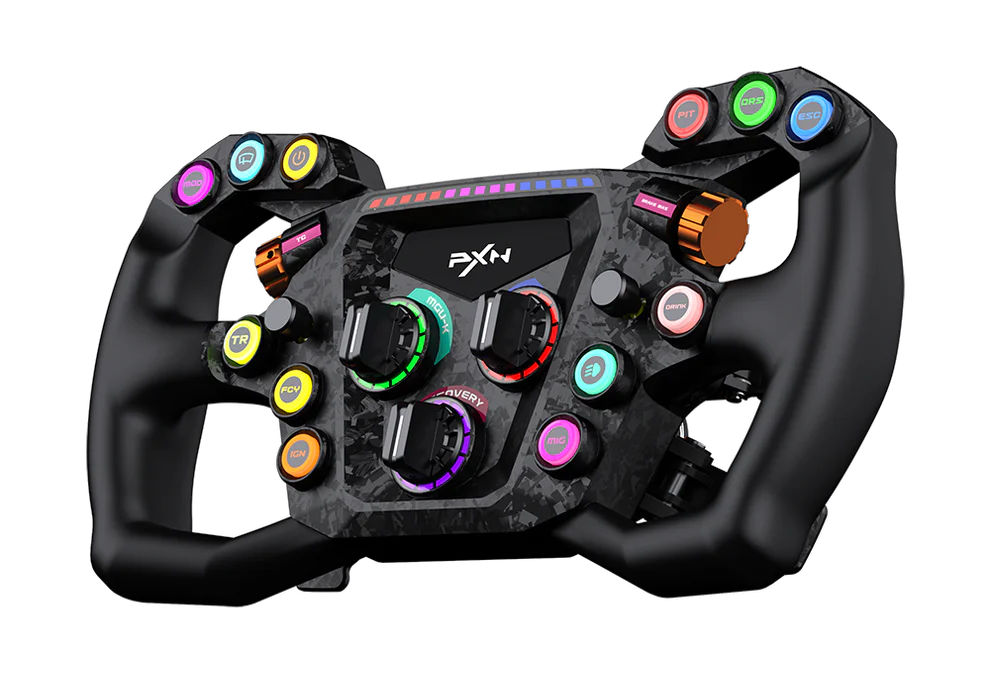
The dual-clutch analogue paddles are a proper standout at this price. They use Hall sensors combined with springs for resistance, which matters because traditional micro-switch clutch paddles are binary – on or off – making clutch management at race starts essentially guesswork. Hall sensors give you the full analogue range, so you can actually modulate the bite point. The travel on the GT One’s analogue paddles is longer than most competitors I’ve tried, and that tracks with what PXN say on the spec sheet. Took a few sessions to calibrate muscle memory, but once dialled in, the clutch feel during standing starts was definitely more controllable than any paddle clutch I’ve used under €400.
The input count is impressive for the money: 12 illuminated buttons, 3 absolute encoders each with 12 positions (switchable between absolute and incremental modes), 2 thumb encoders, and 2 7-way funky switches. The 12-position encoders feel precise mid-stint – no accidental clicks when you’re deep in a race. I mapped one to brake bias, one to traction control, one to ABS in iRacing, and the detents are positive enough to count clicks without looking down. They do feel a little notchy compared to the silky smooth rotaries on a Cube Controls or Ascher rim. Not a problem at this price, honestly. But it’s there.
Hacking the Telemetry: SimHub Integration
The GT One has 15 RPM LEDs and 12 RGB-backlit buttons, all of which work natively with SimHub – that’s the important bit. You can map RPM ranges, flag colours, pit window indicators, fuel warnings, tyre temps, all using the same SimHub profiles you’re already running on your dashboard or monitor overlay. Same workflow you already know. No proprietary app, no locked ecosystem.
Most budget wheels with LED telemetry hide those LEDs behind proprietary software that only works with the manufacturer’s own wheelbase. Buy the lights, find out they’re useless unless you’re running their app on their base. Classic. The GT One sidesteps this through what PXN calls “Intelligent Telemetry,” which is a fancy name for something straightforward: the wheel’s LED controller accepts standard SimHub data over USB.
Setup depends on your base. Running a PXN VD-series unit means everything connects natively, telemetry works out of the box. Running a third-party base like a Simucube 2 Pro or a Fanatec DD means you use the included USB coiled cable to connect the wheel’s electronics directly to your PC as a separate USB device. Force feedback still comes through your base – the wheel doesn’t generate FFB – but all the buttons, encoders, LEDs, and telemetry run through that USB connection.
Mounting needs attention. Bolt pattern on the GT One is 50.8mm. If your base uses 70mm, which Simucube, Fanatec, and most high-end bases do, you’ll need the Z QS Quick Release Adapter at $19.99. Three bolts. Done.
Full input spec below:
| Input Type | Count | Notes |
|---|---|---|
| Illuminated RGB buttons | 12 | Backlit, mappable |
| Absolute encoders (12-pos) | 3 | Switchable absolute/incremental |
| Thumb encoders (12-pos) | 2 | Incremental push-button |
| 7-way funky switches | 2 | Multi-directional + push |
| Magnetic shifter paddles | 2 | Carbon fibre |
| Analogue clutch paddles | 2 | Hall sensor, spring-loaded |
| RPM LEDs | 15 | SimHub-native |
| Total input signals | 78 | All mappable via USB |
One annoyance worth flagging: running the USB cable alongside your wheelbase’s own connection means two cables coming off the wheel area. On a tight rig, that looks messier than it should. Cable-tying along the profile upright sorts it, but it’s not as clean as a single-cable solution. Fair warning.
Head-to-Head: The Budget Performance Matrix
Value comparisons need a reference point, so here’s how the GT One sits against the entry-level and mid-range rims I’ve actually tested or spent time researching:
| Feature | PXN GT One | Fanatec CSL Rim | Logitech G Pro | Thrustmaster T-GT II Rim |
|---|---|---|---|---|
| Price (approx.) | €209 (early bird) | ~€350 | ~€450 (with base) | ~€300 (rim only) |
| Diameter | 300mm | 320mm | 300mm | 280mm |
| Shifter type | Magnetic | Magnetic | Magnetic | Micro-switch |
| Dual-clutch | Hall sensor analogue | Optional add-on | No | No |
| RPM LEDs | 15 (SimHub-native) | 3 (proprietary) | 11 (proprietary) | None |
| RGB buttons | 12 | 0 | 0 | 0 |
| Absolute encoders | 3 (12-pos) | 1 | 2 | 0 |
| Funky switches | 2 (7-way) | 1 | 2 | 0 |
| USB standalone mode | Yes | No (Fanatec base only) | No (Logitech base only) | No (Thrustmaster only) |
| QR standard | 50.8mm (70mm adapter $19.99) | Fanatec proprietary | Logitech proprietary | Thrustmaster proprietary |
The input-per-euro comparison isn’t even close. More physical controls, SimHub-native LEDs, open-standard connectivity, and Hall sensor analogue clutches, all for less than any competitor in that table. The trade-off is real though – no plug-and-play convenience from a matched brand setup, a USB cable workaround, and potentially a QR adapter on top. But if flexibility matters more to you than staying in one brand’s garden, the GT One cleans up.
Pitfalls: Avoiding Common Beginner Mistakes
1. The bolt pattern catches people out. GT One is 50.8mm. Most high-end bases – Simucube, Fanatec Direct Drive, VRS – use 70mm. Buy this wheel for your DD base without ordering the Z QS adapter and you’ll be staring at mismatched bolt holes on setup day. Order it with the wheel. $19.99. Otherwise you’re waiting a week for shipping.
2. Thinking the wheel has force feedback built in. It doesn’t. It’s a rim. Just the steering wheel, nothing else. Force feedback comes from whatever base you bolt it to. PXN does make wheelbases (the VD series and V12 series), but the GT One itself is just the steering wheel. No wheelbase? You’ll need to sort that first. I’ve written a sim racing guide that covers the basics if you’re starting from zero.
3. Cranking up FFB because the wheel feels weak. Not specific to the GT One, but new users with budget rims tend to compensate by maxing out force feedback strength. Strong FFB goes muddy fast. What you’re after is detail in the signal, not raw power through your arms. Drop the FFB, find the detail in the signal, and you’ll drive faster because you can feel tyre slip angle instead of fighting the wheel.
4. Worrying about game compatibility. Almost every PC sim recognises standard USB HID devices. iRacing, ACC, rFactor 2, Automobilista 2, BeamNG. The GT One in USB standalone mode shows up as a standard game controller. If your sim supports custom button mapping – and they all do – you’re fine.
Final Verdict: A New Standard for Entry-Level

€209 gets you Hall sensor clutches, native SimHub telemetry, and open-standard mounting. Hard to argue with that list at this price.
It’s not flawless. The encoder detents feel notchy rather than crisp, and the dual-cable workaround on third-party bases looks messier than it should. I don’t know why PXN didn’t sort that before launch.
But the bones are good. Building your first 80/20 rig? I’d start here. Already running a higher-end setup and just want a secondary GT3 rim without spending €600? Does the job there too. Solid kit.
Sources
- PXN GT One official product page – specifications, pricing, compatibility
- PXN Z QS Quick Release Adapter – 50.8mm to 70mm adapter
- PXN GT One landing page – feature overview
- Overtake.gg review – community review and images
- simracing-pc.de review – independent review
Related Posts
CONSPIT 290 GP vs 300 GT vs Max 01: Which GT or Formula Wheel Wins?
Moza Wheels 2026: The Best Moza Steering Wheels to Buy
PXN GT One: This €200 Wheel is the end of the Entry-level Ecosystem Tax
MOZA Lamborghini Revuelto Steering Wheel Review: Form Over Function
MOZA CS Pro Steering Wheel Review – A $329 Wheel With a Screen That Changes Everything
Fanatec CSL Steering Wheel GT3 Review: The McLaren V2 Replacement That Delivers
Topic: Sim Racing Wheels