| | | | | |

Understeer vs Oversteer: What’s Actually Happening (and Why F1 Drivers Set Up for Each)

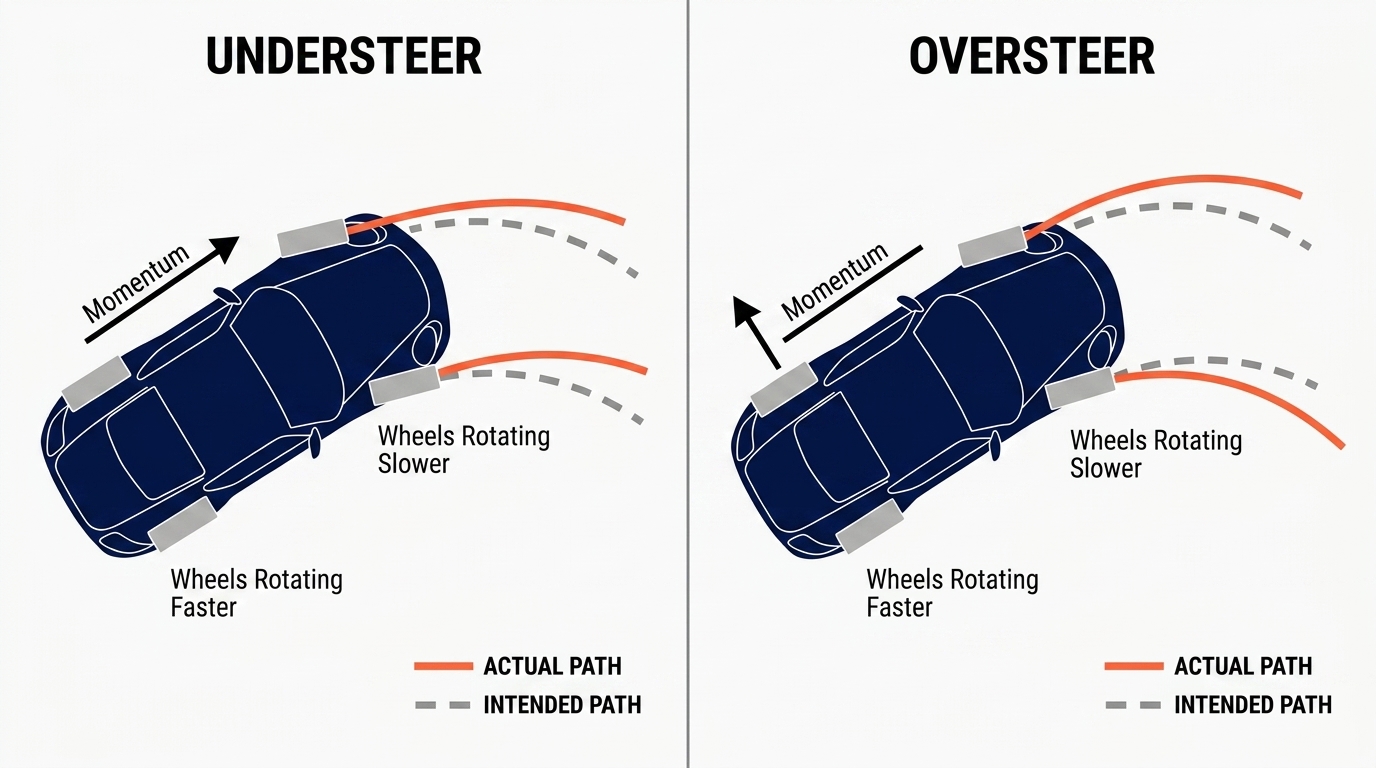
Two top-down panels: understeer (left) shows the car continuing forward while the intended path curves inside; oversteer (right) shows the car rotating with the actual path swinging out wider than the intended path. Navy car bodies, orange solid actual path, grey dashed intended path.

Two failure modes, both real, both with their own defenders at the top of the sport.

Of all the conversations in sim racing forums, understeer-versus-oversteer is the one that won’t go away. The camps that split modern F1 drivers – Alonso and Hamilton on one side, Verstappen and Schumacher on the other – are the same camps that show up in the Discord servers of every direct-drive owner with a few hundred laps of seat time and a strong opinion. Both sides have a point. Neither side is wrong.

The TL;DR, for anyone who only wants the headline: understeer is when the front tyres break traction first, oversteer is when the rears break first, and the lever for fixing either one is throttle and brake – not the steering wheel. The wheel is the dashboard. The feet are the controls.

Quick Navigation
Jump to what you need:
What understeer is | What oversteer is | Two paths through one corner | Front-to-rear balance | Why F1 drivers like understeer | It’s your feet, not your wheel | What the wheel tells you | Which is better? | How to drill it in the sim | Sources

What understeer is (and what it feels like)

Scott Mansell at Driver61 calls understeer “the most disliked handling characteristic of them all”, and the technical definition behind the dislike is simple enough: the front tyres break traction before the rears, the car runs wider than the steering input asked for, and the apex slides past on the wrong side of the windscreen. In the US it’s often called push, which describes the sensation rather better than understeer does – the car is being pushed forward by its momentum, pushing back against the hands at the rim.

Through a direct drive wheel, understeer arrives as a quiet thing. The rim goes light. Nothing’s pushing back any more. You can wind on more lock if you like (the wheel will let you), but Mansell’s warning in Tutorial 7 is the one most drivers learn the hard way: “the grip of the tyres is already being used up at 100%, so it doesn’t matter how much more steering lock you apply, the car won’t turn anymore.” Worse, when the fronts do eventually bite again, all the lock that’s been wound on is still there – which is how the car snaps toward the inside kerb three seconds later and the driver ends up on the runoff, wondering what just happened.

Danny Lee, whose Secret of Sim Racing Success tutorial is required viewing on this topic, frames the same sensation more viscerally – the front tyres feel as if someone has swapped them for hard cheese. The caveat any good coach adds, of course, is that this only counts as understeer if the car is being asked to do something it ought to be able to do. Miss the braking point by thirty metres and run wide at the apex, and that’s not understeer. That’s just the driver.

What oversteer is (and what it feels like)

The flip of all that is oversteer, which Mansell calls “the most fun handling characteristic” in Tutorial 8 – and the technical definition (rear tyres break traction before the fronts, car rotates more than the steering input asked for) hides what makes the sensation so different. Oversteer doesn’t arrive through the steering wheel first. It arrives in the seat. Mansell’s framing is the most accurate around: “you’ll feel it in your backside – you’ll feel it through the seat of the car.” The rim goes slack, briefly, because the rear has unloaded and is no longer fighting the front for direction. The inner ear catches up to what’s happening before the eyes do. And then there’s about half a heartbeat to mirror the slide with opposite lock and a lift of throttle, or the car’s round.

Danny Lee’s analogy is that the car is skating on ice, which probably understates it – ice gives some warning, whereas a GT4 on cold rears at Pouhon doesn’t – but the visual is right. The connection to the road has thinned out at the back. Whatever was holding the rear in place is gone. The car wants to rotate, and the driver has about a moment to decide whether to let it rotate a bit more (the racer’s instinct) or to scrub off the angle and live for another corner (the survival instinct).

The mistake every sim racer makes the first dozen times this happens, and which Mansell calls out by name in Tutorial 8, is the overcorrection: too much opposite lock, the car pendulums the other way, tank slapper, spin. He puts it plainly – “the first thing they do when a car oversteers on them is to overcorrect the slide; they’ll actually apply too much opposite lock and we’ll have a bit of a tank slapper.” There’s nothing for it except seat time. The reflex gets calibrated by repetition, and may take longer to settle than it ought to on cold tyres.

Two paths through one corner

The two failure modes are easier to see drawn out as trajectories than felt through the wheel:

Two top-down panels: understeer (left) shows the car continuing forward while the intended path curves inside; oversteer (right) shows the car rotating with the actual path swinging out wider than the intended path.
Top-down view of both failures. Left: the car continues forward as the intended path bends away from it. Right: the car rotates further than the intended path asked for, and the actual path swings wide on the exit.

The understeer diagram is what most amateur drivers end up driving when they’re hot – they turn the wheel, the front doesn’t follow, they wind on more lock (the dangerous bit), and they end up on the kerb at the exit. The oversteer diagram is the opposite failure: the car rotates harder than the driver asked for, clips an earlier inside line than intended, and on the way out the back swings wide and the driver runs out of road on the far side. Both fail. They fail in different directions for different reasons, and the fix for each is the opposite of the fix for the other.

Underneath the wheel: it’s all front-to-rear balance

What actually shifts between understeer and oversteer isn’t anything to do with steering hands. It’s where the grip lives. Danny Lee’s framing is the cleanest: the front tyres are the ones making the crazy plans, the rear tyres are the ones trying to keep things stable and orderly. A sitcom duo, with the front wanting to do something dramatic and the rear trying to stop the whole thing falling over. If the rear can’t restrain the front, the result is oversteer (the car rotates faster than the hands asked). If the front can’t overcome the rear, the result is understeer (the car won’t turn at all). Lee has a second analogy that may be even better – the rear tyres are like the tail fins on a plane or the feathers on an arrow. Stability comes from the back. Lose that, and the contract with the corner is over.

Mansell does the same teaching with numbers in Tutorial 8 – imagine 100 units of total grip distributed front-to-rear, and ask where they sit at any given moment. Under heavy braking, the car’s nose pitches down, weight transfers forward, and the distribution might run 75/25 forward-biased. Try and turn into the corner with that balance and the rear (which only has 25 units of grip to work with) can’t keep up – the result is oversteer on entry. Come off the brakes a fraction earlier so the platform settles, redistribute to 70/30, and suddenly the rear has just enough to behave. It isn’t a question of whether the car is oversteery – it’s a question of where the grip lives right now, and the answer changes phase-by-phase as the corner unfolds.

Visit Our Sponsors

products per page
Loading products...
Visit our sponsors: Fanatec.com | Moza Racing

Why F1 drivers set up for understeer (some of them, anyway)

The bit that surprises most viewers of Driver61’s Why Alonso LOVES Understeer video is that some of the fastest drivers in F1 deliberately set their cars up to understeer. Fernando Alonso. Lewis Hamilton. Sergio Pérez. Jenson Button. Names motorsport YouTube channels rarely associate with a slow front end. The Verstappen camp – which on Mansell’s reading also includes Schumacher, Vettel, Norris, Leclerc and Senna – really does want the front to rotate the moment the wheel turns. Max has reportedly said, paraphrased by Mansell, that “a car cannot be fast with understeer, it’s impossible”, which is a great quote and, as it turns out, not the whole story.

Here’s the justification the other camp use, and it lands rather neatly once it’s been sat with for a while. Set the car slightly rear-biased – more grip at the back than at the front, just a hint – and when the driver trail brakes into the corner, the front loads up while the rear stays settled rather than coming round. The driver can brake later (because the rear isn’t going anywhere), carry more speed to the apex, and on the way out the rear is still planted, which means earlier and harder throttle without spinning the rears up. The cost is a slightly numb front through the middle of the corner. The benefit is a car that doesn’t try to bite on every entry. Hamilton put this in his own words back in 2014, his first season at Mercedes: “I’ve always needed a car with good rear grip. I don’t mind if I have to struggle with the front, because you can catch that up.”

Mansell has an analogy in Tutorial 8 that lands the smoothness piece of all this rather well, and it’s worth quoting properly: “imagine pushing somebody over. If you push them hard, they’re likely to fall. But if you put the same pressure into them and load them up smoothly, they can still remain standing.” A car on the limit behaves the same way. It’s the rate of input that breaks the contract, not the size of the input. Drivers who set up rear-biased are buying themselves room to load the car up slowly without the rear giving way – and that’s where the lap time comes from, of course, not from looking spectacular on the entry.
It’s your feet, not your wheel

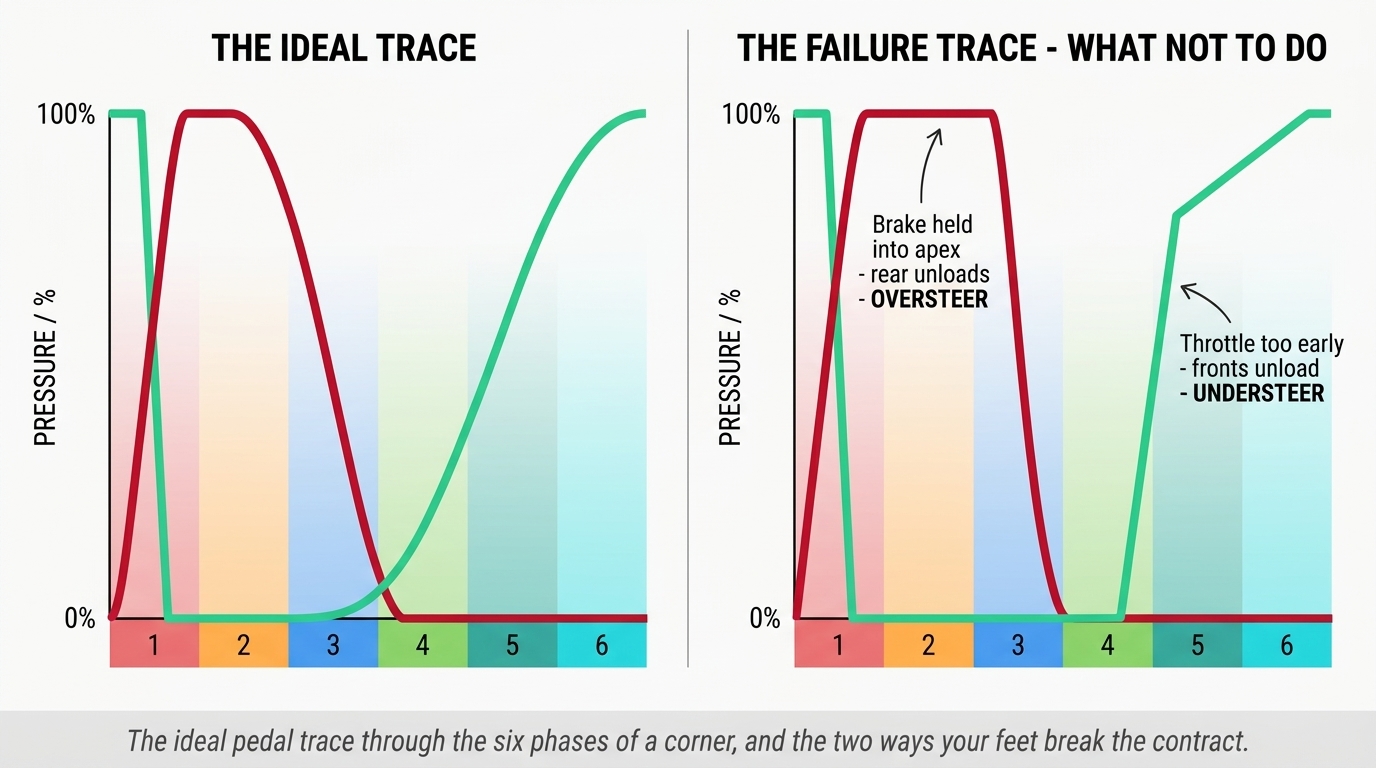
If there’s one teaching that ties the rest of this article together, it’s the central insight from Danny Lee’s sim racing tutorial: “despite understeer and oversteer containing the word steer, both of them are actually closely linked to what you’re doing with your feet. It’s not your steering wheel that shifts the balance of grip between the front and rear – it’s your throttle and brake.” Worth a second read.

Two graph panels showing pedal pressure across the six phases of a corner: left panel is the ideal trace, right panel is the failure trace with brake held into the apex (oversteer) and throttle ramped too early on exit (understeer).
The ideal pedal trace through the six phases of a corner (left), and the failure version (right). Brake held into the apex unloads the rear and triggers oversteer. Throttle ramped too early on exit unloads the fronts and triggers understeer.

Hold the brake too deep into the corner and weight stays forward, the rear unloads, the back snaps loose – that’s the right panel of the diagram, and that’s the oversteer-on-entry failure. The fix isn’t to brake less, which seems counterintuitive until tried. The fix is to come off the brake a fraction earlier so the platform redistributes and the rear settles before being asked to turn. Mansell says it nearly word for word in his driver-analysis videos: “ease up at the brake pedal a little bit earlier – we distribute some of that grip back to where we need it at the rear of the car.”

The other failure – throttle on too early on the exit, weight tips back, fronts unload, the car pushes wide – is the same diagram in mirror. The fix is patience. Wait for the steering angle to open up before stamping the throttle. Mansell has a way of remembering this in The 6 Phases of a Corner tutorial that’s worth keeping in the back pocket every time a slow corner threatens to bite: “imagine a piece of wire going from the top of the steering wheel to the accelerator pedal – as you open up the steering, it allows you to get more on the accelerator.” Open hands first, then progressive throttle. Closed hands plus full throttle equals the front running wide every time.

So the article comes down to this. If the car has understeer, put weight on the front – trail the brake a touch deeper, or lift the throttle. If the car has oversteer, put weight on the rear – get off the brake earlier, or feed in a steady throttle to settle the platform. The hands don’t shift the balance between the two ends of the car. The feet do, and to a lesser extent the setup does, which is the next conversation entirely.

What the steering wheel tells you

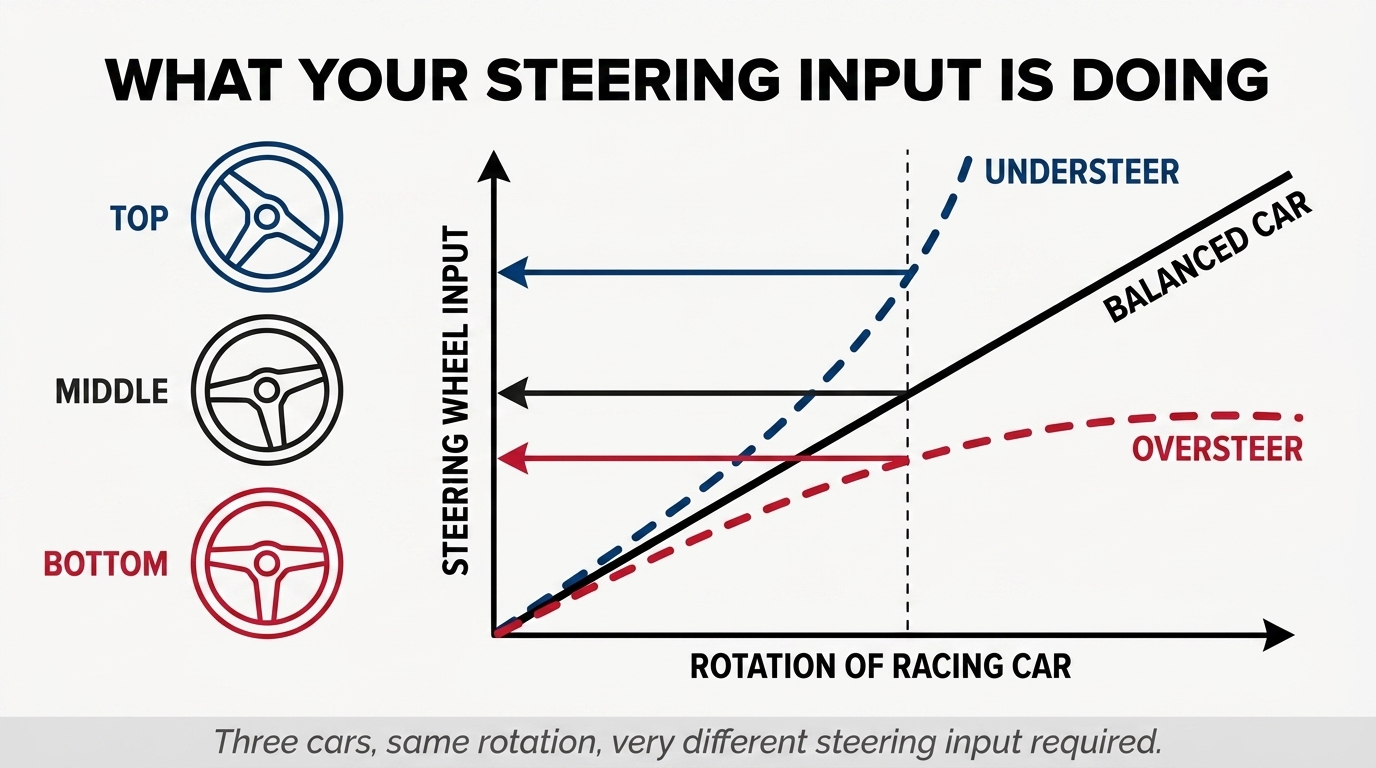
If the feet are the levers, the wheel is the dashboard – it tells the driver which lever to reach for. And the graph that lands this concept most directly is this one:

Graph plotting steering wheel input against rotation of racing car, showing three curves: balanced car (straight diagonal), understeer (curves above the line - more input needed for less rotation), oversteer (curves below - less input for more rotation), with three steering wheel icons on the left showing the different angles.
How much steering input each car requires for the same level of rotation. The understeer car (blue) needs much more lock to get the same result. The oversteer car (red) needs barely any. Same corner, same desired rotation, very different work at the rim.

Reading that graph from the inside of the cockpit, understeer feels like the rim getting weightless and the steering loading up against itself – the blue curve climbing away from the balanced line as more lock gets wound on without producing rotation. Oversteer is the opposite shape – rim goes slack, the car wants to rotate faster than the hands asked for, and the driver is down on the red curve where small inputs produce big results. Mansell’s piece of practical advice in Tutorial 7 is the one most often forgotten and most often relearned: “have a nice relaxed grip on the steering wheel – this will make any movement, whether at the front or the rear, much easier to feel through the steering wheel.” White-knuckling the rim strips out the sensitivity of the only sensor a sim racer has for this. Most drivers do it anyway when they’re pushing. Probably all of us, if we’re honest.

The corollary, walked through in Tutorial 8 and worth restating, is that the worst thing to do when the rear steps out is to over-correct – too much counter-steer and the car pendulums into tank-slapper territory, where it pivots one way and then the other until it spins. Small inputs, fast hands, eyes up where the car needs to go. (The eyes-up part is the hardest. The reflex to look at where the back is sliding is real, and it’s the wrong reflex.)

“Which is better?” (and the other questions worth answering)

The People Also Ask box on Google for this query is mostly variants of one question – is it better to have oversteer or understeer? – and the honest answer is neither, on average. Road cars are deliberately tuned to understeer at the limit because it’s the safer of the two failures; a car that pushes wide is easier to recover than one that swings the rear out and rotates. Race cars are tuned closer to neutral with a hint either way, and the choice between “hint of understeer” and “hint of oversteer” is mostly a driver-preference call, of the kind Alonso and Verstappen disagree on.

The Verstappen-specific question shows up a lot, too. Max prefers oversteer. Pointy front. Schumacher school. He’s said as much in interviews, and Mansell has built a whole video around it.

The do F1 cars understeer or oversteer question is more interesting still, because the technical answer is “neither, by design” and the practical answer is “it depends what phase of the corner you’re in.” Most balanced F1 cars are slightly oversteery on entry under heavy trail braking (weight forward, rear light), then settle to neutral or slightly understeery at minimum speed, then have a touch of oversteer again on power as the rears spin up. That’s why driver feedback at this level is so granular. It’s not “the car is oversteery”, it’s “the car is oversteery on entry but understeery from apex to exit” – a very different setup conversation.

And then there’s the question of whether drifting is just oversteer, which technically is correct – drifting is deliberately maintained oversteer. Driver61’s Learn How to Drift tutorial breaks it down into four stages: starting (unsettle the rear), maintaining (balance throttle against steering), transitioning (over-rotate, catch), exiting (let the slide run out). It’s a completely different sport from circuit racing – drift cars want maximum sideways, race cars want minimum sideways – but the underlying physics is the same set of tyres deciding whether to grip or slide.

One more diagnostic worth keeping in the back pocket. Mansell has a driver-analysis video where he watches an Ariel Atom oversteering at every phase of every corner and concludes, quickly, that “the car’s got oversteer on the entry to the corner, at the apex of the corner, and on the exit – and what that says to me is that it’s a universal setup problem.” The distinction is the useful bit: if the failure shows up in one phase, it’s technique. If it shows up in every phase, it’s setup. That saves a lot of wasted setup tinkering for issues that turn out to be down to getting on the throttle too early.

How to drill this in the sim

The drill that works best is back-to-back stints in the same car at the same track with one setup change between them. GT4s at Brands Hatch are a good test bed – Paddock Hill Bend on the entry is a brilliant oversteer test (if the rear is going to let go, it does it there under the compression), Druids gives a sustained mid-corner phase where any understeer will show up, and Clearways on the way back round is the throttle-on test for exit understeer. One lap, three different failure-modes if the balance is wrong. Run ten clean laps with the default setup, change one thing – usually a click of rear wing, or sometimes a small drop in rear ride height – and run ten more. The before-and-after is what teaches the eye to read the car.

The other habit worth building, and the one that’s harder than it sounds, is verbalising what the car is doing mid-corner, not after the lap. “Front going light NOW” or “rear stepping” or “wheel loading” as it happens, out loud. Half the battle is recognising the failure in time to do something about it, and that recognition is a muscle that builds through naming what’s felt in the moment. Driver61’s masterclass uses the same technique with coaching clients and it works for the same reason that reading a new track works – the moment a label gets put on a sensation, the driver can react to it.

Mansell’s other practical line from Tutorial 7 belongs above the rig: “just stay within the grip threshold of the under steer, be very patient with the accelerator.” Patience is the under-priced asset of the sim-racing limit. The reflex to wind on more lock or stamp the throttle harder is the one to unlearn.

So which one wins?

Both ends of the F1 grid are full of drivers who’ve made either preference work. Hamilton’s seven world titles and Alonso’s two were built on a rear-biased platform with a touch of understeer at apex; Schumacher’s seven and the recent Verstappen run were built on a pointy front and the willingness to live with a rear that occasionally bites. Neither is wrong. Both are fast. Neither one is the racing line you’ll find in a textbook, because the textbook would have to acknowledge that the fastest line through a corner depends as much on the driver’s reflexes as on the geometry of the corner itself.

The point of the article is the one Danny Lee makes most directly and the one Scott Mansell makes more quietly across the Driver’s University series: feel which failure is happening, in which phase, and reach for the right lever – throttle, brake, or the setup screen – rather than winding on more steering lock and hoping. That last reflex is the one to unlearn. Everything else is tuning around it.


Sources & where to go next

On SimRacingCockpit, the related deep-dives are trail braking in the simulator, threshold braking, brake bias for faster lap times, and on the kit side – direct drive wheelbases, where most of the feedback that makes any of this actionable lives.


Related Posts
Understeer vs Oversteer: What’s Actually Happening (and Why F1 Drivers Set Up for Each)
Topic:

Leave a Reply

Your email address will not be published. Required fields are marked *