

I’m a sim racer and amateur racer with a passion for Motorsport, good racecraft and the technical and setup aspect of sim racing.
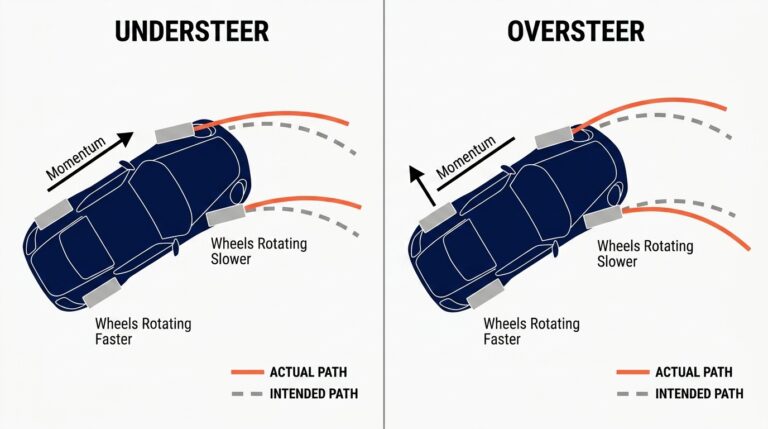
Understeer is the front tyres letting go before the rears – drivers call it push. Oversteer is the rears letting go first. In today’s guide we’re going to look at what each one feels like from the driver’s seat, what your feet (not your hands) do about it, and how to train yourself to catch both in the sim. I’ve had plenty of both – in a Radical SR3 on cold slicks and in iRacing – so where I can, I’ll describe the feeling rather than the theory.
Quick Navigation
Jump directly to what you’re looking for:
What understeer is | Two paths | What oversteer is | Feet, not wheel | Wheel cues | Which is better? | Drilling it | Sources
What understeer is (and what it feels like)
Understeer just feels frustrating. You’re working the steering wheel, wanting the car to head in the direction you’re telling it to, and there simply isn’t the grip on the front of the car. Rather than following the wheel, the car goes almost straight on, and you find yourself nearly crossing your arms over. The steering wheel isn’t doing anything for you anymore – the car pushes the tyres along the tarmac rather than them gripping up and actually steering you. Drivers literally call it push for that reason. Scott Mansell at Driver61 calls understeer “the most disliked handling characteristic of them all”, and I’d agree.
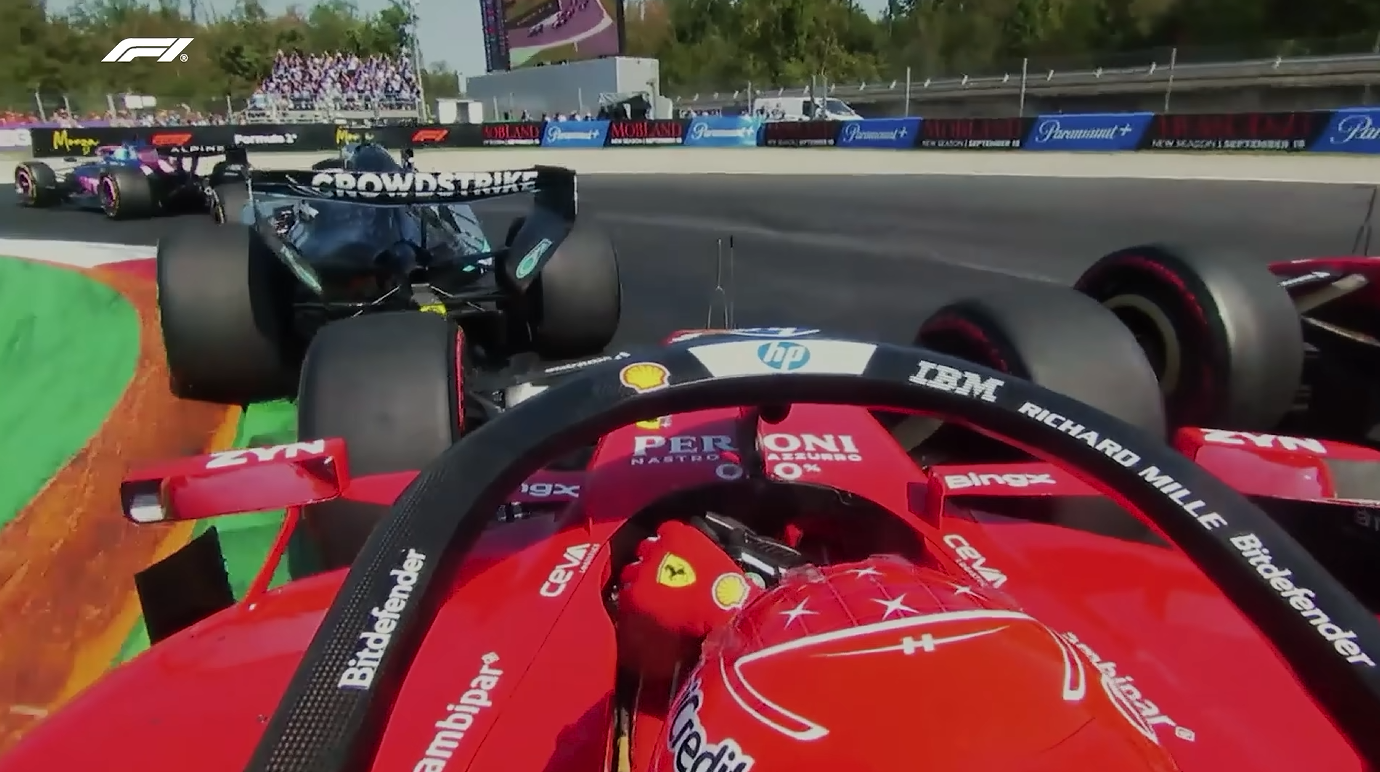
Watch Charles Leclerc’s onboard from Monza 2026 – the opening-lap clash with Lewis Hamilton into the first chicane. My read of that incident is that his front tyres weren’t warm enough, so he didn’t have the grip on the tarmac, and when he turned in the car ran further right than he wanted even as he asked it to go left. His own words afterwards: “I tried to do the tightest corner possible, but that was just not enough.” The car had decided how tight the corner was going to be. That’s understeer.
Cold slicks: the Radical SR3 warmup
The easiest place to catch understeer is on cold tyres. When I raced a Radical SR3 you were on slicks with no tyre warmers, so every session started with a fairly lengthy warmup procedure, front and rear. It’s not really about weaving. On the outlap I’d use lots of straight-line acceleration followed by heavy braking – that puts pressure on the front tyres and works heat through the core of the wheel and into the rubber. Then, still under braking, a little steering to the left and a little to the right each time, which works that heat out into the shoulders. Do that on each side and you end up with a nice amount of heat across the full range of the tyre. Until it’s done, the front simply won’t grip, and you drive accordingly.
Visit Our Sponsors
Two paths through one corner
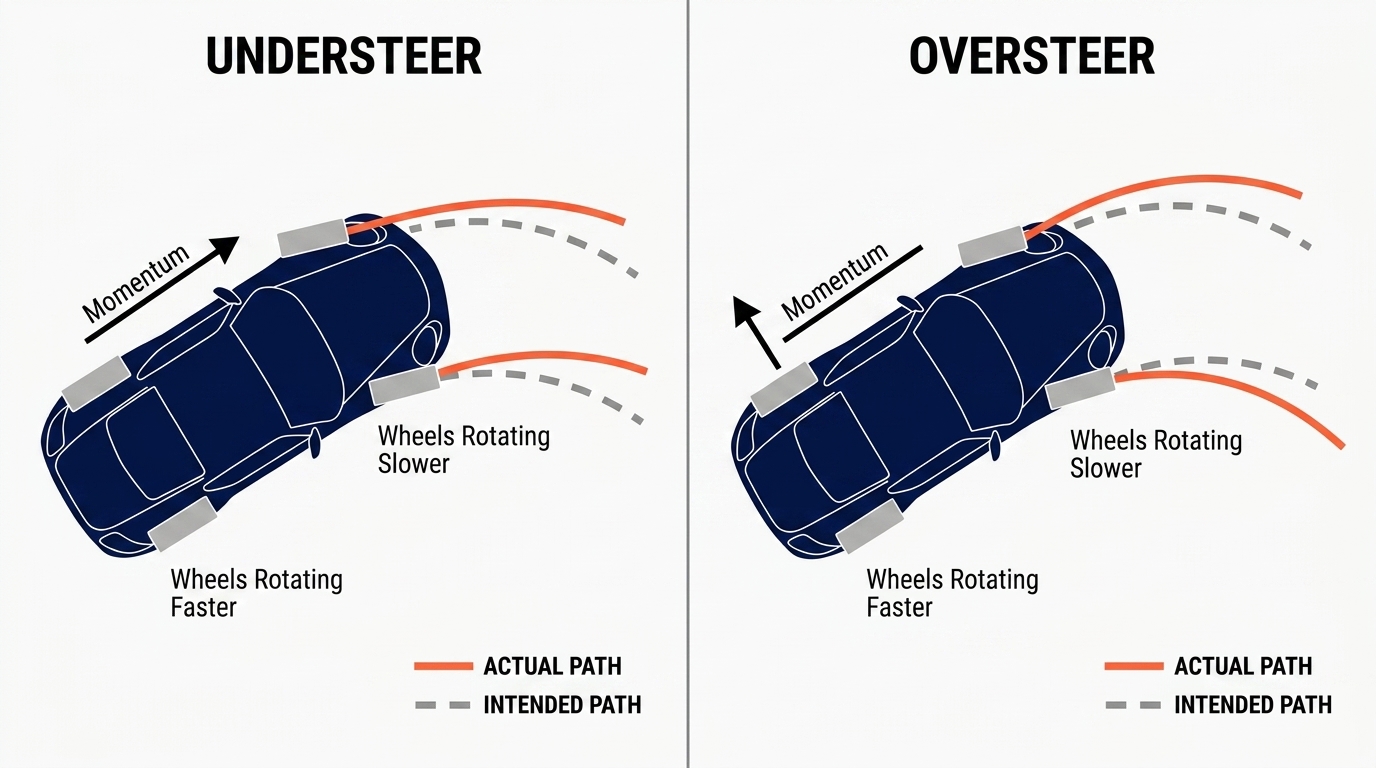
Both problems play out through the same corner. The understeering car runs wide of the line you asked for – it turns, just not as much as you need. The oversteering car rotates past it, the rear swinging round so the nose points further in than you ever intended.
What oversteer is (and what it feels like)
Oversteer is the rear letting go, and depending on the car it can be quite an instant loss of grip. The car suddenly wants to over-rotate. The worst version is snap oversteer – it just suddenly goes, and you have to catch it as quickly as you can. When you’re watching an F1 driver and marvelling at their lightning-fast reflexes, this is what’s actually happening: they’ve had a moment of oversteer and they’ve had to put an instant input into the wheel to straighten the car out. Mansell calls oversteer “the most fun handling characteristic”, and he’s right that you sense it somewhere different to understeer: “you’ll feel it in your backside – you’ll feel it through the seat of the car.” The classic mistake once it starts is overcorrection. Wind on too much opposite lock and the car snaps back the other way – “a bit of a tank slapper”, as he puts it.
It’s your feet, not your wheel
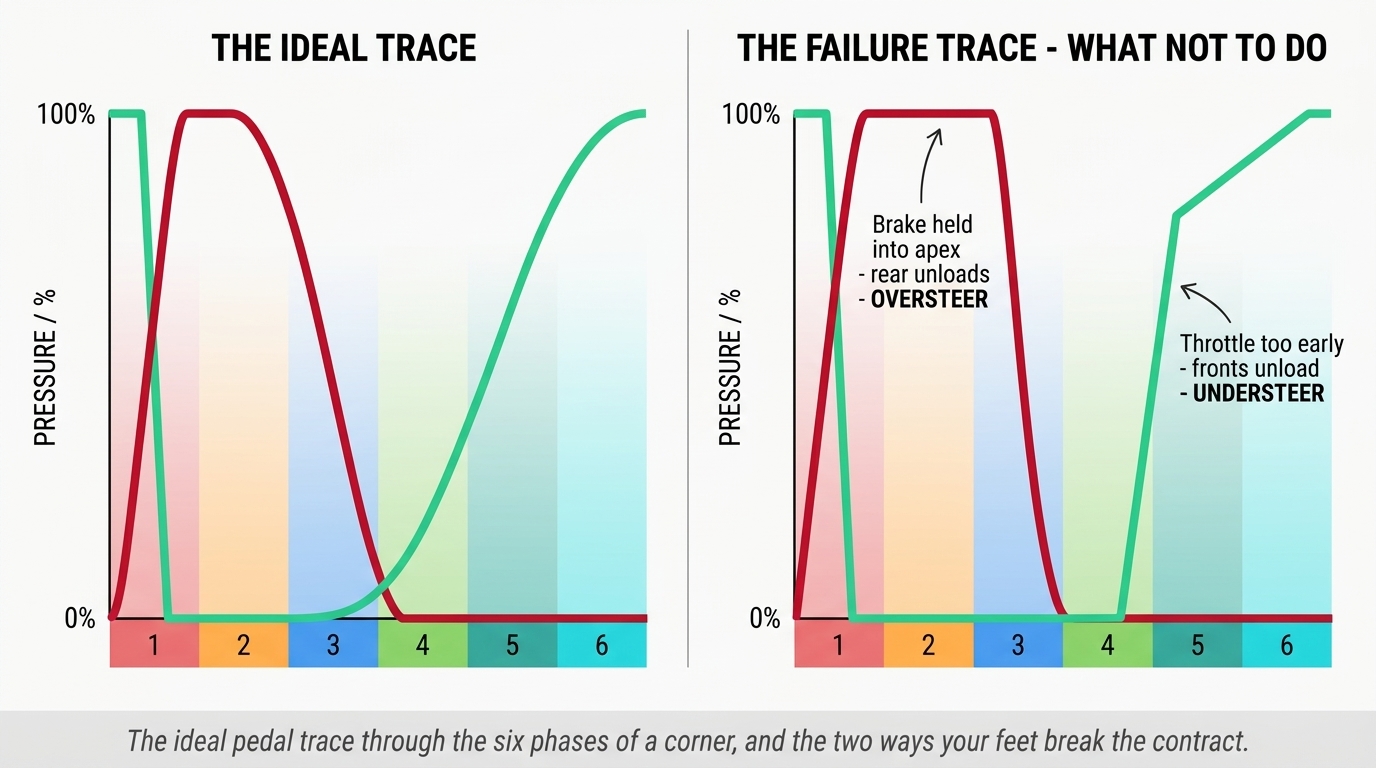
The teaching that ties all of this together comes from coach Danny Lee: despite the names, understeer and oversteer are controlled with your feet, not the wheel. Throttle and brake shift the car’s weight between the front and rear axles, and the loaded end is the end with grip. Hold the brake too deep into the corner and the weight stays forward, the rear unloads, and the back steps out. Get on the throttle too early on exit and the weight tips rearward, the fronts unload, and the car pushes wide. The fixes are mirror images. For understeer, get weight onto the front – trail the brake a touch deeper, or lift. For oversteer, get weight rearward: “ease up at the brake pedal earlier… we distribute some of that grip back to where we need it at the rear of the car.” Driver61’s 6 Phases of a Corner tutorial has a lovely image for the exit: “imagine a piece of wire going from the top of the steering wheel to the accelerator pedal – as you open up the steering, it allows you to get more on the accelerator.” And there’s one more, on smoothness with every control: “imagine pushing somebody over – if you push them hard, they’re likely to fall on the ground. But if you put the same pressure into them and load them up very smoothly, they can still remain standing.”
What the steering wheel tells you
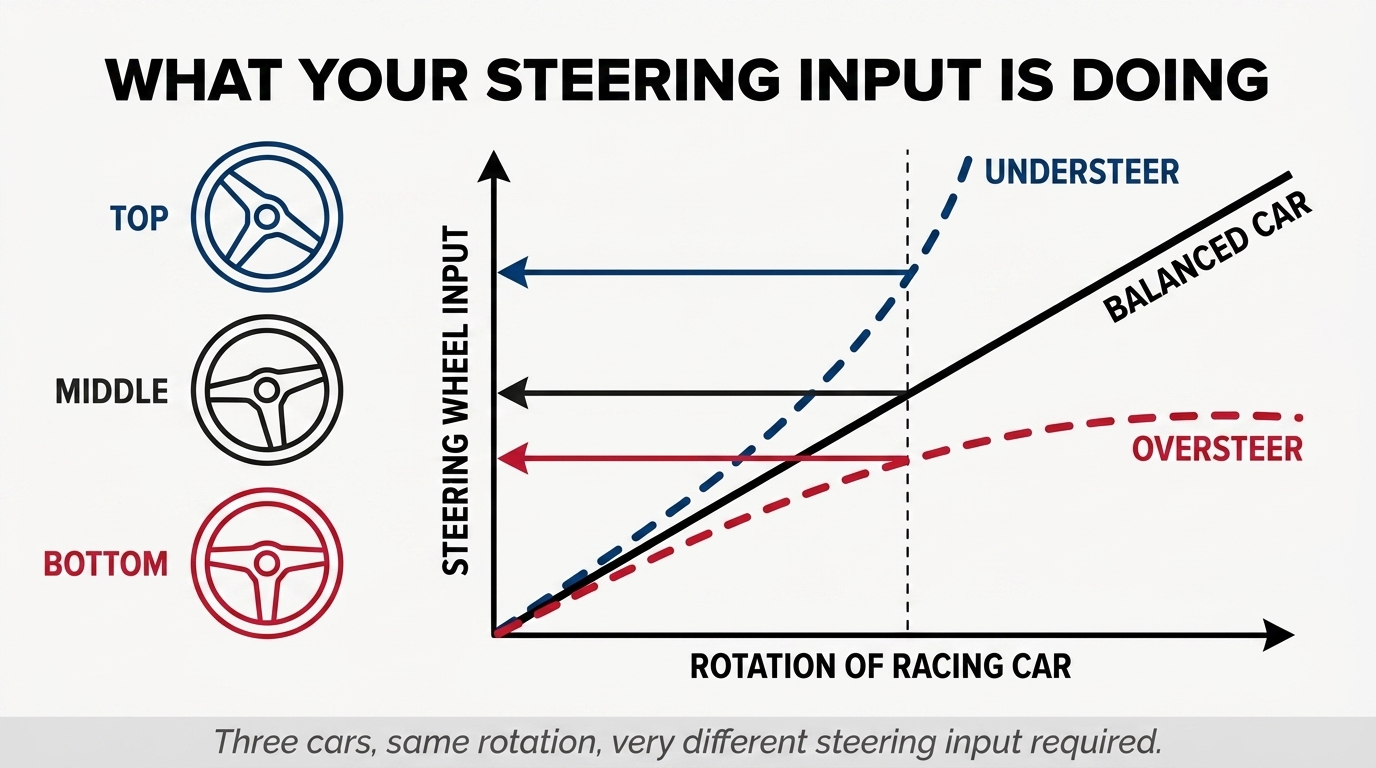
In the sim, understeer to me is a very specific feeling: this is as much as the car’s going to turn, and I’m not going to make it through this corner. The instinct is to put a dab of brake on, which of course moves the weight of the car over the front – your feet again. iRacing is really good here: turn your tyre noise up and you can hear when you’re pushing, which makes it much easier to reconcile a front-grip issue with what you’re hearing. Oversteer is where a well-set-up direct drive wheelbase earns its keep. Get the settings right and you can almost feel the rotation of the car – the wheel provides a sense of resistance into the corner, and you can play with that. Mansell’s advice applies doubly on a rig: “Have a nice relaxed grip on the steering wheel – this will make any movement, whether at the front or the rear, much easier to feel.”
Which is better?
There’s no correct answer, and F1 proves it. Some of the fastest drivers of all time deliberately set their cars up with a touch of understeer – Fernando Alonso is the famous example, and Driver61 has a whole video on why he loves it. Max Verstappen sits in the other camp: a pointy front end that rotates the moment he asks. Both approaches have won championships. What actually decides it is consistency – a balance you can predict lap after lap is worth more than a theoretically faster one you can’t. Drifting, for the record, is simply oversteer maintained on purpose.
How to drill this in the sim
The drill is simple. Run back-to-back stints in the same car on the same track, and make one setup change between them – one, so whatever you feel can be attributed to the thing you changed. While you’re out there, say out loud what the car is doing mid-corner, not after the lap; naming it as it happens sharpens your awareness of it enormously. And on the way out of the corner, Mansell again: “just stay within the grip threshold of the under steer, be very patient with the accelerator”.
Once you can feel which end is letting go, the next thing to work on is your brake foot. We have a full guide to trail braking, and another on threshold braking – start with the trail braking one.
Sources & where to go next
- Driver61 – Why Alonso LOVES Understeer – the F1-preference angle. Worth watching first if the rest of this is new ground.
- Driver61 – Understeer Explained (Tutorial 7) – the foundational definition, cues, and corrections by corner section.
- Driver61 – Oversteer Explained (Tutorial 8) – the foundational oversteer tutorial plus the “imagine pushing someone over” smoothness analogy.
- Driver61 – The 6 Phases of a Corner – the corner-anatomy framework plus the ideal-trace version of the pedal-pressure graph.
- Driver61 – Can You Fix Oversteer with Setup & Technique? – the diagnostic for universal-oversteer versus phase-specific failure.
- Danny Lee – Learn To Control Understeer and Oversteer – the sim-racing-specific application plus the “feet not wheel” central teaching.
On SimRacingCockpit, the related deep-dives are trail braking in the simulator, threshold braking, brake bias for faster lap times, and on the kit side – direct drive wheelbases, where most of the feedback that makes any of this actionable lives.
Related Posts
Racing Line Explained: Late vs Geometric Apex (with diagrams)
Understeer vs Oversteer: What’s Actually Happening (and Why F1 Drivers Set Up for Each)
How to Learn a New Track Faster in Sim Racing
The Science of Tyre Warming in iRacing: Testing Shows Braking Beats Weaving
Le Mans Ultimate: How to Drive the LMGT3 and Hypercar
How to Pull off the Perfect Overtake / Pass in Sim Racing
Topic: understeer vs oversteer