

I’m a sim racer and amateur racer with a passion for Motorsport, good racecraft and the technical and setup aspect of sim racing.
I’ve been on iRacing for years, and the question every newcomer texts me about is the same one: “why did my safety rating just drop?” Usually it’s followed by a screenshot of the post-race results. Sometimes a clip of the incident. Always the same flavour of disbelief – they think they had a clean race, the number says otherwise, and the explanation isn’t anywhere obvious in the iRacing UI. So this is that explanation. What the Inc N/17 counter at top-left is counting, how it gets turned into the 0.00-4.99 SR float on your stats page, and what to do once it’s gone the wrong way.
Quick Navigation
Jump directly to what you’re looking for:
What the Inc N/17 counter is counting |
How the 0.00-4.99 number is calculated |
Why it matters when you’re racing |
How to recover SR when it’s dropped |
The honest limits |
Common misconceptions |
Where to start if you’ve just had a bad race
What the Inc N/17 counter is counting
The number that lives top-left of your iRacing screen during a race – “Inc 4 / 17” or similar – is the cumulative incident points you’ve collected this session. Hit the cap (17x in most series) and you’re disqualified. Most newcomers assume the count is incidents-the-event, like the score in a video game. It’s actually a points total – some incidents are worth more than others.
The four point values, plain and simple:
- 0x – light car contact where nothing significant happened. No advantage gained, no damage done. The contact is registered, the count doesn’t move. This is the one most people get wrong – 0x doesn’t mean nothing happened, it means iRacing decided what happened wasn’t worth points.
- 1x – off-track. The centre-line of your car crosses the track boundary. The most common one. Usually a corner you ran wide on, occasionally a slide that put you in the grass.
- 2x – loss of control (you spun past 90 degrees) OR light wall contact. Whichever happened first. A clean spin in the middle of an empty track is the same value as gently brushing a wall on exit.
- 4x – heavy car contact. The expensive one. Even a relatively gentle hit can be flagged 4x if iRacing decides the contact was substantial. Jackzer’s Bathurst race vlog has a moment where he describes a 4x as “on the most gentle of taps, that was enough to give us a 4x” – which sounds wrong until you’ve eaten a couple of them yourself and realised the threshold is lower than you’d expect.
One critical thing the manual doesn’t quite spell out: the sequence cap. If multiple incidents happen in one unbroken slide, iRacing only applies the highest value, not the sum. Drop two wheels in the grass (1x), lose the car (2x), then collect another car on the way back (4x), all within the same incident sequence – you get 4x for the lot, not 7x. The system is mean about contact but it doesn’t pile on. Worth knowing the next time you watch a replay and find yourself counting up everything that went wrong in a single corner.
One more thing the counter doesn’t count: pit-lane infractions. Speeding in the pits, crossing the pit-exit blend line, passing under a yellow flag – none of those add x’s. They give you a black flag instead, which is its own punishment (drive-through or stop-and-go), but they don’t directly hurt your safety rating. Different system, different penalty box. If you want the rules text in full, the iRacing sporting code summary is over here.
How the 0.00-4.99 number is calculated
This is the part most newcomers never see explained properly. The 0.00 to 4.99 number on your stats page isn’t a per-race average. It’s not a per-season number. It’s a rolling average of Corners Per Incident across a window of recent corners. That’s the unit. Corners.
The window scales with your licence. A Rookie’s window covers only a few hundred corners, which is why one bad race feels punishing – the window’s small enough that a single 12x effectively rewrites the average. An A-class window is closer to a couple of thousand. iRacing keep the exact figures internal, so any precise number you see online is community-reverse-engineered rather than gospel. The community estimate is roughly 15-20 corners per incident to hold a D-licence at 3.00 SR, and roughly 70-80 to hold an A-licence at the same SR. Take those as ballpark, not law.
The corner-window design is what makes SR feel asymmetric in the wild. A bad race – say a 12x where you collected someone in lap one – pushes a clean race out of your window. The clean race that propped your average up gets dropped, and the bad race gets weighted in. SR drops fast. A clean race pushing another clean race out of the window? It barely moves anything. SR climbs slowly. That’s the rolling-average mechanic doing its work, and there’s no shortcut around it.
One detail that explains a lot of “why did my licence not change yet” frustration: the +0.40 whole-number bump. Every time your SR crosses a whole number (2.98 ticks up to 3.02, say), iRacing artificially adds 0.40 to it. So you don’t really sit at 3.02; you sit at 3.42 the moment you cross. The bump exists to stop your licence oscillating up and down every time you hover at the boundary, and it’s why you can have a slightly bad week and still keep your licence even though the underlying CPI has dipped. It’s also why the SR jump from a “promotion” race feels weirdly satisfying – you crossed the line and got handed a head start.
Promotion thresholds, the official ones:
Visit Our Sponsors
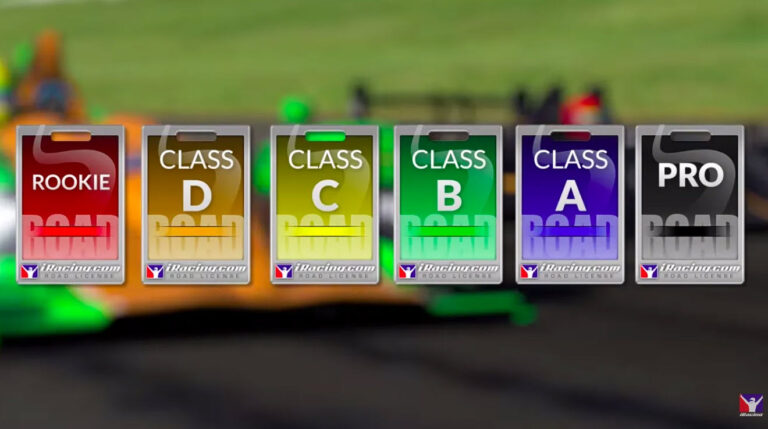
- Fast-track promotion mid-season at 4.00 SR (provided you’ve met the Minimum Participation Requirement – 4 official races or time trials in your current licence class)
- End-of-season promotion at 3.00 SR (Rookies promote at 3.00 immediately, no end-of-season wait)
- Fast-track demotion if you drop below 1.00 SR
- End-of-season demotion if you finish a season below 2.00 SR
If you want the full path-from-rookie-to-GT3 view rather than the SR-mechanics view, that’s covered in the iRacing career guide. They’re sister pieces – this one is the maths, that one is the path.
Why it matters when you’re racing
Once you understand the corner-window mechanic, three things change about how you race.
Track choice starts to matter. A clean race at the Nordschleige (70-plus corners per lap) feeds your CPI window with vastly more clean-corner data than a clean race at an oval or a short club circuit. If your SR has dropped and you need to recover, long tracks are your friend. Short tracks are arithmetically harder to climb back from. Jackzer himself says it mid-race in his Bathurst vlog, when he’s well aware his SR is hurting: “with the length of this race and the amount of corners, I think we are going to gain something.” That’s a working iRacer thinking out loud about the same calculus.
Midpack discipline becomes a real thing. When you’re P2 with clean air, you can drive like a hero. When you’re P14 in traffic, every car ahead is a potential incident sequence. Jackzer puts the principle bluntly in his “avoid 90% of crashes” essay – “midpack is not the place to drive like you’re leading. People leave zero margin. They sit half a car length off the guy in front. They break at the exact same marker they would in clean air. They trust the guy ahead to be perfect, and the guy ahead of him, and the guy ahead of him. That’s not racecraft. That’s optimism.” The fix is the boring one – leave bigger gaps in traffic, brake earlier than you’d naturally want to, and pick which corners you race hard and which you race conservative.
You start watching the counter mid-race. Regular iRacers track their incident count almost reflexively – you can hear it in race vlogs. Jackzer drops “we are still at a sweet, sweet zero X” in the middle of a Bathurst commentary. Most newcomers don’t think about the counter until the post-race screen. The habit of glancing top-left every few laps is the practical change that follows from understanding the system. You stop being surprised after the race.
How to recover SR when it’s dropped
So you’ve had a bad race. Maybe you got punted, maybe you punted someone, maybe the car wouldn’t behave on cold tyres and you piled into a wall on lap one. SR’s dropped, the licence is in jeopardy, and you want it back. The practical recovery options, in order of how much they’ll annoy you:
Run long-track series for a couple of weeks. The Nürburgring 24 events, the Spa series, anything that puts you on a circuit with serious corner counts per lap. Even a mid-pack finish at a long track does more for your CPI than a P3 at a short oval. This is the highest-payoff move and it’s mathematical, not vibes.
Time trials are your safe-harbour option. They count for SR and for your Minimum Participation Requirement, but they’re weighted at 0.35x compared to a full race – so it takes roughly three times as many corners in a time trial to gain the equivalent SR. The trade-off is zero risk of getting punted by a stranger in a Mazda. If wheel-to-wheel feels too dicey for a few sessions, time trials are how you stay productive.
The “slow car at the back” approach mathematically works, and it’s a trap. Skip qualifying, start from the pits, cruise at the back keeping out of trouble – your CPI will climb and your SR will recover. The catch is that it tanks your iRating (the matchmaking number) which then drops you into lower splits where the standard of car control is materially worse. You end up in races where 4x crashes are more frequent and less avoidable, not less. You’re trading short-term SR gain for medium-term SR misery. Use sparingly if at all.
The other thing worth saying: when an unavoidable crash starts unfolding around you, the right call is almost always to stop the car rather than try to thread it. Jackzer puts it cleanly: “you’re much better stopping the car and losing 10 seconds than ramming it into a wall and losing 20 minutes.” The 4x for stopping in the racing line is small change compared to the 4x for ploughing in. Same logic at the start – the entry to Monza’s Turn 1, the chicane after T1 at Monza, T2 and T3 at Daytona, these are 50-50 lap-one crash zones regardless of your iRating. Pre-plan the bail-out line for each of those before the lights go out, and you’ll farm SR by being the driver who survived rather than the driver who tried to win lap one.
The honest limits – what’s frustrating about this system
The no-fault rule is the bit that grinds people. If someone rear-ends you on the pit straight while you’re holding a perfect line, you both eat the 4x. iRacing’s stance has been consistent for years – a no-fault system is the only statistically viable way to automate safety across thousands of daily races without having human stewards. They’re probably right about the maths, for now. It’s still painful when it’s you on the receiving end.
Phantom 1x off-tracks at known-buggy track-limits zones used to be more common than they are now. Through 2024 and 2025 iRacing rolled out a “Slow Down” time-penalty system at problematic apexes, which replaced some of the automatic 1x off-tracks with a small in-race time hit instead. It’s better, for now. It’s not gone everywhere yet, and a few surfaces still trigger inconsistent off-tracks if you’re a foot wide of where the limit visually appears.
The proprietary CPI numbers are the other genuine gripe. iRacing don’t publish the corner-window size per licence, the exact CPI thresholds for each SR band, or the precise weighting of practice/warmup vs race sessions. Everything you read about “you need 70 corners per incident at A-class” is community reverse-engineering, not iRacing’s own documentation. Useful as a rule of thumb, not as gospel.
Common misconceptions
The list of things newcomers get wrong about SR is well-established at this point. These are the ones that move the needle:
- SR is per-discipline, not global. iRacing maintains five separate licences – Oval, Dirt Oval, Sports Car, Formula, Dirt Road. Crashing in a Formula race has zero impact on your Sports Car SR. They are five entirely separate buckets. The Road licence split into Sports Car and Formula in early 2024, so anyone who started before that change still occasionally trips on the assumption that Road is one licence.
- Open practice doesn’t count for SR. The standalone public practice sessions you join from the iRacing UI – those don’t affect your SR at all. The 3-minute official warmup that’s attached immediately before a race session, that one does count, at 0.5x weight. Confusing because the UI doesn’t really telegraph the difference.
- Offline AI races don’t affect SR. AI-only sessions, Week 13 fun series, private hosted sessions – none of them touch your SR or your iRating. Only official races on iRacing’s matchmaking server move the numbers.
- Lower iRating doesn’t mean easier racing. The bottom splits have notoriously poor car control. If you tank your iRating to farm SR, you’ll find yourself in races with more unavoidable 4x crashes, not fewer. The mythology that “lower split = chill, higher split = sweat-fest” is half-true at best – the chill is at mid-tier iRating where drivers are competent enough to avoid you and not skilled enough to be racing the limit on every corner.
- Time trials count, just at 0.35x weight. The cap on Minimum Participation Requirement is 4 official sessions in your licence class, and time trials count toward that. They take longer to move SR by the same amount, but they move it.
Where to start if you’ve just had a bad race
If you’ve just landed here from a 4x-heavy race and the licence is at risk, here’s the order I’d run:
One, check which licence is hurting and stay in that discipline for the recovery work. Don’t switch to oval to “cool off” if it’s your Sports Car SR that’s dropped – they’re separate, the rest week does nothing. Two, find a long-track series in your licence class for the next couple of weeks. The Spa weeks, the long Nordschleige rounds, anything with serious corners-per-lap. Three, if wheel-to-wheel feels too risky right now, run the time trial for the same week’s car at the same long track – 0.35x weight, but zero risk of getting punted by a stranger. Four, if the licence is properly about to drop, the slow-car-at-the-back option exists – just know you’re trading SR recovery for an iRating dip, and budget for the lower-split crashes that follow.
If you want the practical-tools layer alongside this – the apps that surface incident risk in real-time, overlays for managing your spot awareness in traffic – the free iRacing apps roundup covers Crew Chief and Race Labs, both of which help. And if you’re brand new to sim racing entirely (not just iRacing), the sim racing setup guide is the broader starting point.
The closing bit, mostly nicked from Jack’s 2026 iRacing beginner guide because it’s the right framing – focus on being safe, not being fast. The drivers who climb the licences quickest are almost never the fastest in their split. They’re the ones who finish, lap after lap, week after week, with single-digit incident counts. Be a rookie, enjoy being a rookie, and the SR comes back of its own accord. That’s the part nobody tells you when you’re staring at the post-race screen wondering where the number went.
Related Posts
iRacing Simagic Settings: FFB for the Alpha EVO and Alpha Mini
iRacing Simucube Settings: Simucube 2 Pro, Sport and Simucube 3
iRacing FFB Settings: Force Feedback for Fanatec, Moza, Logitech and More
iRacing Promo Codes 2026: Verified Discount Codes
iRacing Safety Rating, Explained: How the Number Actually Moves (and How to Get It Back)
The iRacing Career Guide: From Rookie to GT3
Topic: Sim Racing Guides