


I’m a sim racer and amateur racer with a passion for Motorsport, good racecraft and the technical and setup aspect of sim racing.
Today we’re covering Fanatec settings for Assetto Corsa Competizione, base by base: the CSL DD and GT DD Pro, the ClubSport DD and DD+, the new Podium DD, and the discontinued DD1 and DD2 that plenty of people still have bolted to the rig. Every number on this page comes from Fanatec’s recommended profile or from a named community one, and where the two disagree, both are shown so you can pick a side.
The short version, if you’d rather be out on track: set the tuning menu from your base’s table below, leave Dynamic Damping at 100 and Road Effects at 0 in the game, and let the FFB meter settle your Gain. Everything else is detail.
Quick Navigation
Jump to the base you’re running:
How ACC’s FFB works |
The Fanatec App |
CSL DD and GT DD Pro |
ClubSport DD and DD+ |
Podium DD, DD1 and DD2 |
In-game settings |
Common mistakes
How ACC does force feedback on a Fanatec base
ACC computes its force feedback straight from the physics – the steering rack, the tyre loads, the kerbs. There are no canned effects layered on top, which is why the wheel can feel a bit quiet on your first drive, especially if you’ve come from a sim that adds artificial rumble to everything. That’s by design, not a fault. Aris Vasilakos, who built ACC’s physics at Kunos, has covered this at length on his Aris.Drives YouTube channel: the road is already in the physics, so anything you add on top of it is noise.
Two settings follow directly from that. Dynamic Damping, despite the name, is not a filter – it models the gyroscopic weight of the spinning tyres, and it belongs at 100. Road Effects is the one canned effect in the whole menu; that goes to 0, and the wheelbase’s own natural effects stay low for the same reason.
Worth knowing: ACC is finished. The final update, 1.10.4 in December 2025, changed nothing in the FFB menu, so these values won’t rot. And FullForce (FUL on the base) isn’t used by ACC at all – set it to whatever you like.
Set up the Fanatec App first
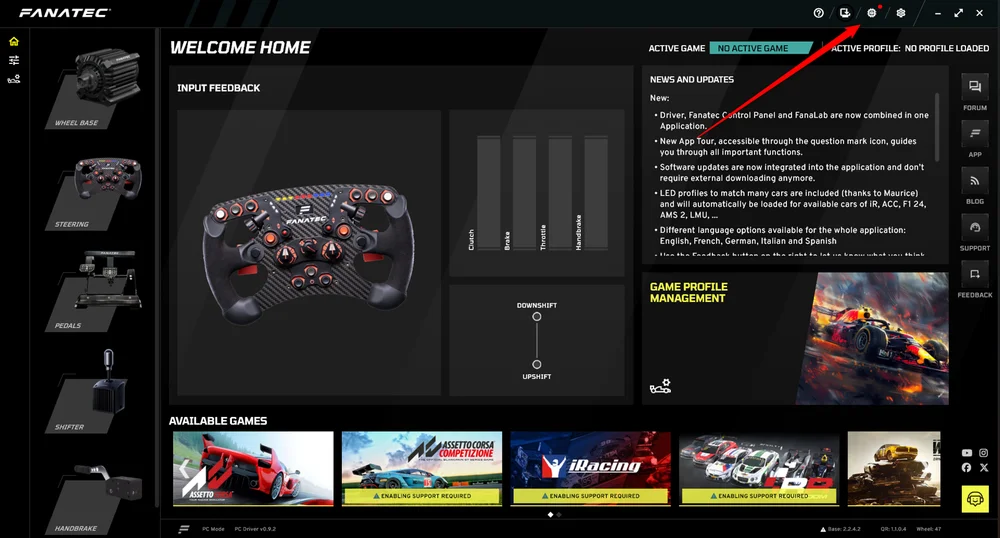
Before touching a single setting, install the Fanatec App. It has replaced the old Control Panel and FanaLab as the one piece of software for the whole direct drive range – tuning menu, firmware, all of it in one place.
Do the firmware update, because this one is worth having. The May 2026 firmware raised the ClubSport DD from 12 to 15 Nm and the ClubSport DD+ from 15 to 18 Nm. Same hardware, more torque, free! The App also ships with a built-in ACC preset, and that preset is where the tuning-menu profiles below come from.
CSL DD and GT DD Pro settings
The CSL DD and the GT DD Pro share the same motor and electronics, so they share a profile. If you’re on the GT DD Pro, boot it into PC mode first; after that, everything below applies as-is.
| Setting | CSL DD (5 Nm and 8 Nm) and GT DD Pro | Where sources split |
|---|---|---|
| SEN | 1080 (or Auto) | – |
| FF | 100 | – |
| FFS | Peak | – |
| NDP | 20 | – |
| NFR | Off | – |
| NIN | 3 | – |
| INT | 4 (Fanatec) | 1-2 in the community profiles, for less smoothing |
| FEI | 100 | – |
| FOR / SPR | 100 | – |
| DPR | 50 | – |
The full tuning menu is in the table, so I won’t repeat it here – the anchors are SEN 1080, FF 100, FFS Peak and NDP 20. The setting to experiment with is INT. Fanatec’s preset runs it at 4, which is smooth; the community profiles on Fanatec’s own forum run 1 or 2, which gives sharper kerb and slip detail at the cost of some grain. Gain is contested too: Fanatec says 70, while the forum runs 60-65 on the 8 Nm bases to keep clipping headroom, and 75-85 on the 5 Nm base to find some weight.
ClubSport DD and DD+ settings
The ClubSport bases take a different profile from the CSL family, and the change that matters is the scaling mode: FFS goes to Linear. On a 15 or 18 Nm base you want cornering weight that builds predictably, rather than the base reserving headroom for spikes, and the natural effects come down as well.
| Setting | ClubSport DD and DD+ | Where sources split |
|---|---|---|
| SEN | 1080 | 900 in random callsign’s profile |
| FF | 100 | 75 in random callsign’s profile, trading top-end for headroom |
| FFS | Linear | Peak was the DD1/DD2-era advice; Linear is the current consensus on high torque |
| NDP | 15 | 0 in random callsign’s profile |
| NFR | 2 | 0 in random callsign’s profile |
| NIN | 0 | – |
| INT | 2 | 1 if you want it rawer still |
| FEI | 100 | – |
| FOR / SPR / DPR | 100 | – |
| FUL | 100 (ignored by ACC) | – |
Peak versus Linear is an old argument. The DD1/DD2-era guidance said Peak for transient headroom; the current consensus on high-torque bases is Linear. And if you fancy a different starting point altogether, the YouTube channel random callsign runs his ClubSport DD+ with the natural effects zeroed, FF at 75, in-game Gain at 35 and Road Effects at 9. His reasoning: ACC’s steering-rack simulation is already heavily damped, and he wants the raw signal. That’s a genuine split, not a mistake.
Podium DD, and the old DD1 and DD2
The Podium DD is the current 25 Nm flagship and, being honest, Fanatec hasn’t published an ACC profile for it yet. The sensible start is the ClubSport DD+ column with in-game Gain pulled right down to 25-35; a 25 Nm base reproduces the rack forces at close to 1:1, so strength is not something you’ll be short of. One piece of legacy advice to ignore: the old DD2 guidance ran NIN at 3 to mask a heavy motor, and this base doesn’t have one. Leave inertia at 0.
The DD1 and DD2 are discontinued, but plenty of people still own them and the long-standing forum baseline still holds: FF 38-45, FFS Peak, Dynamic Damping 100. That FF number is a safety margin, not a compromise. A 20 Nm+ base at full strength is a wrist injury waiting for a crash, and 40% is still more wheel than most of us could drive a stint against. The Fanatec App now carries these bases too; FanaLab is legacy.
| Setting | Podium DD (25 Nm) | DD1 / DD2 (discontinued) |
|---|---|---|
| SEN | 1080 | 1080 |
| FF | 100 | 38-45 |
| FFS | Linear | Peak |
| NDP | 15-20 | 15 |
| NFR | 2 | 2 |
| NIN | 0 | 3 |
| INT | 2 | 2 |
| FEI | 100 | 100 |
| FOR / SPR / DPR | 100 | 100 |
If you’re weighing up which base deserves your ACC hours, the current range and today’s prices are below.
The in-game ACC settings
The in-game menu is only four sliders: Gain, Min Force, Dynamic Damping and Road Effects. Three of them are the same whatever base you own – Min Force 0, Dynamic Damping 100, Road Effects 0. Min Force exists to push through the deadzone on a belt-driven wheel; a direct drive base has no deadzone, and anything above 0 just sets the wheel oscillating on the straights.
| Setting | CSL DD family | ClubSport DD / DD+ | Podium DD / DD1 / DD2 |
|---|---|---|---|
| Gain | 70 (Fanatec); 60-65 community on 8 Nm, 75-85 on 5 Nm | 55-60 / 45-55 | 25-35 (60-70 on DD1/DD2 with FF at 38-45) |
| Min Force | 0 | 0 | 0 |
| Dynamic Damping | 100 | 100 (0 in random callsign’s profile) | 100 |
| Road Effects | 0 | 0 (9 in random callsign’s profile) | 0 |
| Steer lock | 1080 | 1080 | 1080 |
Gain is the one that scales with your base, and its whole job is keeping the signal out of clipping. Turn on ACC’s FFB meter in the HUD, run a few laps somewhere fast and loaded (Eau Rouge is ideal), and watch the bar. If it tops out, you’re clipping and losing detail exactly where you need it – bring Gain down until it stops. Don’t drop the base’s FF to fix it; that compresses the whole range.
Steering angle is simple: SEN 1080 on the base, 1080 in-game, and ACC sets the correct lock per car automatically.
Common mistakes
Turning Dynamic Damping off
It sounds like a filter, so people switch it off expecting more detail. It isn’t one – it’s the simulated gyroscopic weight of the spinning tyres, and without it the car feels floaty at speed. Leave it at 100. (random callsign’s zero is a deliberate, worked-out exception, not this mistake.)
Adding Road Effects to “feel the track”
Tempting, but the road is already in the physics – kerbs, bumps, camber, all of it. Road Effects is the one canned effect in the menu, and turning it up buries real information under artificial vibration. Keep it at 0.
The wrong scaling mode for your base
Peak on a high-torque ClubSport or Podium, or Linear on a CSL DD, and the weight of the wheel never quite makes sense. The scaling mode follows the torque class: Peak on the 5-8 Nm bases, Linear from 15 Nm up. Both camps are named above if you want the history.
Min Force above 0
A belt-wheel habit that has no business on a direct drive base. There’s no deadzone to overcome, so any Min Force just becomes oscillation on the straights – the wheel hunting left and right on its own. Set it to 0 and forget it exists.
Chasing strength until the signal clips
If the wheel feels light, the fix is not winding Gain up until the FFB meter is permanently topped out. A clipped signal is a flat one; all the detail at the top of the range is gone. Use the meter, trim Gain, and never drop base FF to compensate.
That’s the whole job: set the tuning menu once from your base’s table, baseline the in-game screen, then give the FFB meter ten minutes of honest laps. If you’re running other sims too, our ACC wheel settings page covers every brand, the direct drive settings hub goes deeper on the tuning menu itself, and if the base is misbehaving rather than just feeling wrong, start with our Fanatec troubleshooting guide.
Related Posts
Sim Racing Wheel Stands and Folding Cockpits: Why I’d Skip One, and What to Buy Instead
The Best Direct Drive Sim Racing Bundles (2026)
Best Thrustmaster Wheel and Pedal Mods (2026)
ButtKicker and Tactile Feedback for Sim Racing: The Highest-ROI Upgrade You Shouldn’t Skip (2026 Beginner’s Guide)
Sim Racing Motion Platforms: A Beginner’s Guide to Adding Motion to Your Rig (2026)
D-Box Sim Racing: The FIA-Supplier Haptic System Explained (2026 Buyer’s Guide)
Topic: Direct Drive Wheel Settings