
I’m a sim racer and amateur racer with a passion for Motorsport, good racecraft and the technical and setup aspect of sim racing.
The MOZA SRP2 is a £139 load cell pedal set that fixes most of what made the original SR-P feel like a learner’s tool. It’s heavier, the throttle and clutch finally have proper preload adjustment, and the brake now uses a stacked-elastomer assembly that gives you 25 stock combinations (and 1,000+ with the Performance Kit) instead of two spring swaps. At this price – with this much adjustability built in – it’s the budget load cell pedal set I’d recommend right now. With a couple of honest caveats.
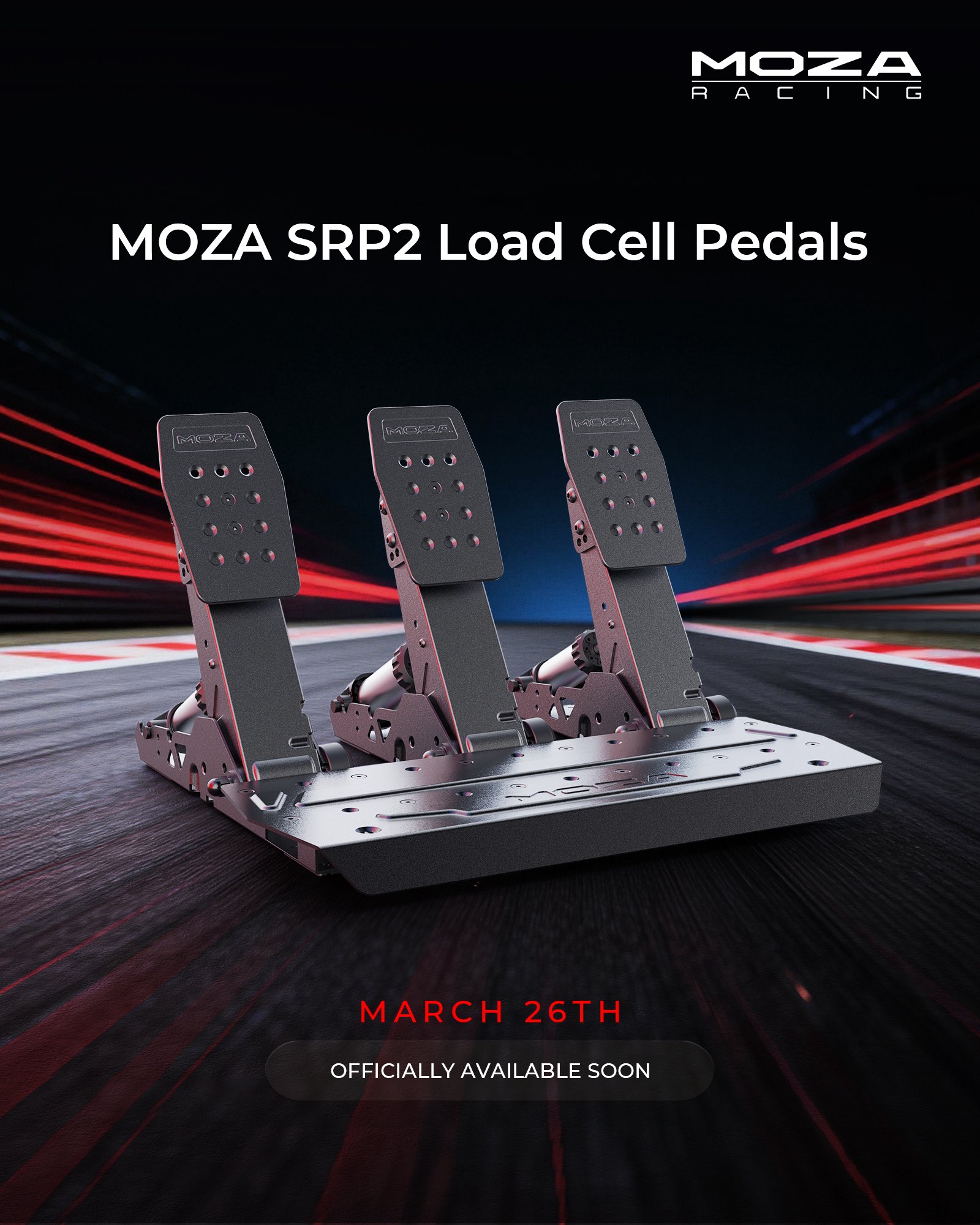
Moza discount code: use SIMRACINGCOCKPIT at checkout for 3% off at mozaracing.com.
SRP2 Technical Specifications
| Price (2 pedals) | $149 USD / £139 GBP / €159 EUR / $299 AUD |
| Pedal Count | 2 (throttle + brake). Clutch sold separately ($45.90 / £45.90 / €49.90 / $99 AUD) |
| Brake Sensor | Hybrid: 100kg load cell + 15-bit angle sensor with software blend |
| Brake Resistance | Stacked elastomer assembly (8 elastomers in any combination of grey 60R, black 70R, yellow 80P) plus tool-less preload screw |
| Throttle / Clutch | Hall-effect angle sensor with 2-step preload adjustment |
| Frame Material | High-strength steel frame and base plate (Moza’s marketing also mentions “aerospace aluminium” – it’s not, the spec sheet confirms steel) |
| Pedal Face Adjustment | Angle 10° / 25° (two-stage) / Spacing ±15 mm / Height 36 mm range |
| Connectivity | USB to PC. RJ45 to MOZA wheelbase pedal port (one or the other, not both) |
| Platform | PC only. No PlayStation. No Xbox |
| Software | MOZA Pit House (calibration, dual-sensor blend, per-pedal response curves, per-sim presets) |
| Optional Accessories | Clutch pedal ($45.90), rear support bracket ($29 / €35 / £29), Brake Performance Kit ($29.90 – expands to 1,000+ brake setups) |
| Mounting | Steel base plate included. Multiple hole patterns. Floor / wheel stand / cockpit. Anti-slip pads on the base for floor use |
Three specs do most of the work here. The hybrid brake sensor (load cell + angle, blendable in software) is the one most people will notice on track. The stacked elastomer system gives you a much wider tuning range than the original SR-P. And the tool-less angle adjustment finally makes these usable on a wheel stand without you fighting the geometry.
Compatibility
PC only. No PlayStation, no Xbox. Connects via USB directly to your PC, no need for a MOZA wheelbase in the chain. If your wheelbase has a pedal port, the pedals can connect to it via RJ45 instead, but only one connection at a time, never both. If you’re running a Fanatec base with these pedals, or a Simucube, or anything else, they work fine as a standalone USB device.
Software is MOZA Pit House. If you’re already running MOZA gear with an R5 or R9 base, Pit House manages your wheelbase and pedals from one app. If you’re mixing brands, Pit House still handles calibration and curve editing for the pedals independently.
Build Quality and First Impressions
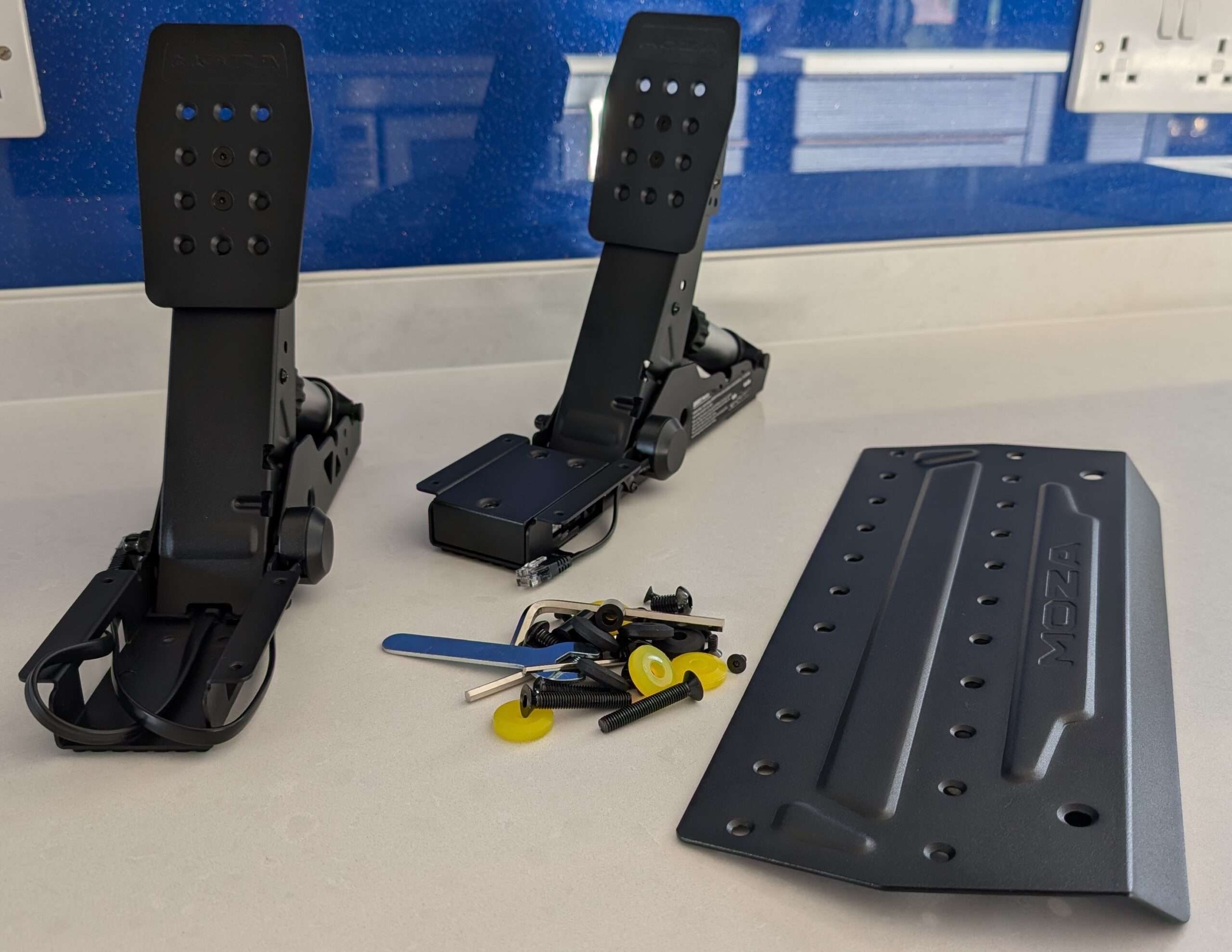
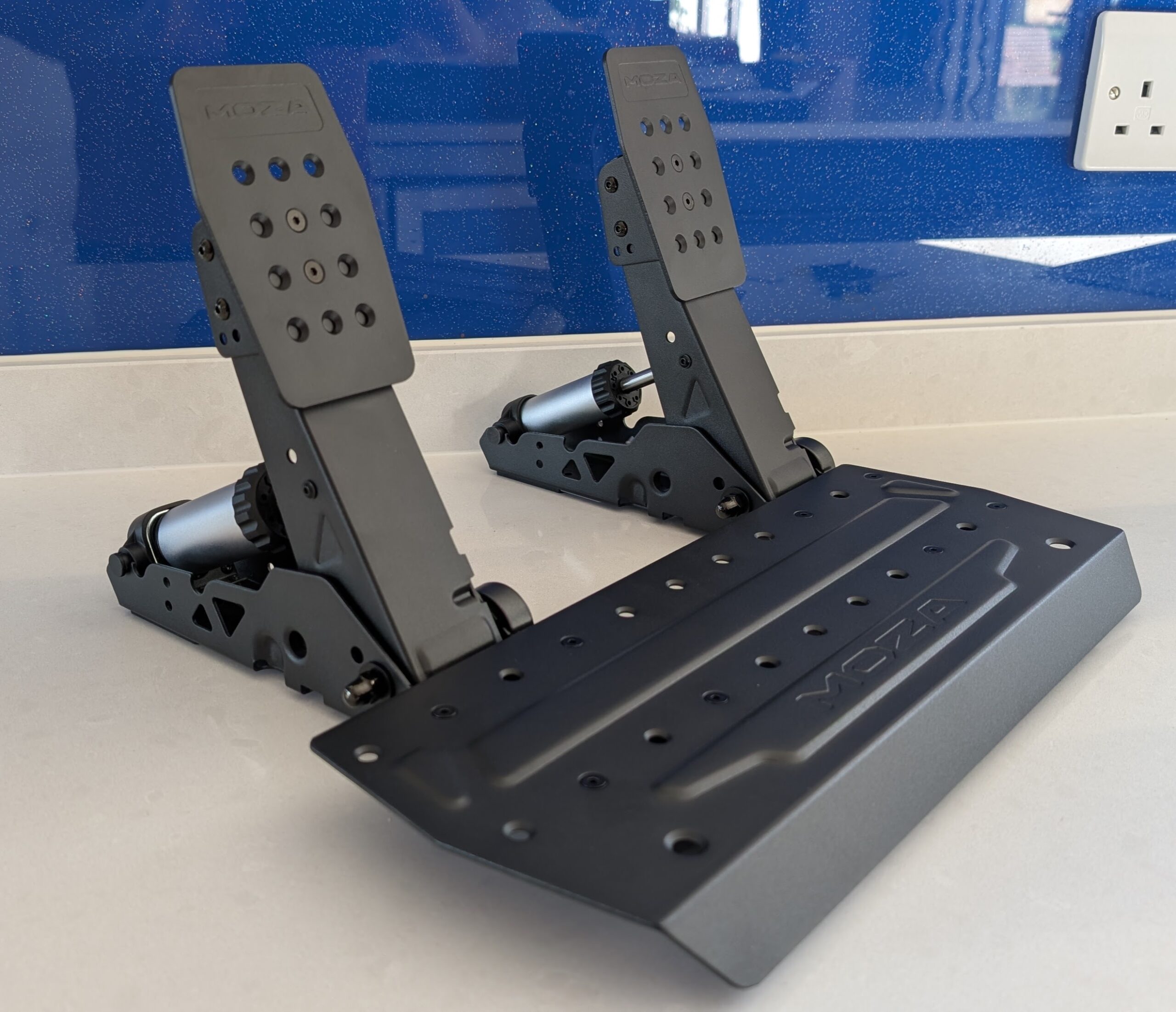
Pick them up and you notice the weight straight away. The original SR-P felt light, not flimsy exactly, but light enough that I worried about it sliding on a desk setup. The SRP2 has proper mass to it. Steel frame, steel base plate, chunky pivot points. One small downgrade: the pedal pads are now pressed steel with a powder-coated finish rather than the original SR-P’s CNC-machined anodised aluminium. Looks less premium up close. Doesn’t feel any worse on track. The new pads are slightly grippier if anything, helped by the cut-outs that double as adjustment holes.
One thing the marketing gets wrong: Moza’s product page says “CNC aerospace-grade aluminum and high-strength steel”. The structural parts are steel – a magnet sticks to the frame throughout, which it wouldn’t to aluminium. The aluminium claim is generous at best. I’m not bothered by it – the pedals feel solid, no meaningful flex when bolted to a rig – but if you bought these expecting what the marketing said, fair to know.
Assembly took about ten minutes. Both pedals slot onto the base plate, you bolt them down at your preferred spacing, run the cables into the throttle’s control box, and plug in USB. Zero faff. The base plate has rows of mounting holes, enough options for any foot size or rig configuration. The included 2.5mm hex key handles every adjustment job.
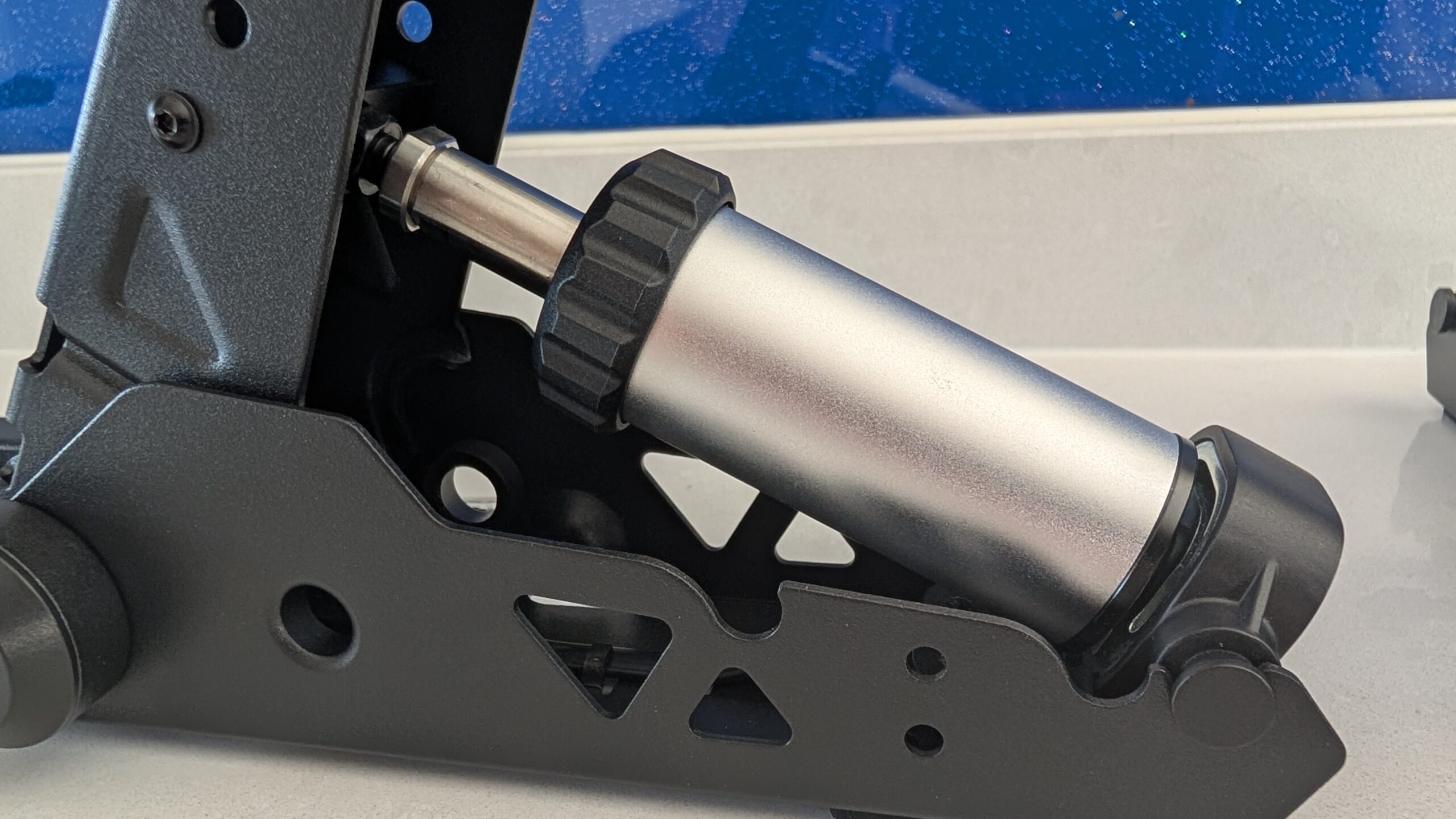
The headline upgrade is sitting right behind the brake pedal. Pull off the cylinder cap and you get an elastomer stack: eight little discs sandwiched between metal washers. The standard set is all grey (60R hardness). Three black discs (70R) and four yellow ones (80P, the firmest, polyurethane rather than rubber) are included so you can mix combinations to get the brake feel you want. The manual literally says “always install 8 elastomers in total” – so the question isn’t how many, it’s which combination. Twenty-five stock setups out of the box. Buy the optional Brake Performance Kit ($29.90) and that goes past 1,000.
Behind the elastomer stack is a screw-adjustable preload mechanism. You can change initial brake resistance without swapping any elastomers, just by rotating the pressure rod with the included 12mm wrench. Most preload tweaks happen tool-less by sliding the limiter shaft between two slots. So in practice: pick your elastomer combination once when you set the pedals up, then tune brake feel session-to-session via the preload slot.
Performance
The original SR-P’s brake felt like mush no matter what spring you fitted. Single elastomer plus a spring, two real brake-feel options if you were generous about it, and “soft enough to drift” or “stiff enough for GT” was about the range. Ian Korf at You Suck At Racing went further than most reviewers and ripped the spring out entirely, replacing it with skateboard bushings to get a brake worth driving.
The SRP2 fixes that without forcing anyone into spring-mod territory. Run all-grey for a road-car feel. Mix in three or four yellows for a GT3 feel. Stack the firmest combination (four black plus four yellow) for a formula car. The pedal pushes back consistently from the start of the travel rather than collapsing through the soft zone before the load cell engages. Properly progressive, in a way the SR-P never quite was. Not CRP2-firm (that’s a different tier with its 200kg load cell and the actual aerospace aluminium) but noticeably stiffer than the original SR-P could manage even after the skateboard bushing mod.
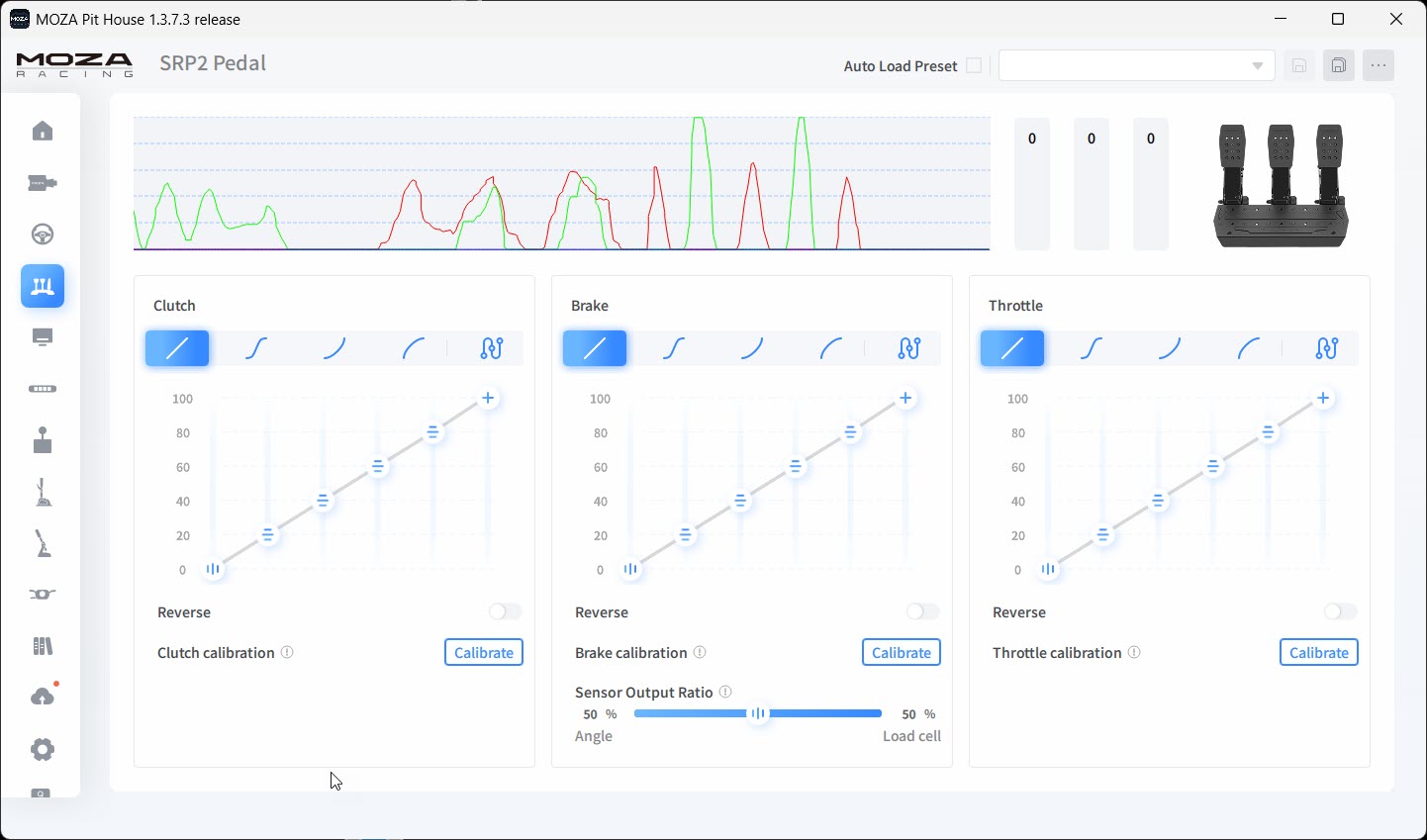
The dual sensor system is worth understanding. The brake has both a 15-bit angle sensor (32,768 individual position steps) and a 100kg load cell. Pit House lets you blend between them with a slider that goes from 100% angle on one end to 100% load cell on the other. Default blend is somewhere mid-range. After a few sessions I pushed mine to about 80% load cell. At that ratio, light braking still has some travel-based feel which helps with trail braking, and hard braking is all pressure. Felt right for iRacing and ACC GT3.
One quirk Ian Korf flagged about the original SR-P: the default Pit House setting was 100% pedal travel and 0% load cell. Selling a load cell pedal with the load cell turned off is, frankly, mad. The SRP2 ships with a more sensible default but check Pit House regardless. Two clicks to fix.
Throttle pedal is straightforward. Hall-effect sensor, smooth travel, no dead zones. The two-step preload upgrade over the original SR-P matters more than it sounds – the SR-P throttle was too light for confident modulation in throttle-limited cars (the Mazda MX-5 Cup in iRacing is the obvious one), and the SRP2 has proper resistance even on the lighter setting. Clutch pedal is identical to the throttle (no two-stage bite-point mechanism, no clutch-effect emulation), but for £46 extra it’s the cheapest “real” sim clutch you can buy.
Recommended Brake Setup by Car Type
The Moza manual provides a starting-point table for the angle/load-cell sensor blend. I’ve raced enough cars on these pedals to confirm the suggested ratios are sensible. Treat this as the calibration baseline for each car class:
| Car class | Recommended sensor blend | Suggested elastomer combination |
| Road cars, hot hatches, performance cars, rally | 60-80% angle sensor | All grey (default) |
| GT4 / GT3 | 60-80% load cell sensor | 5x grey + 3x black |
| LMP, F3, F2, F1 | 100% load cell sensor | 4x black + 4x yellow (firmest) |
The blend slider lives in Pit House under the brake pedal’s settings. The elastomer combination requires popping the rear sleeve off and rebuilding the stack, so it’s a 5-minute job rather than a per-session adjustment. If you race a single class, set it once. If you switch between road cars and GT3 regularly, leave the elastomers in a GT4-friendly mid setup and use the preload slot plus the software blend to bias one way or the other. Saves you constantly disassembling the brake.
Where the criticisms land
Some reviews score the SRP2 lower than I do. That’s worth explaining, because the criticisms behind those scores aren’t wrong – we’re just measuring different things. Sim Racing Corner, Inside Sim Racing and Da Sim Simma all landed positive; RandomCallsign was more reserved.
The SRP2 is a smart and well-executed update, and the fair criticisms come down to three things. Pedal pads are pressed steel rather than the original’s machined aluminium (cosmetic, doesn’t affect driving). No pedal throw adjustment (true – you get angle, not throw). And the brake assembly cable is too short and easy to damage when reassembling the elastomer stack (I noticed the same).
None of those are dealbreakers, but they’re fair. A scoring scale that weights materials and refinement heavily lands the SRP2 lower; mine is closer to “does it do the job for the money”, which puts it higher. Both views are defensible. If you wanted the premium feel of a £400 pedal at half the price you’ll be disappointed. If you want a load cell pedal that performs at £139, the SRP2 does the job.
The score I’d worry about isn’t 6.4. It’s anyone calling these endgame. They’re not. Strong entry-to-mid load cell set that gets out of your way and lets you drive.
Issues and Things to Know
PC only. If you need PlayStation or Xbox support, look at Fanatec’s CSL Pedals plus the Load Cell Kit instead.
The clutch isn’t included. $45.90 / £45.90 extra if you want it. Most sim racers run two pedals anyway, but if you’re driving road cars, doing manual hill starts in truck sims, or racing with a paddle clutch on a real H-pattern shifter, budget for three pedals.
No inverted mounting. The CRP2 supports inverted (formula-style) mounting; the SRP2 doesn’t. Desktop, wheel stand, or cockpit mounting only, pedals on the floor.
The brake assembly cable is short. When you pop the rear sleeve off to swap elastomers, the cable connecting the load cell to the control box has very little slack. Easy to pinch or pull if you’re not paying attention. Worth a 5-second pause every time you reassemble.
The brake pedal isn’t directly bolted to the base plate at the front. The hard-mount points are drilled through the pedals on the throttle and clutch, but on the brake the load cell sits where the bolt would go. The brake relies entirely on the heel plate for support. Hands-on, this isn’t a problem. The brake feels planted and there’s no perceptible bounce when bolted to a rig. But if you obsess over rigid mounting, this might bother you on paper.
How It Compares
SRP2 vs the original SR-P
If you already own the SR-P and are happy with it, you don’t need to upgrade. The SRP2 isn’t a step-change in driving experience – it’s the same fundamental pedal set with better adjustment range. The differences that matter: the elastomer stack is far more granular than the SR-P’s two-elastomer-and-spring system; throttle and clutch finally have proper preload adjustment; the brake’s pressed-steel pedal pad is a small visual downgrade from the original’s machined aluminium. If the SR-P frustrated you because the brake felt like mush no matter what spring you fitted, the SRP2 fixes that. If you ran the SR-P with the skateboard-bushing mod and you liked the result, the SRP2 gives you the same kind of firmness without the modding.
SRP2 vs Moza SR-P Lite
The SR-P Lite is the pedal set that ships with the Moza R5 bundle. It’s not a load cell – it uses a Hall-effect angle sensor on the brake just like the throttle, which means braking is travel-based not pressure-based. For under-£100 pedals this is fine, but it’s a fundamentally different driving experience to a load cell setup. The SRP2 is the obvious upgrade path if you started on the R5 bundle and want to go faster. The performance gap between SR-P Lite and SRP2 is bigger than the gap between SRP2 and CRP2. Spend the £139 here before you spend anywhere else on your rig.
SRP2 vs Moza CRP2
Stepping up to the MOZA CRP2 costs roughly three times as much. Aerospace aluminium (real this time, not marketing copy), 200kg load cell instead of 100kg, supports inverted mounting, more refined elastomer-and-spring brake system. The SRP2 closes the gap to the CRP2 a bit compared to where the SR-P sat – the elastomer stack approach used here is borrowed directly from the CRP2 – but the materials, sensor capacity and mounting flexibility still put the CRP2 in a different league. Worth the jump if you’re on a dedicated rig, you’ve outgrown the SRP2’s 100kg ceiling, or you want a brake that won’t be the limiting factor for the next decade. Overkill for a desktop or wheel stand setup.
SRP2 vs Fanatec, Logitech, Simagic at the same price
Fanatec’s CSL Pedals plus the Load Cell Kit lands around $180-200 depending on region. Works on PlayStation and Xbox – that’s the differentiator. PC only? The SRP2 is cheaper and arguably has better brake feel. Console need? Fanatec wins by default.
Logitech’s G Pro pedals are the closest mass-market alternative for PC at this price. They’re solid, the load cell is well integrated, and they slot straight into the G Pro Racing Wheel range. The SRP2 has more granular brake adjustability and a stiffer feel out of the box. Logitech wins on brand familiarity and console compatibility (the G Pro pedals work on PS5 with the G Pro wheelbase). The SRP2 wins on pure feel for PC racers who don’t need console support.
Simagic’s P1000 lands at a similar price point with full CNC-machined aluminium construction. The materials feel more premium than the SRP2’s steel frame. The SRP2 has the dual-sensor blend and the granular elastomer system, which gives more software-side tuning. Both are good at this price. Comes down to whether you value materials (P1000) or adjustability (SRP2).
Who Should Buy the SRP2
Budget rig builders. Desktop sim racers. Anyone upgrading from potentiometer pedals or the SR-P Lite and wanting their first proper load cell set without spending more than £150. If you’re already running MOZA gear with an R5, R9, R12 or R16 base, this is the obvious pedal pairing – they connect natively to the wheelbase pedal port via RJ45, no extra USB cable required.
Coming from the original SR-P? Worth the upgrade only if you found the original brake too soft and the throttle too light. The elastomer stack and the throttle preload fix both of those. If you’re already happy with the SR-P after spring-stack mods or skateboard bushing fixes, you’ll get less out of the upgrade than someone coming in fresh.
If you need console support – skip it, look at Fanatec or Logitech. If you want inverted mounting or a 200kg brake ceiling, the CRP2 is the move. If you’re chasing genuine endgame realism, look at active pedals like the MOZA mBooster or the Simucube ActivePedal. For everyone else at this price point, the SRP2 is the one to beat.
Pros
- Stacked elastomer brake assembly with 25 stock combinations (1,000+ with the Performance Kit) – far more granular than the original SR-P’s two-spring system
- Hybrid brake sensor (100kg load cell + 15-bit angle sensor) with software blending gives proper control over light and heavy braking
- £139 with a steel base plate, USB connectivity, multi-stage angle adjustment, and tool-less preload tuning
- Throttle and clutch finally have two-step preload adjustment – fixes the over-light feel of the original SR-P
- Dead simple assembly. Works as a standalone USB device with any wheelbase brand
Cons
- PC only – no PlayStation or Xbox support at all
- Clutch pedal is an extra £46. For a three-pedal set you’re closer to £185
- Pedal pads are pressed steel, a visual downgrade from the original SR-P’s machined aluminium
- Brake assembly cable is short and easy to damage when swapping elastomers
- No inverted mounting and no pedal throw adjustment (angle and height yes, throw no)
- Moza’s marketing claim of “aerospace aluminium” is misleading – the structural parts are steel
Pricing and Where to Buy
$149 USD, £139 GBP, €159 EUR, $299 AUD for the two-pedal set. Clutch add-on is $45.90 / £45.90 / €49.90 / $99 AUD. Rear support bracket is $29 / £29 / €35. Brake Performance Kit (expands brake feel to 1,000+ setups) is $29.90 – worth the upgrade if you race more than one car class regularly. Available direct from MOZA’s online store and partner resellers in 22 countries. Launched 26 March 2026.
MOZA News
The SRP2 launched alongside the Lamborghini Revuelto sim wheel ($399) on the same day. MOZA has been busy across late 2025 and early 2026 – the R21 Ultra and R25 Ultra wheelbases arrived in late 2025, the Porsche Mission R wheel at CES 2026, the new MRP rudder pedals for flight sim, an AI coaching system at GDC 2026, and the CS Pro and KS Pro wheels alongside the SRP2. They’re refreshing every tier of the lineup simultaneously. The SRP2 slots in as the entry-level pedal refresh while the CRP2 and mBooster handle the mid and high end.
Related Posts
Sim Racing Wheel Stands and Folding Cockpits: Why I’d Skip One, and What to Buy Instead
The Best Direct Drive Sim Racing Bundles (2026)
Best Thrustmaster Wheel and Pedal Mods (2026)
ButtKicker and Tactile Feedback for Sim Racing: The Highest-ROI Upgrade You Shouldn’t Skip (2026 Beginner’s Guide)
Sim Racing Motion Platforms: A Beginner’s Guide to Adding Motion to Your Rig (2026)
D-Box Sim Racing: The FIA-Supplier Haptic System Explained (2026 Buyer’s Guide)
Topic: Sim Racing Pedals